Big Walk Review - A Positive Connection
Nearly 7 years ago, the developer House House's mischievous goose first honked into our lives and delivered a humorous indie gem, Untitled Goose Game. Now, House House are back with a drastically different title, Big Walk, a cooperative puzzle game that the developers describe as an online walker-talker with close friends. And after playing Big Walk it's hard to argue with that description.
In or away from games, it's human nature to be intrigued by mysteries or the unknown, and it's even more natural to want to spend time hanging out with friends. Big Walk combines the two with aplomb. It's a rare gem where the journey of discovery, emergent storytelling, and escape room style puzzles create something unique. Where gameplay mechanics and tools encourage teamwork, saboteurs and bonding, to progress through the game's large island.
Big Walk is the latest online only multiplayer title. But unlike the trove of unfortunately named Friend Slop games, it aims to evoke something deeper - all the emotionally resonant seriousness and silliness of friendship - a true peri and post-pandemic expressive piece of art. Something that strives to create connections.
A whimsical score sets the tone as you boot up the game. But it's the written statement of intent by House House that grabbed my attention. They reaffirm that Big Walk should only be played via the in-game proximity voice chat, and for those who can, I'd completely agree. The developers have put an insane amount of work to get the proximity chat to respond differently to distance and direction, echo in tunnels and over precipices, be static on a walkie talkies and more. Easily immersing you into a creative and attentive mindset.
But the most crucial feature is how many players can join a game. As a multiplayer only game, Big Walk has 2 player, 3 player, and over 4 players that caters for a chaotic maximum of 12 players. House House clearly states that each player counts puzzles have been scaled accordingly. Unfortunately, I could only play through the game on 2 player during the review period, so my playthrough is from that perspective.
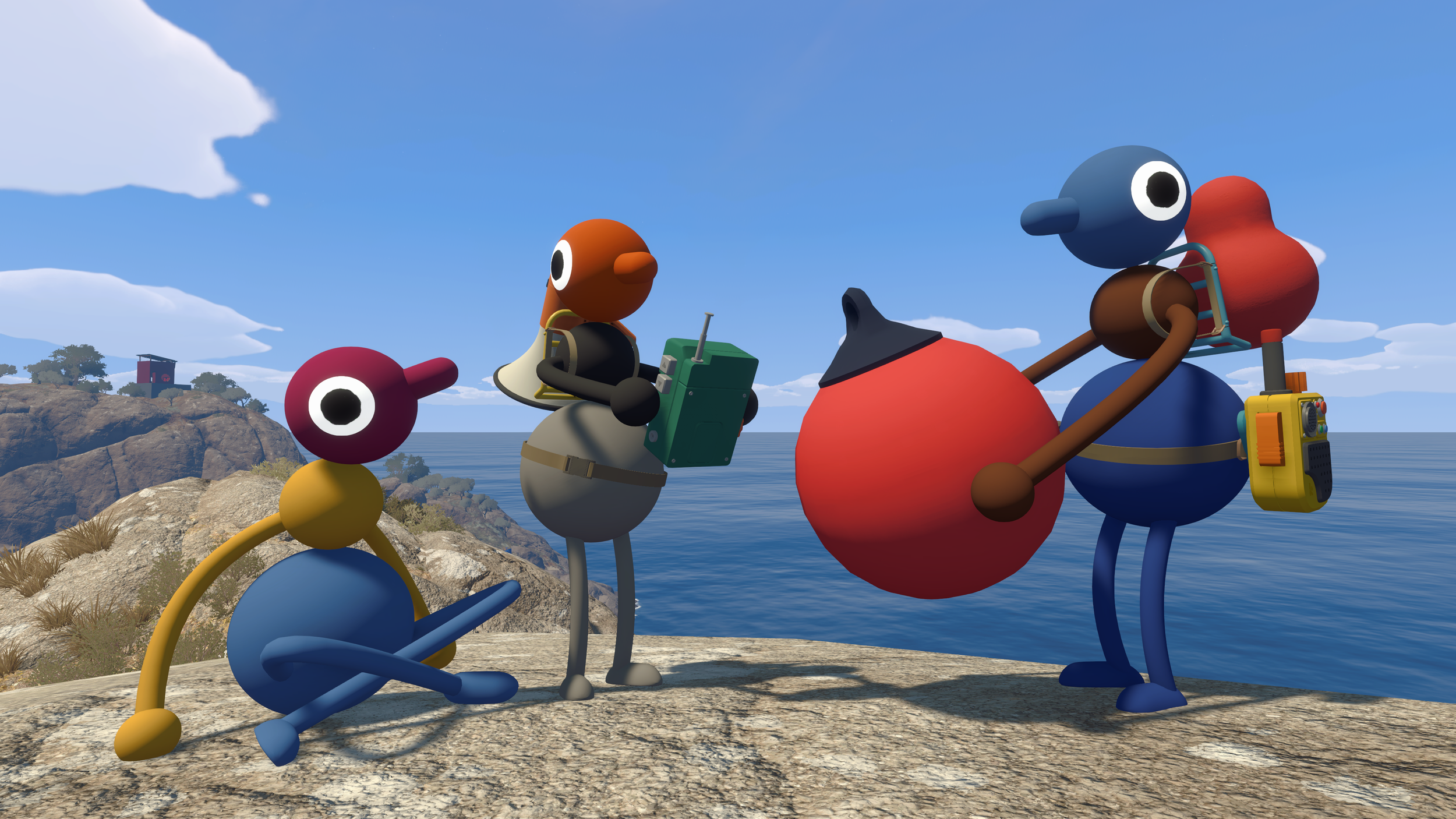
Image: Big Walk - Co-op
You can either host a game where the saved data will remain on your account, or join one from your friends list or by entering a room code. But before finishing the setup, Big Walk asks if you want to add their accessibility mode so that people of varying abilities can skip certain puzzles. I quickly messed about with this mode, and it's a great addition that helps to include many people who otherwise wouldn't have been able to play. A sign with buttons appears beside a puzzle location, and you simply press the buttons down in unison with your teammate to skip the puzzle.
Before I describe the game itself, Big Walk is reliant on the feeling of discovery and figuring out how to proceed by using environmental clues. So, I will keep details vague beyond the first two zones.
After setting up a game, you launch into a colourful hub zone. You turn around and walk down a red corridor into an open room with lots of objects and short tutorials to teach you the basic controls. But first, you turn to see your co-op partner: a toy-like 3D character model that stands out against the more realistic environment of the open world island.
Naturally, you begin to acclimatise to the distance proximity chat can reach, and then, experiment with the tutorials on the floor. You learn to jump, crouch, pick up items and activate them, drop or kick objects you hold, pick up your teammate, sit down to relax or slide down hills, outstretch your arms, and activate text chat to communicate without voice chat.
But the real game begins when you step outside and see the open zone in front of you. Depending on how long you take to go outside, the 24 hour day and night cycle could leave you in the dark. I left the hub in total darkness and immediately found a handy orb light that can be turned on and placed down to light the path during the night. Like all good non-directed open games, Big Walk uses diegetic environmental cues like distant lights, colourful markers and other structures with blinking lights.
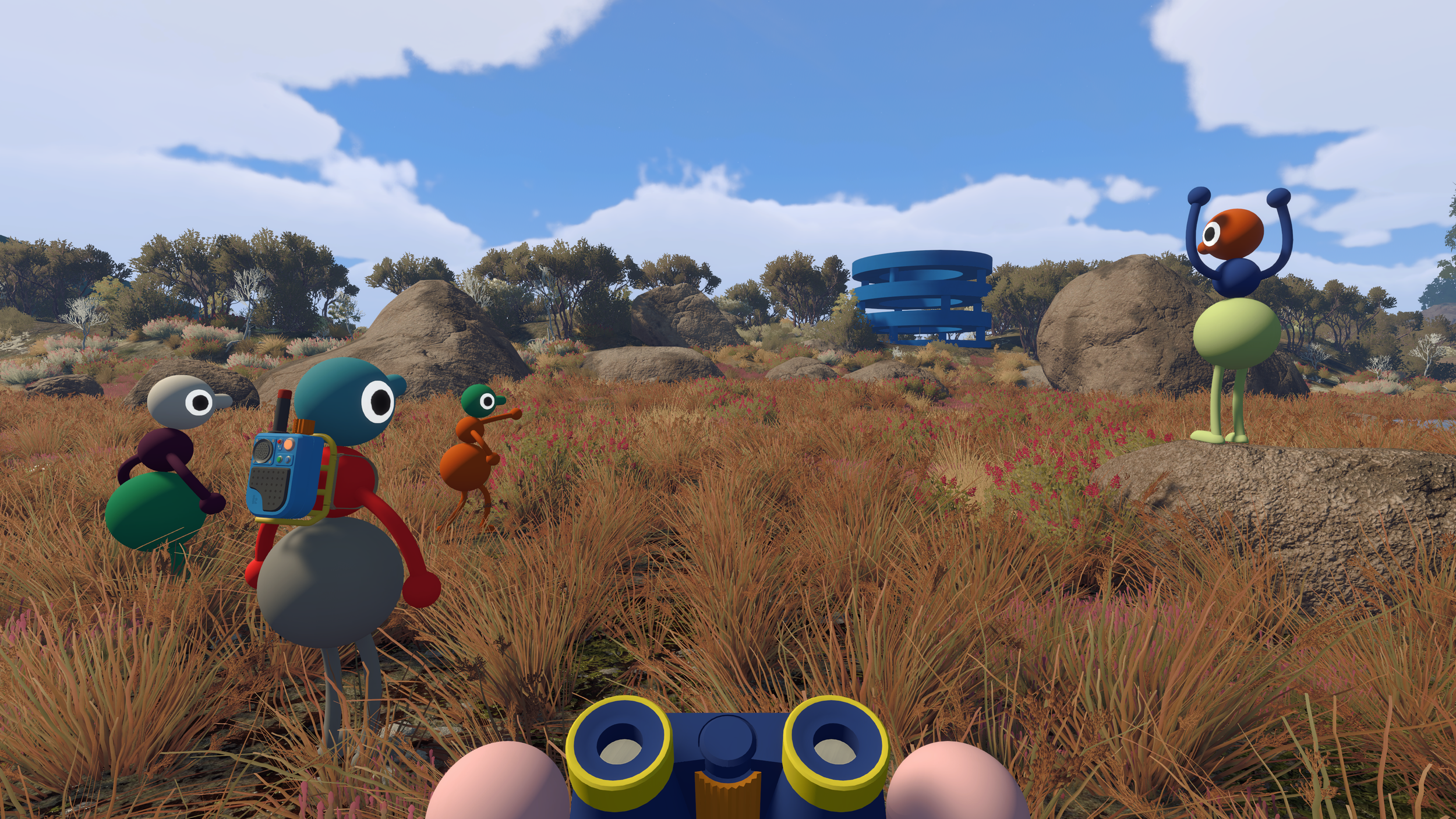
Image: Big Walk - Jump
Directly in front of you when you leave the hub is a lit up structure. Unsure of where to go or what to do, you instinctively brave the night and rough terrain to make it down to the structure. But it isn't a puzzle after all. There's a giant paintbrush and a wall of coloured paints for you to use to customise your characters. You wield the paintbrush and communicate with your teammate which colour they want to be painted, or ignore them and choose yourself. It's a nice interactive touch, to slowly build up trust and your co-operative muscles, ready for the countless puzzles on the road ahead.
But the puzzles in the first zone are cleverly designed to acclimate you and your teammate to their functions. Each player will stumble onto puzzles in a different order. The first I encountered had me holding down a switch to open something in the distance, whilst my teammate crossed the ravine without verbal communication to collect it. Like every puzzle, they collected a red doll-like object that's key to proceed.
Another puzzle tests motor skills as you need to pick up your teammate. One requires one teammate to be locked in a room to describe symbols only they can see inside, to guide their partner to insert the correct symbols. Each one teaches a variety of actions needed to complete the puzzles: from listening to sounds, attentively watching visual cues, directing teammates with your arms, working in synch, and more.
At this stage, players can only hold one object each until you discover missable backpacks and other add-ons to be able to carry multiple items. So, you need to figure out what to do with the red dolls or struggle to continue.
After waiting and admiring the sun to rise over the realistically rendered coastline while chatting to your teammate, the daylight illuminates a raised white platform. This is where the gameplay loop shows itself. While the starting zone is in an inescapable valley, the rest of the game has other routes. Each area has one of these platforms. Five glass cases and buttons hold a giant uncut key in place. Then once you've worked together to open the cases and place all five dolls, the key releases. Then, you search for a nearby pedestal with a key slot. You insert the key and you see the pedestal open and cut a section of the key. Once the key is ejected, an arrow appears on top of the pedestal to guide you to the next pedestal until the key is completely cut.
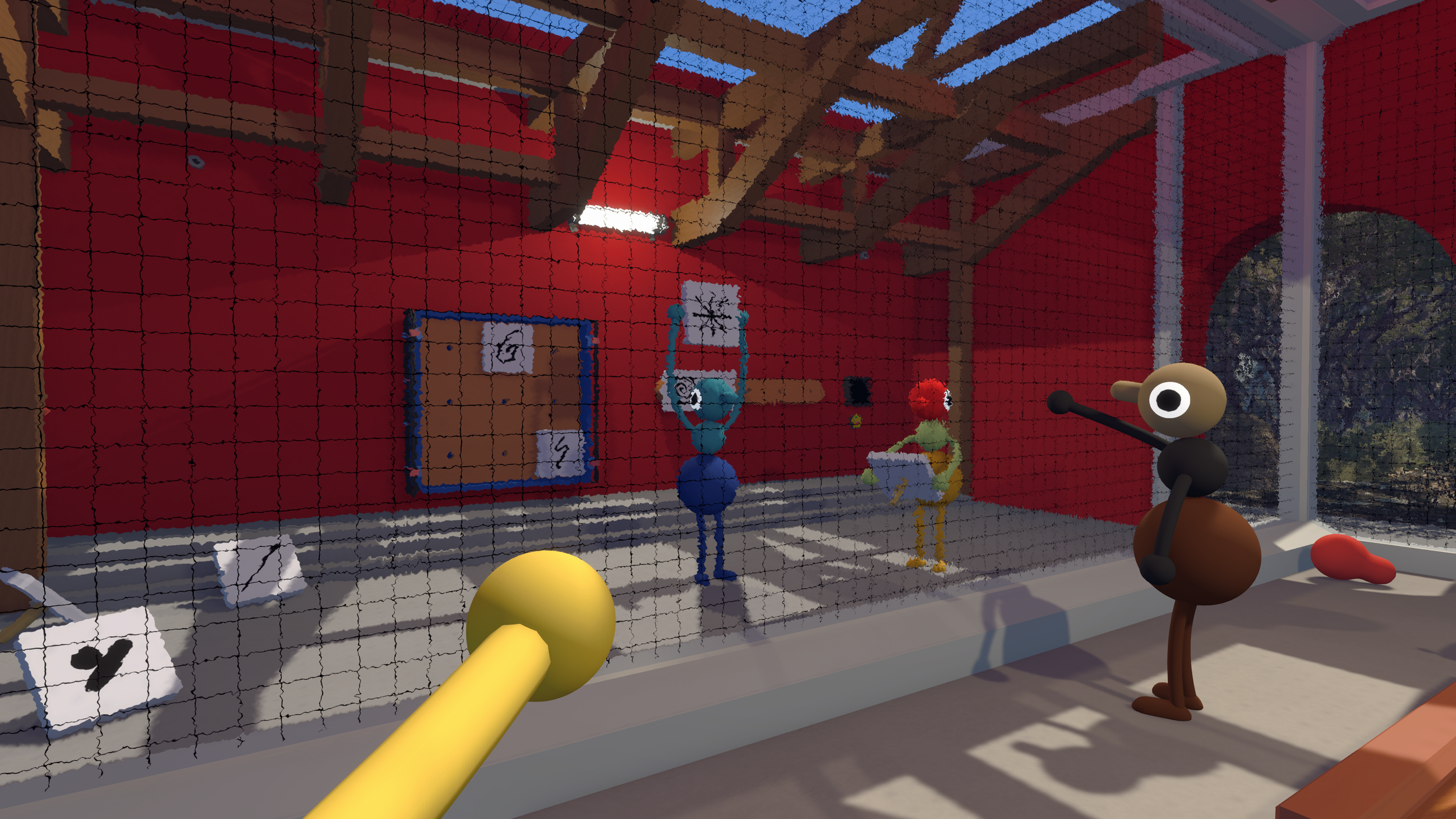
Image: Big Walk - Puzzle
You'll eventually end up at an impassable red bridge with an empty key slot. Inserting the key lets you walk along a massive cliff side bridge that extends around a large chunk of the island. It's a scenic route with musical rest stops for you and your friend to stop and enjoy. But when you make the long walk to the next area, the game unleashes the full scope of the open island and the freedom it represents.
Flare stations are incrementally positioned around the island to send a loud and vibrant signal to friends who become lost. Shortcuts offer rapid routes to and from the starting hub, in numerous helpful directions. But they also help when rejoining a game session. As all of your held items respawn on a platform in the hub, so you can resume your adventure without backtracking for the items you want. It often feels like going on a long hike; an adventure where you keep discovering other layers to the world. Eventually, discovering and activating faster means of transportation which would be very beneficial with a higher player count.
But it's the gradual reveal of tools that changes the way you explore: a map shows you puzzle locations, laser pointers guide players from above, walkie talkies allow solo discovery and easy meetups, a flashlight makes nighttime travel more feasible, a compass keeps you from getting lost, and much more. All optional and game changing tools which I imagine would be far more beneficial in larger groups. Although they still help discover puzzle locations once the island opens up.
Later puzzles range from the simplistic, hands-on, inventive, to the more obtuse. One has you figure out how to transport an immovable orb up a hillside. Another circumvent a maze to deliver a time sensitive object before it disappears. But I really enjoyed the more inventive ones, such as a puzzle where one player stands inside a soundproof room, and must use non-verbal communication to direct their teammate to press buttons. Each puzzle feels like a distinct snapshot from an escape room.
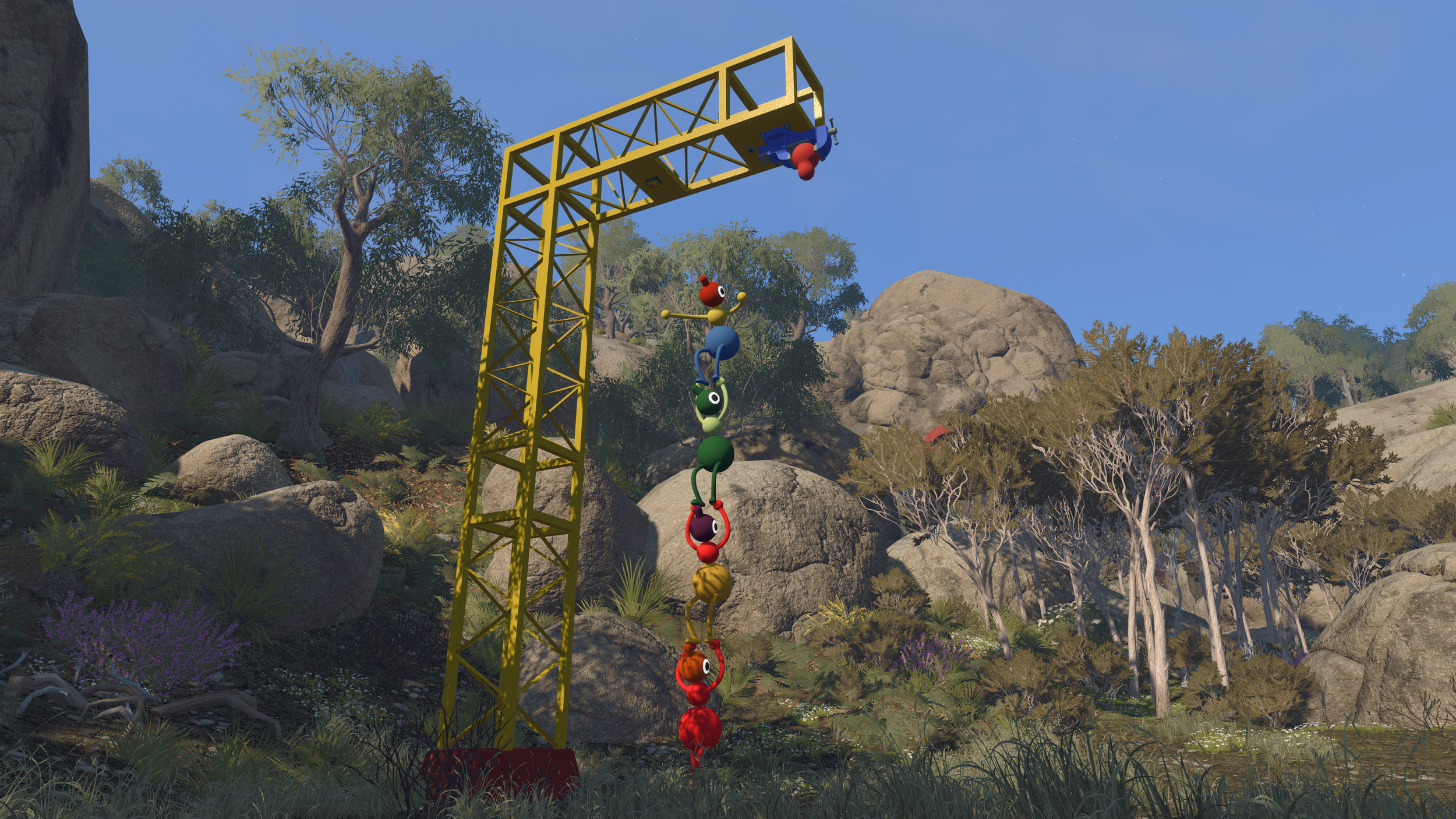
Image: Big Walk - Tall
However, there's much more I could say about later puzzles, but it's the kind of game where it's best to go into it without knowing too much. As your own discovery, emergent gameplay and conversations will make the experience bespoke to you. One group could sit around and talk about anything as the sunsets. Another player could mess with his friends and boot one of their items off the island. Between the puzzles and how they go about discovering them, everyone will have their own unique experience. But anyone will share that overriding sense of accomplishment that makes you feel smart once you complete a puzzle.
Yet, Big Walk isn't without issues. Sometimes you can get lost when playing as a duo. But I imagine this is largely negated in bigger groups. But my main complaint was object visibility. There were times when I slipped down a hillside and dropped a crucial object into a mass of shrubs. Unfortunately, items aren't always easy to visibly parse through dense flora. I also found myself getting stuck on terrain countless times, which halted my momentum.
Thankfully, none of this ruined the unique emergent gameplay. Everything has been meticulously designed to benefit the co-op experience. Teamwork is at the forefront of Big Walk's core design. It succeeds at summoning player creativity and a sense of camaraderie rarely seen in a puzzle video game.
Big Walk is a special puzzle game that encourages friendship and connection. It puts equal emphasis on creating a sense of childlike wonder, discovery, teamwork, fun, and accomplishment. But House House understands how equally important it is to relax and take a beat to establish positive connections with others, and that's what makes Big Walk memorable.