
Review - TR-49
The last few years have brought us a wealth of great puzzle deduction games from The Golden Idol series, to the excellent The Roottrees are Dead. Each have stood out due to their impeccable writing and addictive puzzle mechanics. And 2026 looks to attempt to continue that trend with the mysterious, TR-49.
Only one year after launching the well-reviewed Expelled!, the spiritual successor to the enjoyable, Overboard!, Cambridge founded video game studio, Inkle, are back with a very different game in TR-49. I would've been surprised if it was a different studio changing up its game design, but Inkle is a different story. They've always shown a proficiency to innovate and experiment with how gameplay can interact with player choice. But Inkle's immovable constant is strong narrative design; whether in the beautiful platformer, A Highland Song, or the narrative strategy game, 80 Days - and in TR-49, I can safely say that Inkle's trademark continues with confidence.
TR-49 is a unique game that's part audio drama, part narrative deduction game. You play as Abbi who finds herself in a dank, dimly lit basement, staring down a large, old machine - a technological enigma built to break German codes during World War 2. Now, it serves a more mysterious purpose to consume the contents of books and texts fed into its system. But when the reassuring voice of a man called Liam tells her she's the only person who can work through the books and corrupted data inside the machine, he persuades her to match the titles she finds to the nameless texts, and eventually, locate a document that might hold the key to changing the world.
Due to TR-49's mysterious nature, I won't be discussing story details that spoil anything beyond the first thirty minutes. As the narrative is one of the core pillars that makes TR-49 a uniquely Inkle experience - an academic and philosophical mystery about the power of words, and a creator's responsibility to enjoy the creation of meaningful art that can breathe inspiration into the world. Ruminating on how words can be the most powerful tools in the universe; they can birth hatred or endless compassion - a reflection to how without a human touch, machines can irresponsibily commodify art and plagiarise, to influence with unclear, mutated and stolen ideas.
In order to search for the document, your first task is to input the code to turn on the machine. This zooms in the screen into the fixed, minimalist layout that you see for the rest of the game: the machine's circular display on the left, and on the right, the lever controlled machine that's used to input codes. This puts you at the centre of the mystery instantly. The atmosphere is set by the realistic painterly style of the scene, with a distinctly yellow brown screen and bright numbers, backdropped by the muted dark colours of metals and wires. Everything brought to life by just enough animations, as dust particles dance in baked light, and reflections shine from the glass panel.
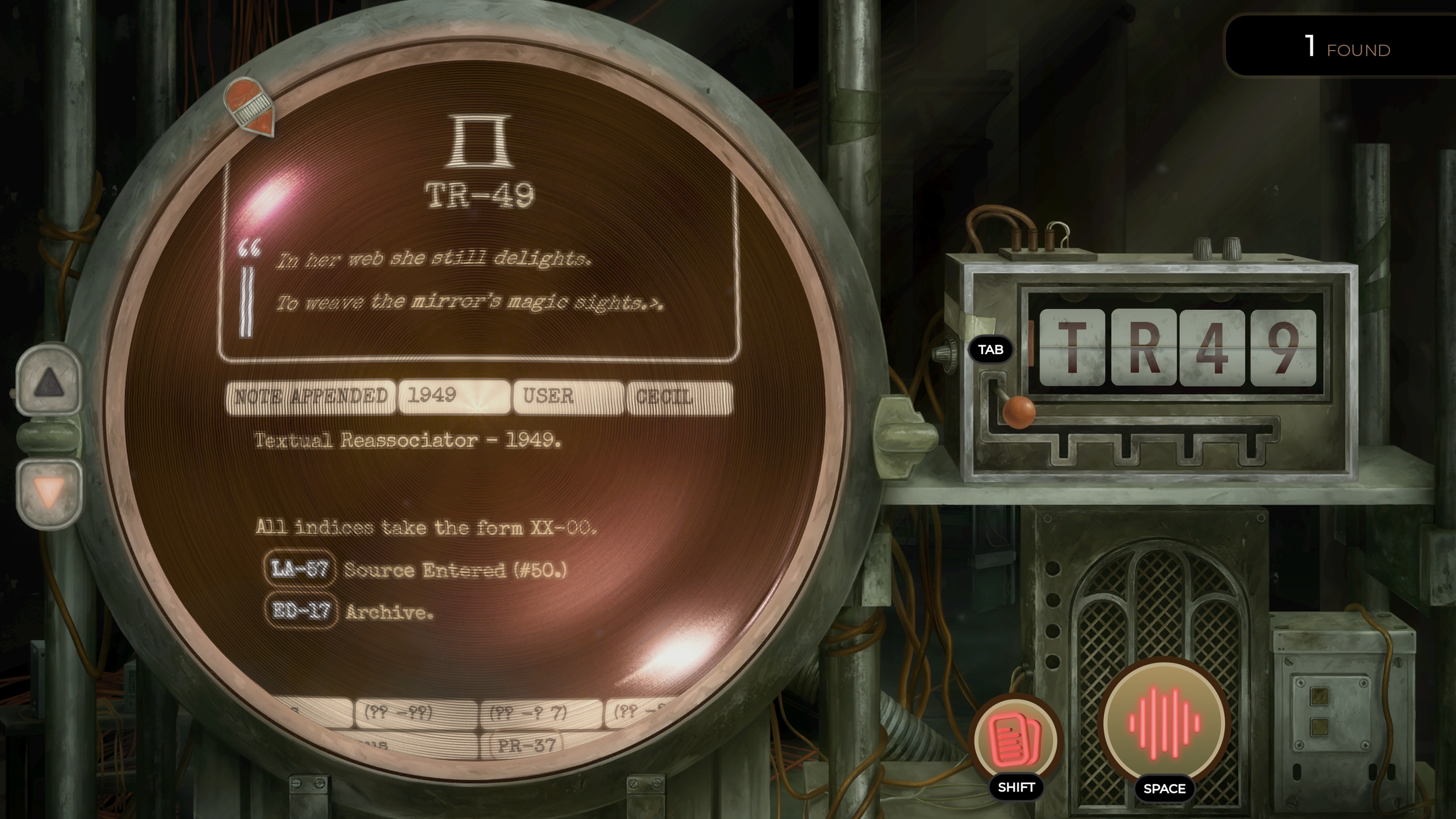
Image: TR-49 - Screen - Inkle
The graphical presentation keeps you drawn and locked to the screen of the machine - a minimalist look that doesn't get bogged down in detail. It suits a deduction game perfectly. Ideal for focusing on the little flickering details on corrupted documents, that have an almost hypnotic swirling backlight. However, upon discovering the author of a text, a haunting illustration of the writer's face will fill the in-game screen.
This focus on the little details carries over to the stand holding the code input device, which lights up whenever the intercom goes off and Liam is trying to contact you, which is your cue to hit the space bar to continue the conversation whenever you've completed your current investigation. Another immersive touch is the code inputter itself, which mimics a mechanical flip clock with four separate panels that flick over in a nice animation whenever you input a new code. Although there's only one environment in TR-49, the level of detail and focus is perfect for this genre and size of video game. As really, it's the narrative and gameplay mechanics that can make or break a puzzle game.
But in order to discuss how the narrative is told, it's crucial to understand how the deduction mechanics work. You need to find mentions of book and extract tiles to catalogue, and decode clues to codes in extracts, or sometimes, simply read them. Then, match the titles to the corresponding documents you've found with the codes. All the while learning about the authors, the world and the machine; each discovery a step closer to uncovering TR-49's time-spanning mystery.
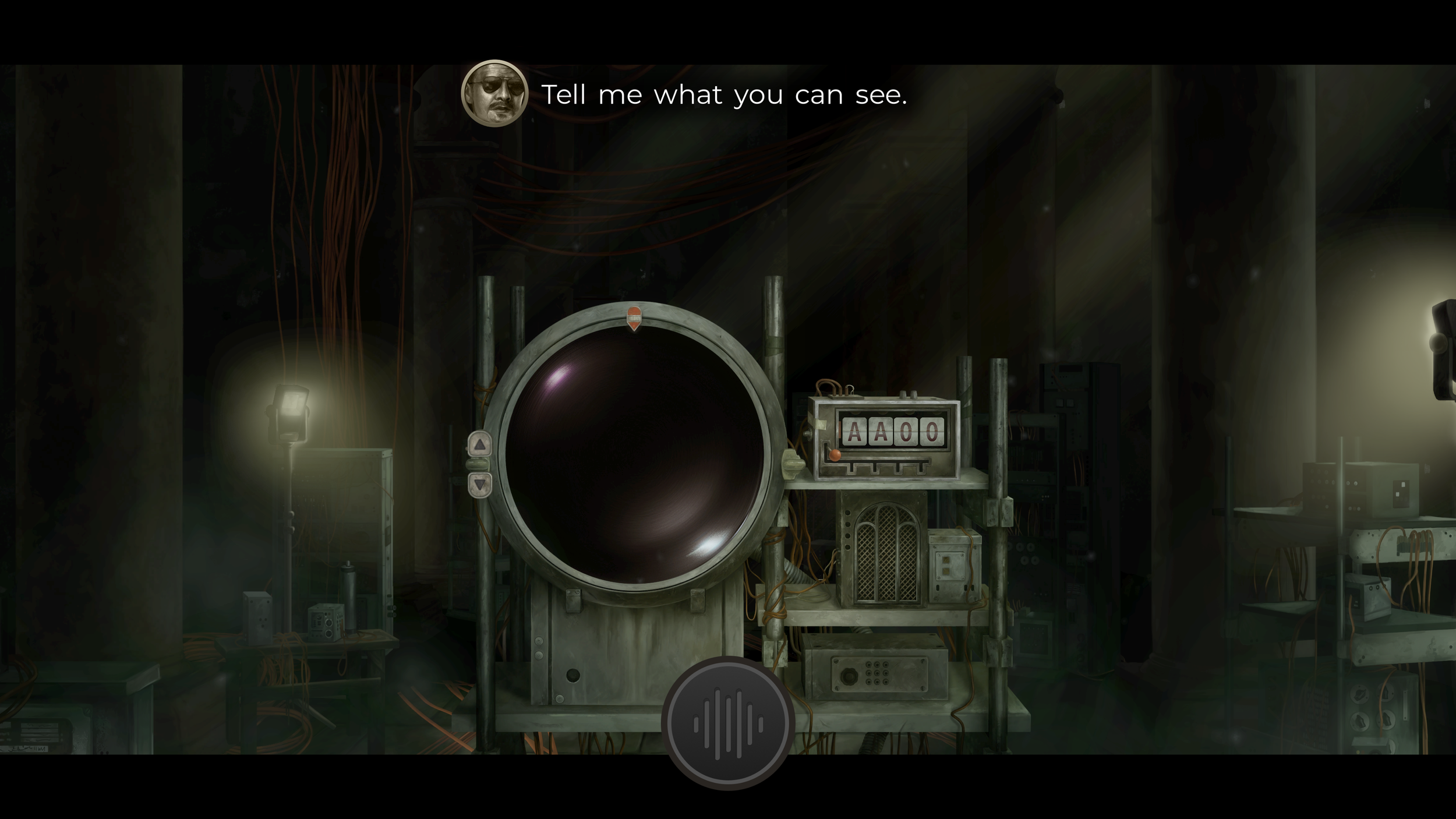
Image: TR-49 - Machine - Inkle
Once the first page is accessed, Inkle smartly on boards players by teaching you how to decipher clues to codes, which all start with two letters and end in two numbers. These can be found in numerous ways: sometimes initials will be mentioned in the same extract as a numbered journal, or you can learn the date of someone's death in relation to a book launch and have to do the simple maths to find the code. This rhythmic pattern of deduction becomes addictive, especially when the game tells you how many pages there are to find. And you'll want them all.
Although, without a built-in hint system or notepad like The Roottrees are Dead, players might decide to opt for a physical pen and paper to write notes to order the non-chronological story. However, it does handily keep track of every important story detail about each author and log them on the individual folders inside the sources menu.
The sources menu logs which documents and books have been found and titled, and which ones are still waiting to be named. It's also home to the code-breaking machine's system command codes, which are needed throughout. Basically, a clear and concise inventory to help analyse the evidence found and to catch anything that's slipped past a first read through - a perfect tool to untangle the story. If it isn't already clear, TR-49 is a video game that rewards you for investing time into the systems.
All of these systems controlled perfectly on both mouse and via the Steam Deck's controller layout. I found the performance on both platforms to be flawless, and the Steam Deck was the perfect device to switch to and reread through the extracts for lore I had missed. It was ideal for jotting down story details on a notepad, whilst switching between extracts.
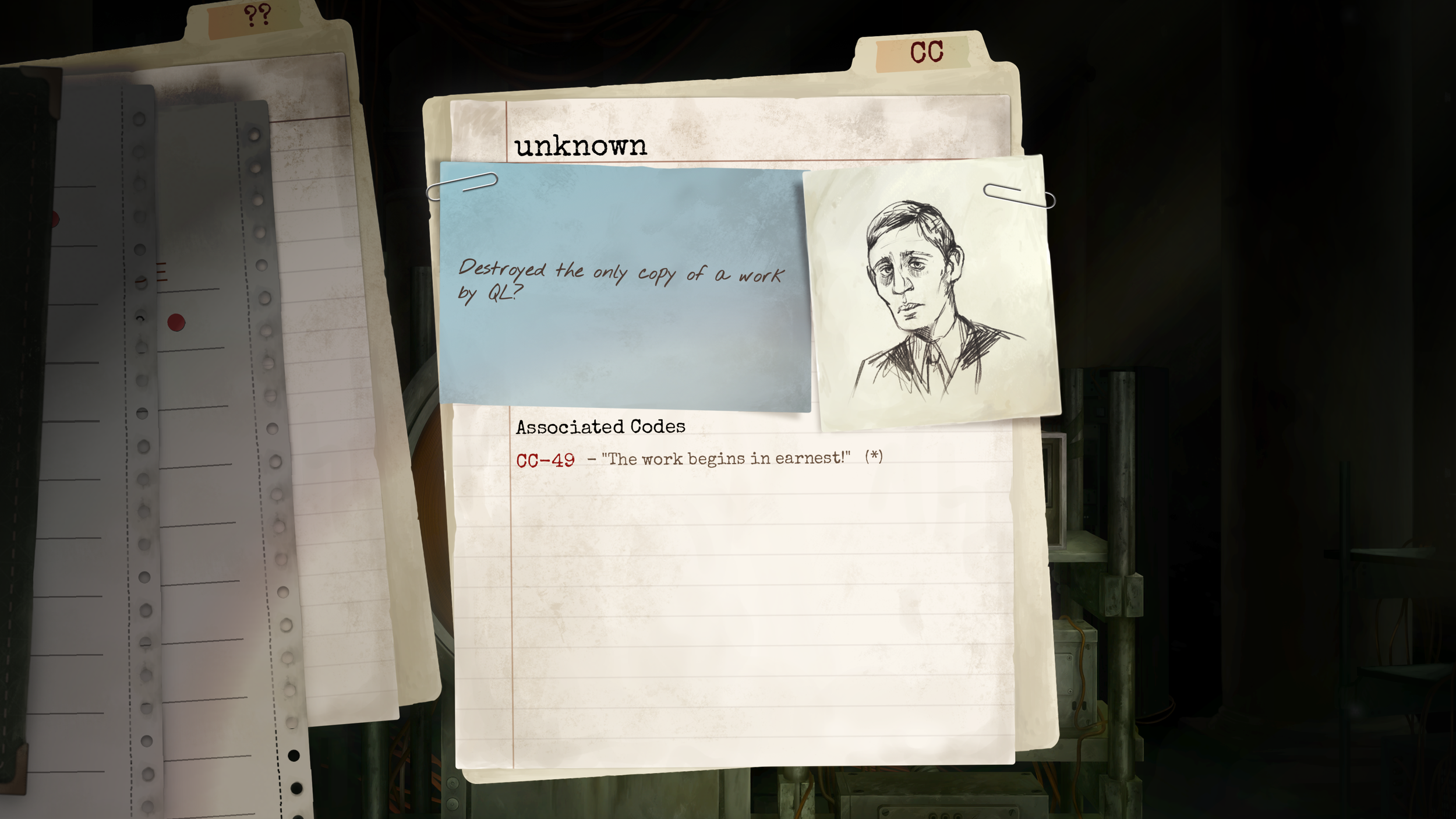
Image: TR-49 - Documents - Inkle
Although I enjoyed the deduction mechanics, I would've liked just a few more variations to how codes are found. Something to break up the pace, like how The Roottrees are Dead had photograph puzzles. But what is here is very strong, and in typical Inkle fashion, industry leading narrative infuses with the game mechanics to make another unique video game.
As someone who studied and values narrative design, it cannot be discounted how skilfully Inkle have threaded a non-chronological story that develops in differing orders due to player choice. Inkle's Jon Ingold has written captivating prose, that expands TR-49's interesting world at every opportunity. Each fictional author is given a distinctive and era appropriate voice, that drift from academic to intensely poetic verve. It felt similar to the quality work by The Chinese Room: the wistful lyricism of Dear Esther, and one of my recent favourites, the brilliant script in Still Wakes the Deep.
I knew it was good writing when I started to recognise writing styles. Every little discovery egged me on to keep searching for the next one; a game with the knack for destroying sleep schedules. And sometimes roadblocks are hit, until like in all good deduction games, that viola moment arrives and you feel smart.
Although, I do feel TR-49 is slightly less accessible, due to the non-chronological story that's told by reliable and unreliable narrators. But when the game gets its hooks into someone, I am certain it's really going to land.
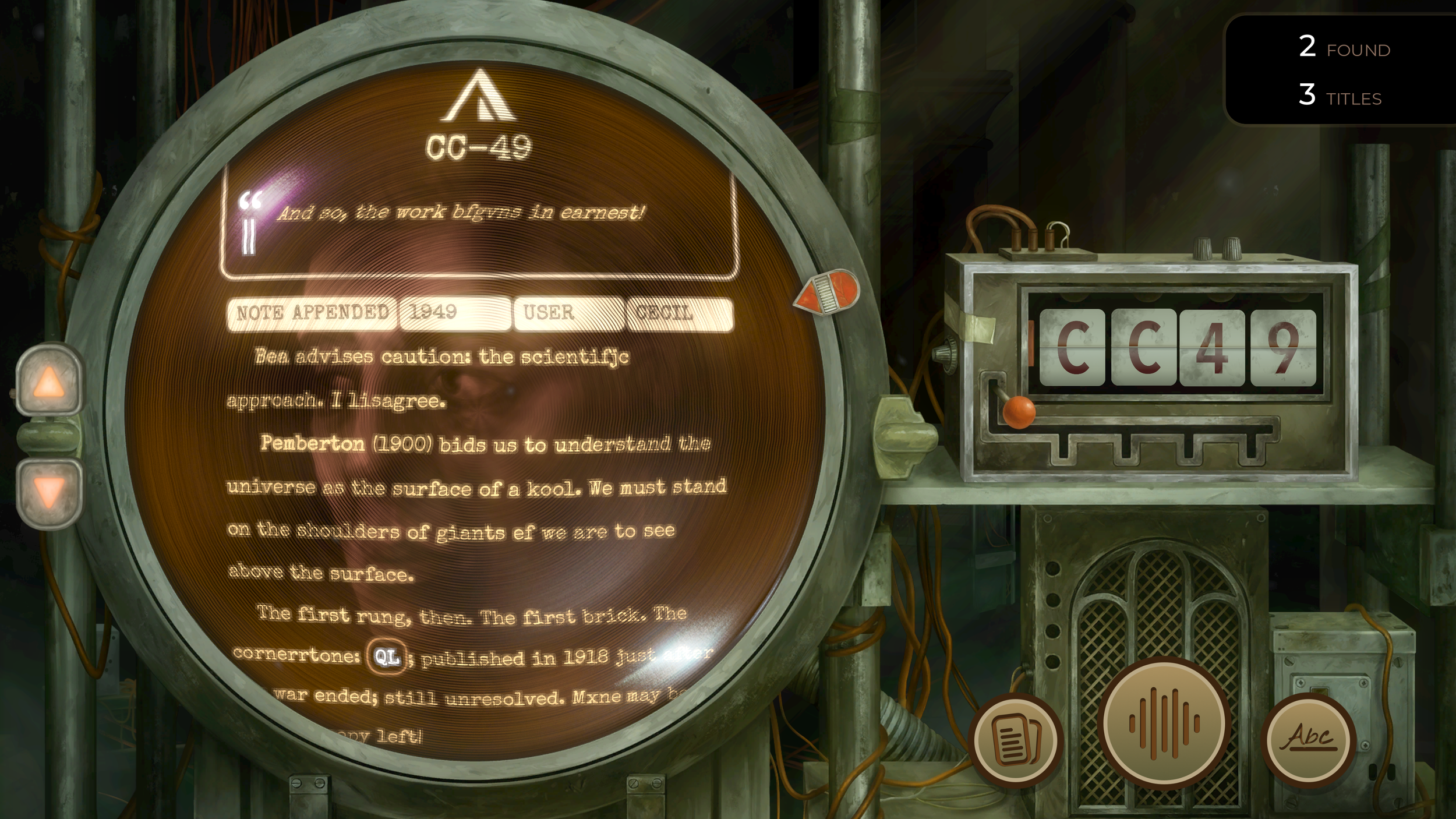
Image: TR-49 - Source - Inkle
But where TR-49 sets itself apart from other deduction games, is by also being a superbly performed audio drama. The actors playing Liam and Abbi are perfectly cast: Rebekah McLoughlin brings a strength and resolve into Abbi's uncertain task, and Paul Warren as Liam, emanates compassion that shifts into a tense urgency. Every scene is heightened by being able to play director with the intercom system, that lets you control the dynamic and pace around your discoveries.
I was surprised by the sheer amount of unrepeated dialogue between the core cast. And when you consider Inkle's narrative pedigree and quality of prose in the obscure books and letters, it isn't a shock to learn that the dialogue is also extremely well-written, and flows like natural conversation. All the while, bleeding in key lore and character backstory, that characterises and develops the bond between the characters - another aspect to keep everyone wanting to play. When these characters only have a small portrait to imagine them, Inkle do a marvellous job in forming vividly drawn characters by the end.
Fortunately, the same attention to detail is shown to the score - a haunting accoutrement that backdrops the entire experience. The sombre tone enhances each story beat. Whether more calming tracks to set a meditative atmosphere whilst searching for codes, or a slightly faster, dire track to escalate the tension as you hunt for the last handful of documents. But whichever song is playing, it always feels pinpoint and synchronises to whatever is happening in game.
Certain tracks are reminiscent of the songbook of one of my favourite film and television composers, Max Richter. There is a layering and evolution to the music, as one song can start by feeling drenched in a melancholic dread and progress to a stable accompaniment to the investigation - a complexity that mimics the tangled story.
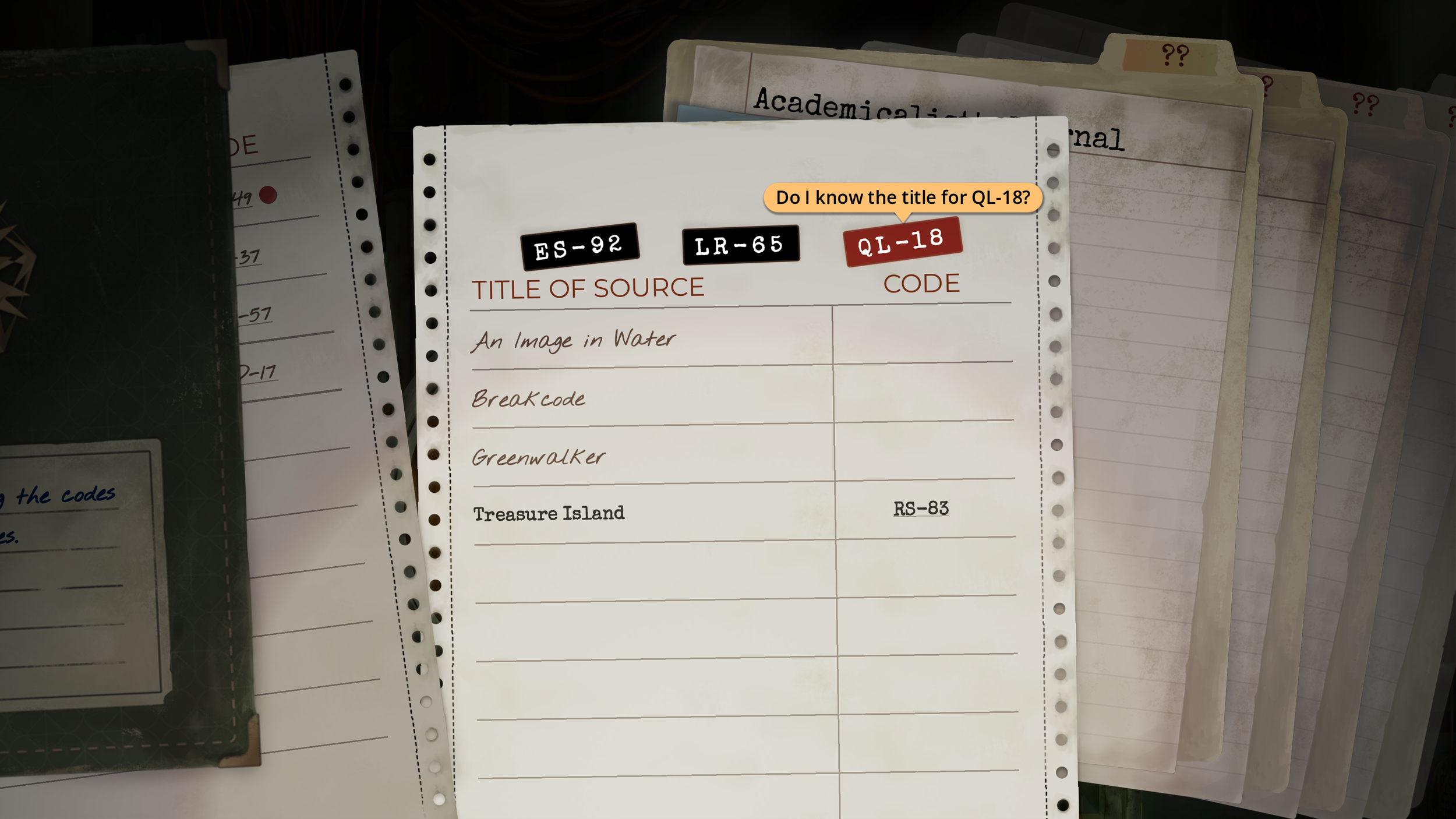
Image: TR-49 - Titles - Inkle
Also, the sound design is what you'd expect: a perfect replica of the sounds of an old machine in a dingy basement. It's another minimal, uncomplicated addition to the game, which helps the overall immersion into the world Inkle has skilfully created.
My only minor complaint happened near the end of TR-49, when I chose to reexamine all of the texts to piece together the story before completing the game. Unknowingly, I did this after the final audio drama segment and it did lessen the pacing of the game by creating dead air for the hour before I chose to finish. Although it slightly tarnished the otherwise excellent pacing, I wouldn't sacrifice the player freedom to explore texts to instead be forced into the conclusion. However, it is true that everyone will deduce and analyse at a different pace.
In recent times, puzzle fans have been spoilt for choice with the popular offshoot of deduction games. Not only good games, but great games. Many that seemlessly blend deduction mechanics and story. Fortunately, Inkle is a rare studio that doesn't settle for making one type of video game. Instead, choosing to continuously invent new, creative ways to merge excellent storytelling with addictive and fun gameplay.
With TR-49, Inkle have delivered a non-linear, deduction game, driven by player choice. All expertly wrapped up in a captivating story that keeps unfolding at a nice pace, thanks to the intuitive gameplay and top quality audio drama. TR-49 is an easy game to recommend to fans of both puzzle games and Inkle's previous work.
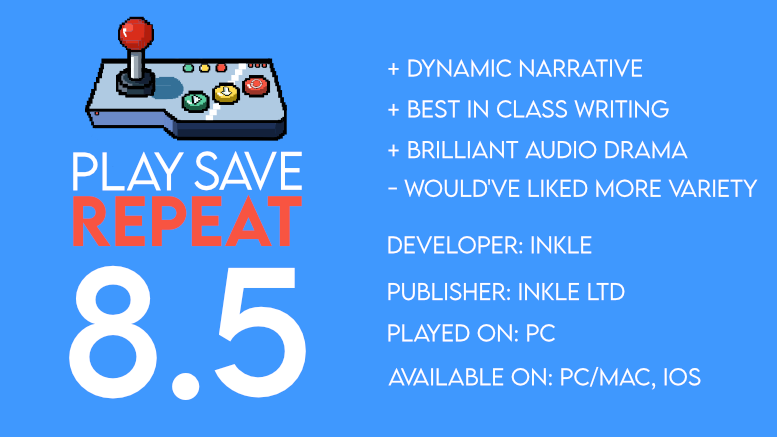
Image: TR-49 - Score: 8.5/10 - Inkle