
In modern times, indie developers have delivered countless memorable narrative experiences, such as Gone Home, What Remains of Edith Finch?, and Mouthwashing to name a few. Most rely on minimal gameplay mechanics to drive their thematically rich stories that reframe how players view the world, and Virtue and a Sledgehammer isn't any different.
Virtue and a Sledgehammer is a narrative indie meets destruction simulator from co-developers Selkie Harbour and Deconstructeam. A piece of art with a clear creative vision from beginning to end - an emotional adventure where every gameplay mechanic serves the narrative.
Returning to her hometown in Spain, Pratelle arrives with one mission: use the sledgehammer she calls 20lbs of physical media, to undo and understand the wrongs of her loved ones. An emotional journey through traumatic memories, her conflicted psyche, and anything that stands in her way - a violent therapy session that doesn't shy away from the tough questions.
Virtue and a Sledgehammer begins not with a hammer, but hard hitting questions that setup the story and test your morals. It's clear Pratelle has beef with her mother and sister Nina because of their actions. Even going as far as to ask players if they'd harm their own family to stop them from doing something utterly abhorrent. A clever narrative device to understand Pratelle's guilt and rage, and present it as a mirror to a player's story decisions.
After leaving her car, Pratelle is standing at the periphery of her small Spanish town, sledgehammer gripped between her hands. The low-poly 3D, graphic novel aesthetic sets a distinctly beautiful melancholic atmosphere. Moodily lit in reds and blues like something ripped from a Remedy game. But when Pratelle is told to smash something with her sledgehammer, the game truly begins. You press the trigger for three different levels of attack: a tap for a harmless shove, a slight hold for a damaging swing, and hold it down for a fatal downwards smash.
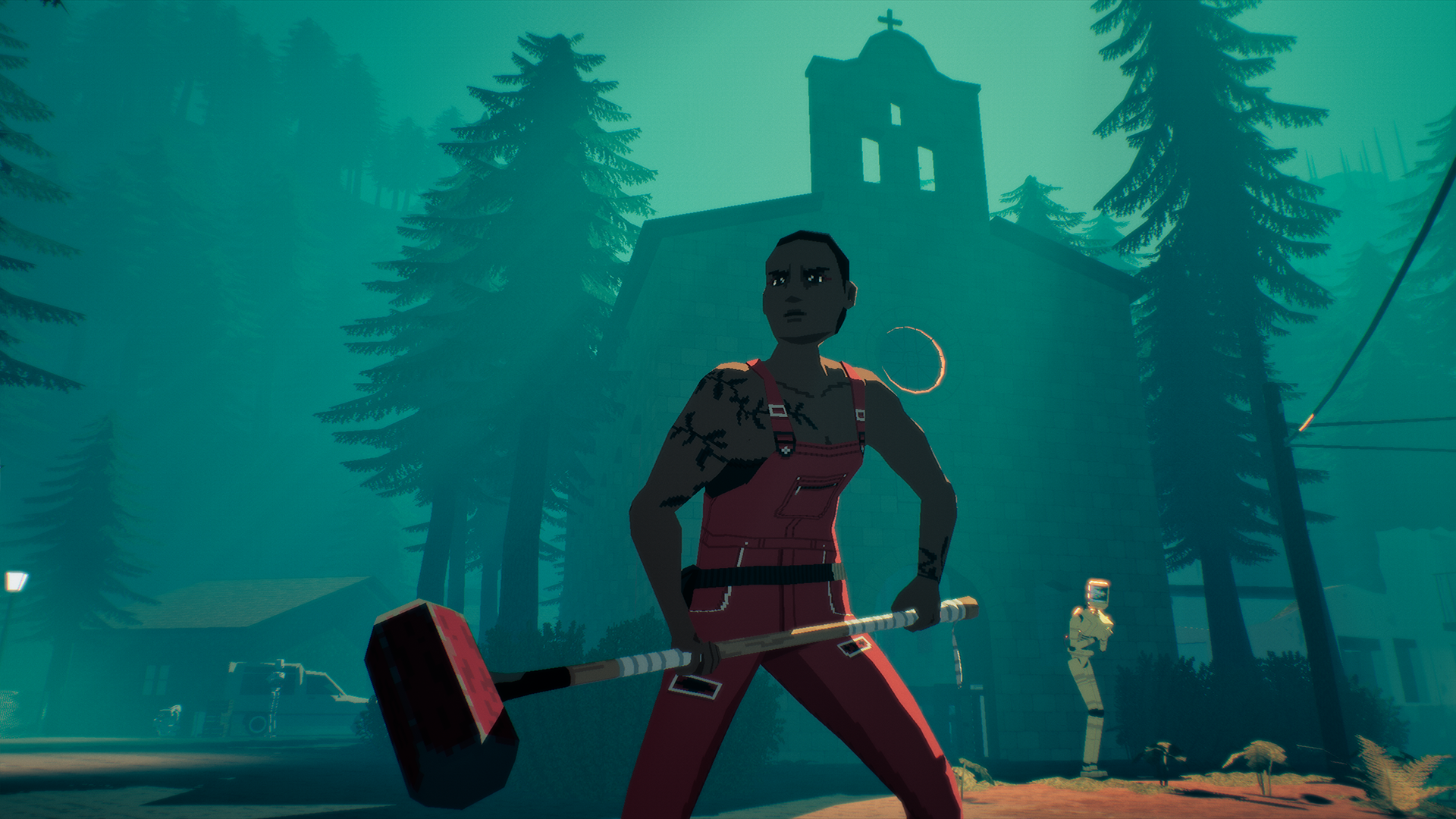
Image: Virtue and a Sledgehammer - Church
As you walk the path towards the town, smashing any obstacles in your way, you quickly realise Pratelle can't sprint or even walk fast. She's stuck in a marauding march - a woman on a mission. This might become a sticking point with some players, but it has a narrative intentionality. It forces you and Pratelle to soak in the changes to the town and neighbours she's grown apart from; a fleet of retro-futurist robots that contradict the rural surroundings rich with history. Machines that Pratelle views as inhuman abominations, like walking through a town of ghosts that failed to understand her.
But the genius of Virtue and a Sledgehammer is how the gameplay serves to heighten these nihilistic tendancies by allowing you to destroy every robot and building in an act of catharsis that purges the past to make room for the future. Without missing a beat to ask if your destruction will simply worsen the pain.
Yet the true masterstroke is how your choice to destroy or not interplays with a semi-dynamic emergent narrative system. On your way to confront Pratelle’s sister about the robots, you'll encounter her old community who've transferred into new metal forms. Some will scream murderer and attack in self-defence for destroying their friends. Others will flee before cowering to beg for their lives.
This emotional tug of war exists in every encounter with the community that left deep scars on Pratelle. But it's when you meet yellow robots that these old wounds are opened. Virtue and a Sledgehammer doesn't shy away from hard subjects such as trauma, anger, being gaslit into believing you're worthless, enduring physical and mental abuse, illness, homophobic, xenophobia, and racism.
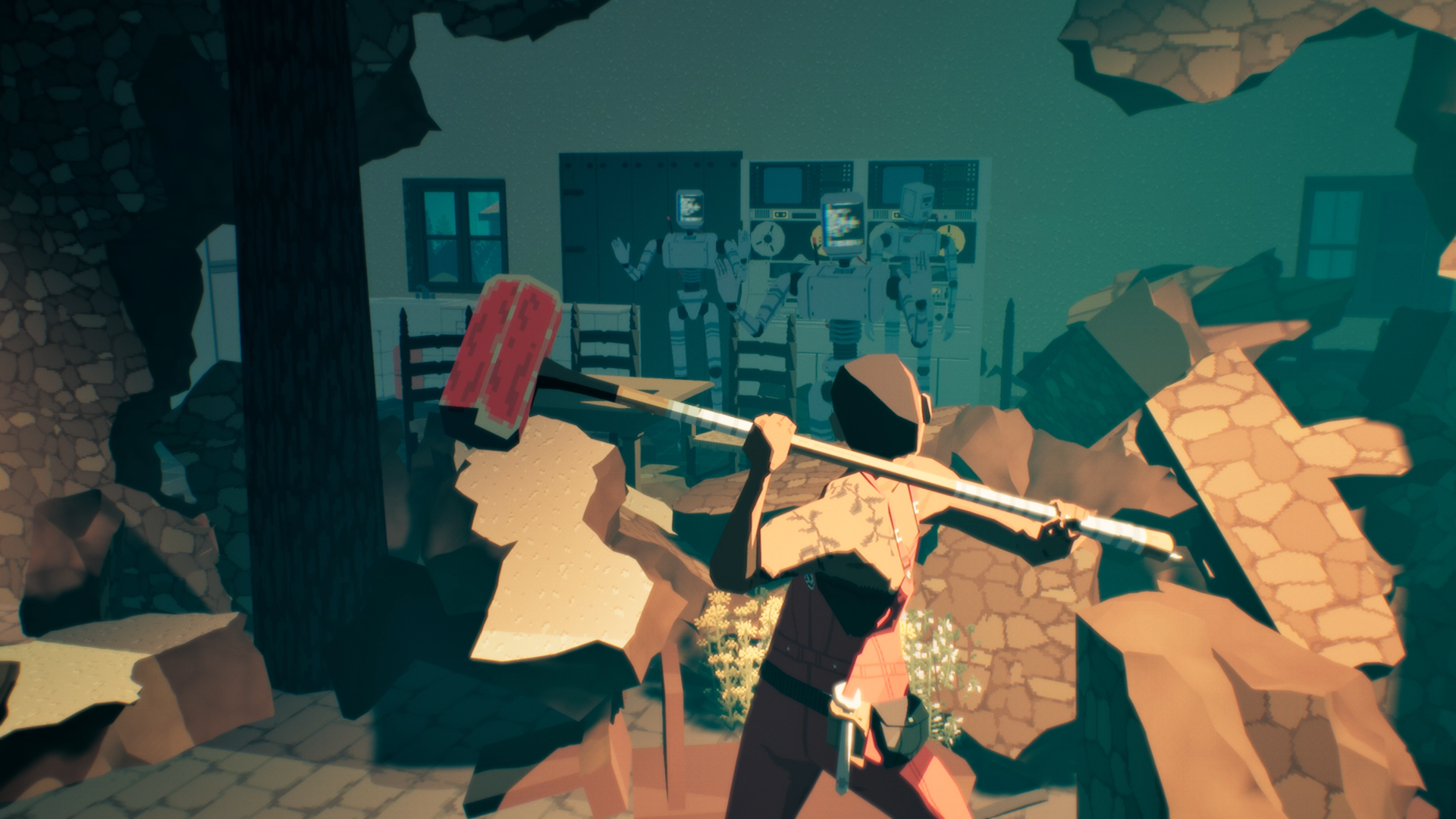
Image: Virtue and a Sledgehammer - Broken Wall
A perfect example of this is when you meet the robot barkeep who even in robotic perpetual life, retains their learned prejudices and discriminatory behaviours. Or a robot nun who still wants to help those in need, even if their new romanticisation of immortality contradicts with their fundamental beliefs.
Every encounter deepens your understanding of Pratelle's upbringing and mindset. It helps influence and add weight to justify your decisions. But it's the white and red crystals scattered around the seamless map that tell Pratelle's non-linear life story. A swing of the sledgehammer is all that's needed to activate these interactive cutscenes.
White crystals explore impactful moments from Pratelle's upbringing, such as a heart-to-heart with her sister about the likelihood of souls, and what makes a human a human. Whereas, after collecting a certain number of red crystals, you access Pratelle's deepest memories that have impacted her psyche.
Memories contextualise whether it's worth breaking entire homes to find red crystals, or whether you leave as many buildings and robots unscathed as possible. Important actions that help form your dialogue choices. But you'll undoubtedly destroy many buildings to experience the physics driven destruction. 3D specialists Selkie Harbour have done an exceptional job creating a cathartic outlet for Pratelle, and a satisfying gameplay mechanic for players. As beyond the story, it lets you forge a unique path through walls and buildings. And the smart decision to be able to look back on the irreversible damage you've caused.
There is real permanence and consequence to your destruction. Smashing a robot to bits is a low stakes act when their computerised mind can be re-uploaded into a new metal husk. But it's another thing entirely to obliterate the source. Virtue and a Sledgehammer asks what it means to be alive; a familiar question in speculative fiction. But a video game has the unique immediacy of being an interactive narrative where you decide the journey by making decisions based on personal experiences. Decisions that have consequences all the way to the end.
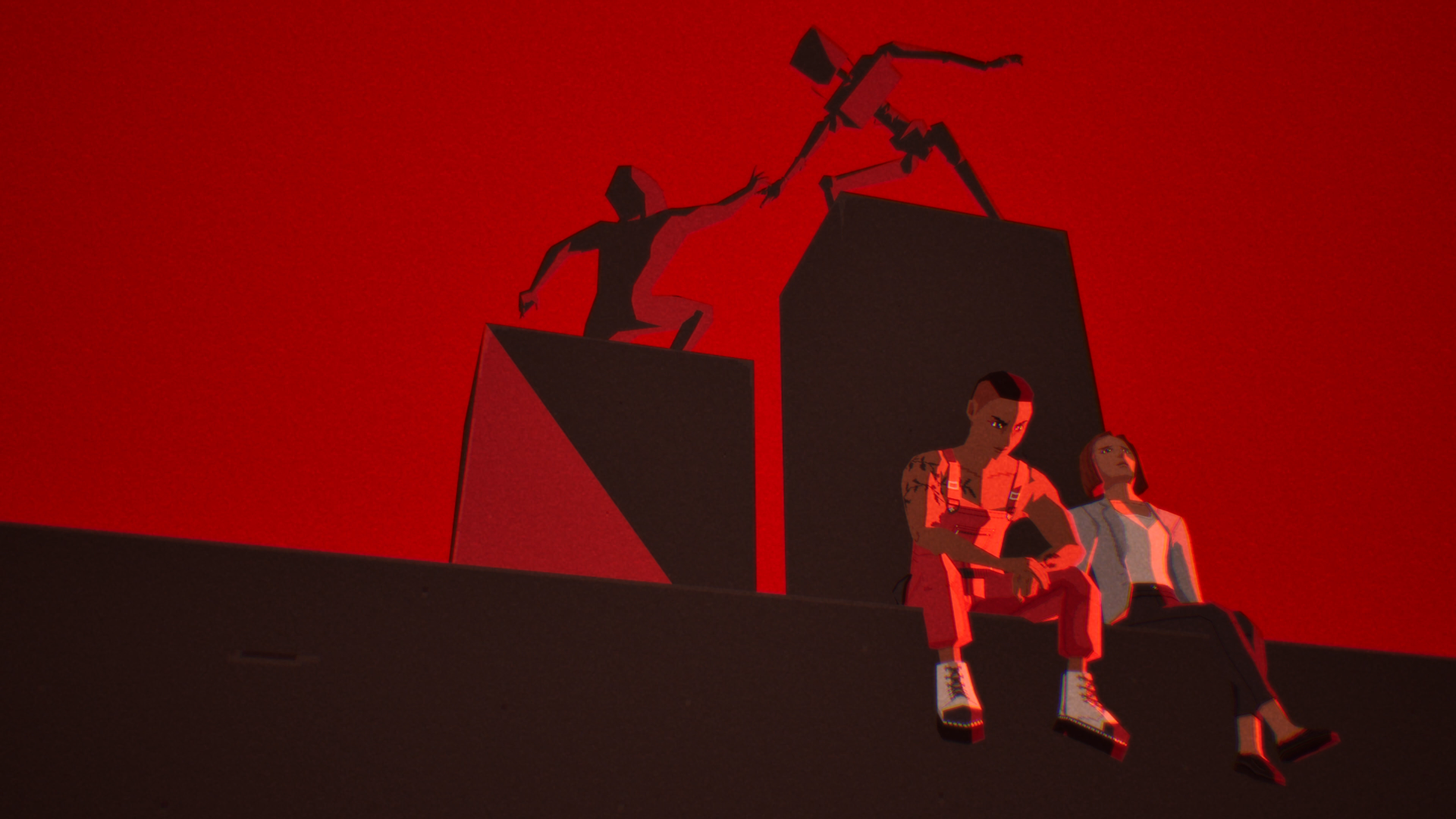
Image: Virtue and a Sledgehammer - Memory
Virtue and a Sledgehammer also excludes voice acting in favour of written dialogue. While I tend to prefer voice acting due to how easily a good performance can immerse you into a world, but here, its absence helps you embody Pratelle as you decide her responses and actions. She's on a defined mission; there isn't any algorithmic hand to puppeteer your opinion. You have the freedom to craft and view Pratelle's journey from your perspective.
There is also a sublime score from Deconstructeam's talented composer, Fingerspit, that backdrops everything from smashing bricks apart, memories, stylish camera work, and short story intermissions. The music shifts from melancholic synths to tone perfect needle drops. Sometimes you even feel like taking a beat to take in the scenery and gravity of Pratelle's story. As it covers many heavy topics and moral quandaries, like the cyclical nature of abuse, and the many conflicting and strange forms of love and hate.
But if you want to survive aggressive robots, you'll need to master how to deal with big groups and different variants that appear as you progress. You shove to create distance before priming a large swing to hit a group. Or knock holes straight through buildings to forge your own path and bypass certain robots.
Although I frequently found myself eavesdropping on conversing robots who engaged in normal every day conversations. Only rarely did it feel like it missed the mark with some pop culture references, but the majority of these small interactions really impact how you feel about Pratelle's community. You're also given further story details in achievement descriptions, which made them a worthwhile read.
Virtue and a Sledgehammer is a video game where the whole design is intrinsically intertwined to serve the narrative. Even the minimalist controls echo Pratelle's personal mission. Everything blends to give players the tools to really soak in the story, and to an extent, make it feel personal. Yet while it could've included a few more gameplay elements to evolve over time, at a completion time of around 3-4 hours, extra mechanics could've potentially undercut the experience.
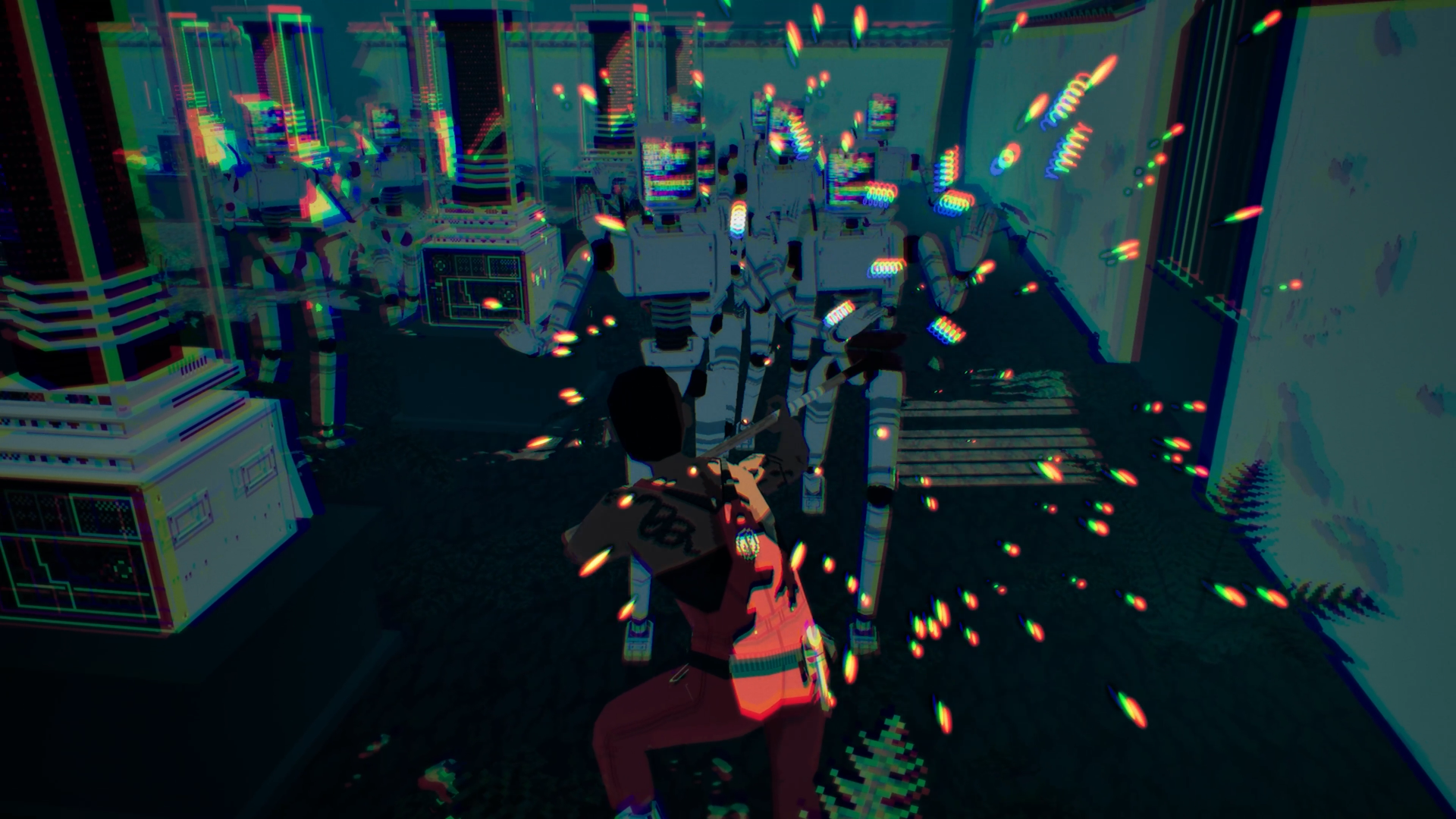
Image: Virtue and a Sledgehammer - Robots
Yet while Virtue and a Sledgehammer isn't strictly a story about artificial intelligence. The developers don't blur the line in offering their opinion through their characters' actions. They constantly ask the question of what is left if there is no longer any human parts or involvement. It mirrors the current creative arts like video games. As why would you want to interact with a facsimile made from an amalgamation of stolen parts?
Despite this, Selkie Harbour and Deconstructeam's creative decisions aren't going to appeal to everyone. The simplistic combat and set walking speed will put some people off. But if people stick with it, there is undoubtedly so much to get from the experience. Virtue and a Sledgehammer is a rare video game unafraid to start conversations by asking questions without giving clear answers.
Selkie Harbour and Deconstructeam have created what is easily one of the best narrative games of the year. If people resonate with its serious themes and engage with its ideas on technology, society, and culture, I can see it becoming an indie favourite. But I do hope Virtue and a Sledgehammer is a success, as in a world of ever-increasing generated copies, the developers' fingerprints can be felt in every second.
*Review Code Provided By Publisher

Image: Virtue and a Sledgehammer - Score - 9/10