

Directive 8020 Review
Directive 8020 is the latest third-person, narrative horror adventure game from Supermassive Games. Ever since their debut in the choice driven horror genre with the excellent Until Dawn, they've been a studio whose games I've eagerly anticipated to play with friends and family. Whether in the teen slasher, The Quarry, or their exploration of horror subgenres in The Dark Pictures series. Unique edge-of-your-seat, imperfect horror games that create memorable multiplayer moments unlike anything else.
The latest entry in The Dark Pictures series sees Supermassive Games dip their toes into the sci-fi horror genre, with a story that feels like John Carpenter's The Thing in space. You play as the intrepid crew of the Cassiopeia - a colonisation spaceship retrofitted to be able to survey a planet by following its orbit. Their mission is to survey Tau Ceti f, a potential planet with promising qualities for human colonisation.
But when a meteorite smashes through the ship's hull, an organic growth of alien origin infects the ship and forces the surveillance team to listen to the on board AI's instructions and fix the breach. Soon enough, things go from bad to worse as the crew wakes up from cryosleep to crash land on Tau Ceti f and find that a presence on board is now hunting them by imitating their appearance - a perfect setup that makes you uncertain of who to trust.
Launching the game, you can choose to play single-player or couch co-op multiplayer for up to five players, with an online multiplayer mode being added in a post-launch update. Having chosen your desired mode, you pick whether to play Survivor where every decision is irreversible, or Explorer where you can access the story trees of all eight episodes and select the branching turning points to rewind and redo pivotal story moments. This new mode makes the game more approachable and replayable from within your own save file. It's a convenient way to quickly experience branching story paths without restarting the entire game.
You can also select many accessibility options: the ability to remove time limits on quick time events, enable the same button for all prompts, hold buttons down instead of mashing them and more.
If you select multiplayer, you can read the crew's biographies, and then, you and your friends can assign each of the six playable characters to whichever player wants to play as them. Then, set your difficulty between forgiving, challenging and lethal. Being able to choose who you play as immediately gets you invested in their backstories, motivations and makes you want to keep them alive. These dynamic choices make for an immersive shared experience that's challenging for experienced players and approachable for casual gamers who aren't familiar with a controller's button layout.
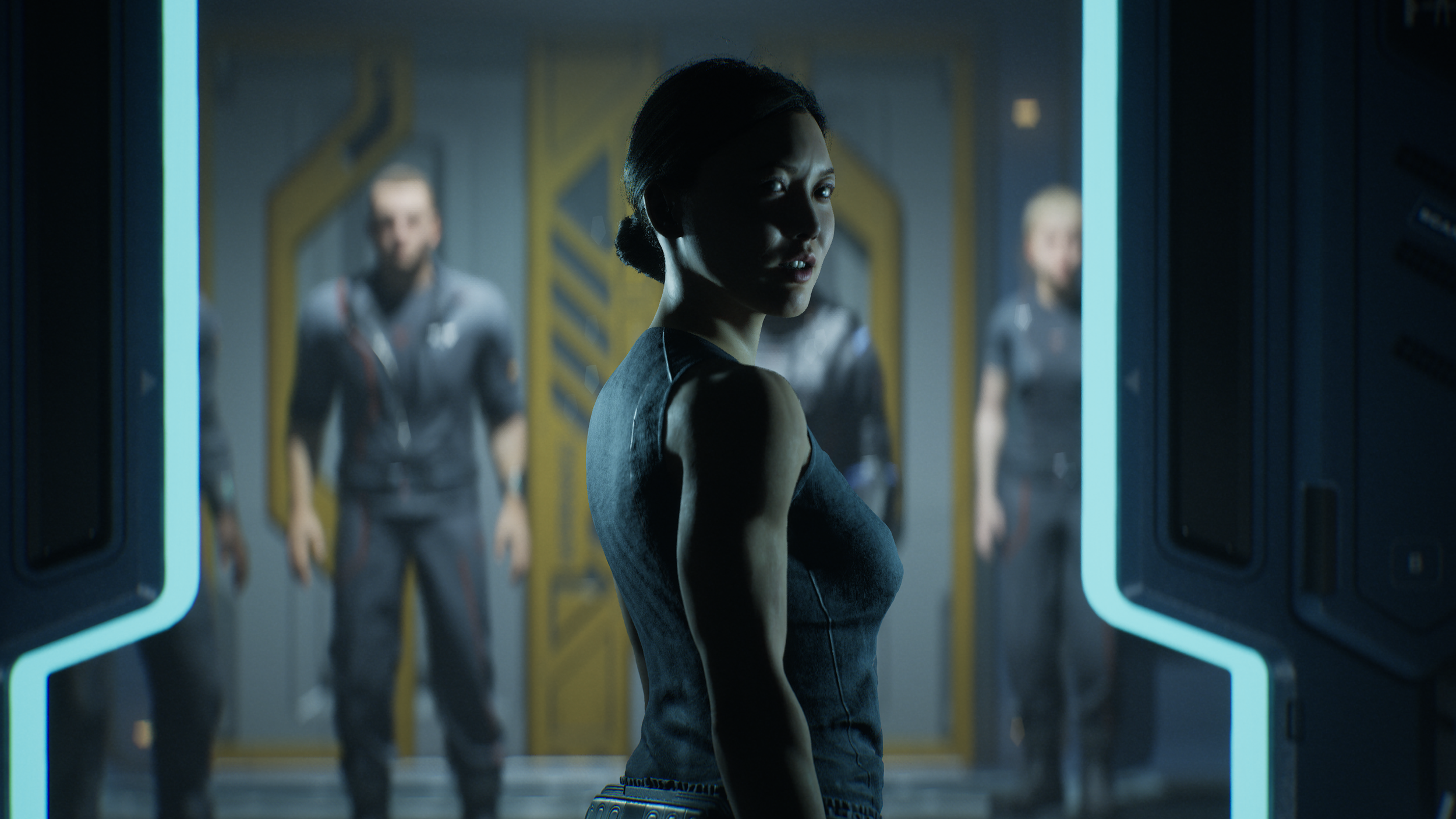
For those familiar with The Dark Picture series, you might be wondering where the narrator, The Curator has gone. Thankfully, Supermassive Games have chosen to implement him in a more interactive way. But I'll leave everyone to discover that for themselves.
Like other Dark Pictures games, Directive 8020 begins with a prologue to setup the story, characters and introduce the returning and new gameplay mechanics. Right away, you are given a dilemma of whether to ask the on board AI for advise or to go and use your initiative to fix up the hole made by the meteorite. This gives you the chance to learn how to use the Utility Strap, a device that scans a room like a radar to highlight enemy locations and electric cables in the walls.
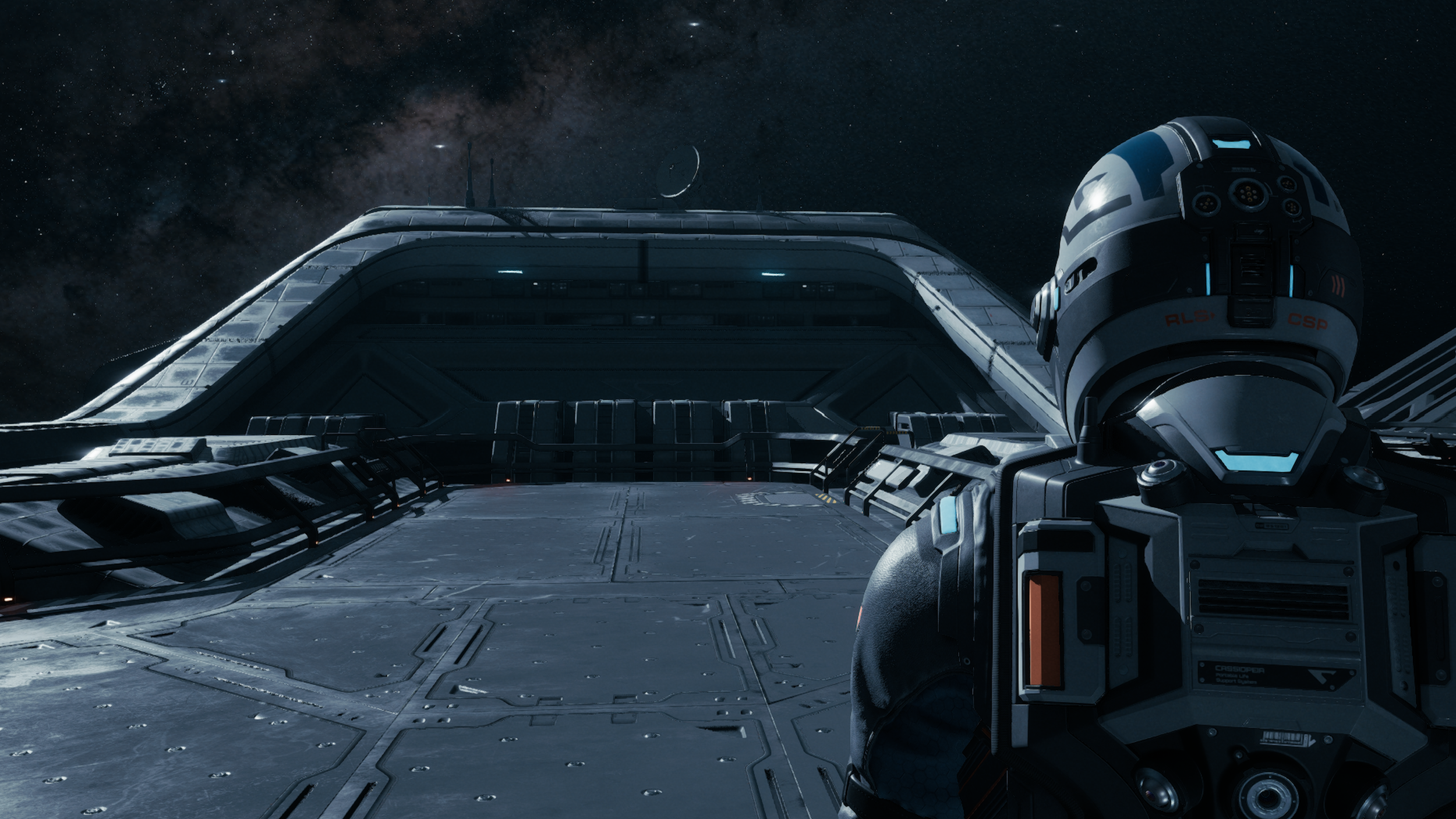
You finally venture outside in your spacesuit and magnetic boots, gazing at the endless vastness of space that's rendered superbly as light shines realistically on every surface. But it doesn't take long for your first quick time events to finish teaching you the basics of the returning gameplay mechanics.
However, like other Dark Pictures games, Supermassive Games have created new and unique gameplay mechanics to distinguish Directive 8020 from the rest of the series. House of Ashes had weapon management and aiming and The Devil in Me had an inventory system. But Directive 8020 takes things a step further by focusing on a fully player controlled stealth system.
Near the end of the prologue, something stalks you in the open halls between you and the crew quarters. You're instantly immersed into edge-of-your-seat stealth horror gameplay that's completely different from anything a Dark Pictures game has ever done before. As the score ratchets up and darkness envelops every room, all you can do is stay hidden.
Stealth functions much like other non-combat stealth games, but more simplified. You crouch behind walls and boxes, heading to your objective by relying on malfunctioning lights as your guide. As using your flashlight will alert the enemy to your location.
Later on, stealth sequences grow in complexity and require the use of the Utility Strap. You can turn on screens, roll down windows to mantle into rooms, open doors and keep tabs on the enemy's location. But any wrong move like accidently stepping over broken glass will give away your location and force an altercation which will lead to a limited defensive manoeuvre or something much worse.
I found stealth sequences worked best in wide linear locations with multi-pathway designs. Not once did I run into any frustrating issues during this variation. Even working when I was tasked with retrieving a power cell, and then return to where I came from with the Mimic on high alert. But these missions grow tenser with the introduction of locked security doors and the Wedge Tool: an electric baton device that's used to stun enemies in desperate moments and unlock security doors. In order to unlock one of the doors, you must complete a quick mini game where you press a button when a marker aligns with either the tiny orange segment for an instant unlock, or by continuously hitting wider grey segments until the door opens. Particularly sweaty moments if an enemy is in full pursuit.
Unfortunately, stealth doesn't perform quite as well in narrow environments where you wait for scripted moments to proceed. It begins to create issues that made stealth feel too frequent and overstay its welcome. Such as one mission where you pull down three levers to power up a machine, while avoiding an enemy that patrols up and down the narrow path. If you are observant and patiently wait a while, the enemy opens your next route, which would've been fine if the enemy didn't randomly see me when I was hidden behind a box. Or when I got caught and stunned the enemy, he instantly exited his incapacitated animation when I pulled a lever, and attacked me.
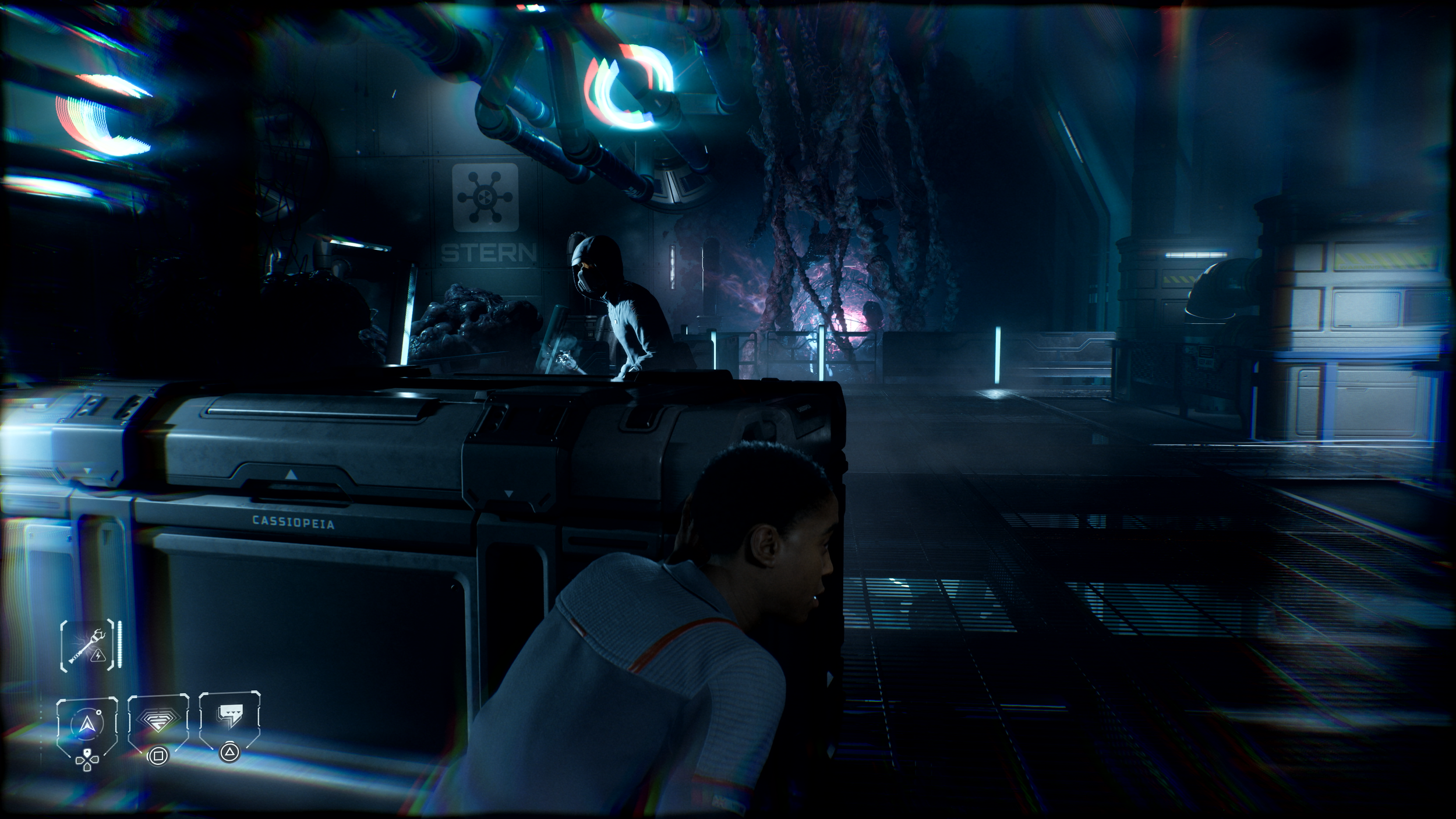
But I can't say that I disliked their attempt at stealth, as when it works, it feels good. I only wish they were less frequent, all wide designs to avoid issues and gone a step further to allow you to actively use a melee weapon in desperate moments, as it would have made the game more immersive.
Despite imperfect stealth, the heart of what makes a Dark Pictures game tick is still as strong as ever. Multiple story altering decisions drastically change the outcome of current and later scenes, such as an early, seemingly innocuous decision - in my game which was made by another player - to deactivate the Cassiopeia's landing capabilities instead of its fire systems, initiating a ripple effect in a pivotal scene where the Cassiopeia crashes. Impacting a later scene where I role-played as the character's personality to an undesired outcome due to the results of another person's decision - unique gaming moments that make a Supermassive Games title memorable.
You also explore environments during the story by following a character's emergency trails to find their location, or to find hidden secrets to learn about the mission: video messages that contain compelling subplots and missable areas that impact and add context to the main story. With your flashlight equipped, you explore a brooding atmosphere of organic growths and a fully designed spacecraft.
Although, Supermassive Games varies the gameplay with simple puzzles and activities. Such as a Sherlock Holmes style body examination, immersing you in your character's occupation as a medical officer. Or when you use your scanner to follow cables to figure out how to operate a crane and create a makeshift path. And a selection of simple puzzles like solving numerical codes or synthesising medication by using environmental clues - a nice break from the cinematic dialogue, action scenes and stealth sections.
But the game never strays too far from cranking up the horror. One way it does this is by the use of vents, to either hide in or to setup claustrophobic jump scares, all in first-person. Drawing your attention to distant fans where blades of light cut through and figures dart across. And the developers never forget to build up to a big crescendo in the form of quick time event filled action scenes and chase sequences. Pulse pounding missions where you sprint away from pursuing enemies.
Although it is the communication feature that provides both positives and negatives within each episode: a crew wide text messaging system, where you receive texts during exploration and can select multiple responses to impact the crew's personalities. However, this feels fine when the messages factor in what's happening in the story or when you're exploring a quiet space before things go sideways, but when notifications flash when you are being hunted, it feels unrealistic to stop in a horrific environment to have a conversation over text.
Yet a choose-your-own-adventure wouldn't be anywhere near as good without an engaging plot, interesting characters, and meaningful choices to branch the narrative. I've enjoyed playing through every Supermassive Game, but I have always found strong and weak moments, and Directive 8020 is no different. There's many parts I enjoyed and some that I would've changed, but I also realise how challenging it is to make a fulfilling and compelling branching story that seamlessly fits together.
Sometimes the writers show us subtle details about characters through personal belongings or general conversations, but more often than not, unnatural exposition is used to quickly inform players of a character's backstory and personality traits. At times it feels clunky, but I understand the need to connect players to their chosen characters as soon as possible. Then, the story can move forward to focus on player choices. It attempts to create this story propulsion with flash forwards; intense tastes of what horrors are to come.
Yet, a cinematic adventure needs solid characters played by a talented group of actors to be engrossing and appealing to the player. Directive 8020 maintains the tradition of casting a famous film and TV actor to front the cast. Lashana Lynch of No Time to Die and The Day of the Jackal fame leads the cast as Pilot Brianna Young - a character trying to live up to her father's memory.
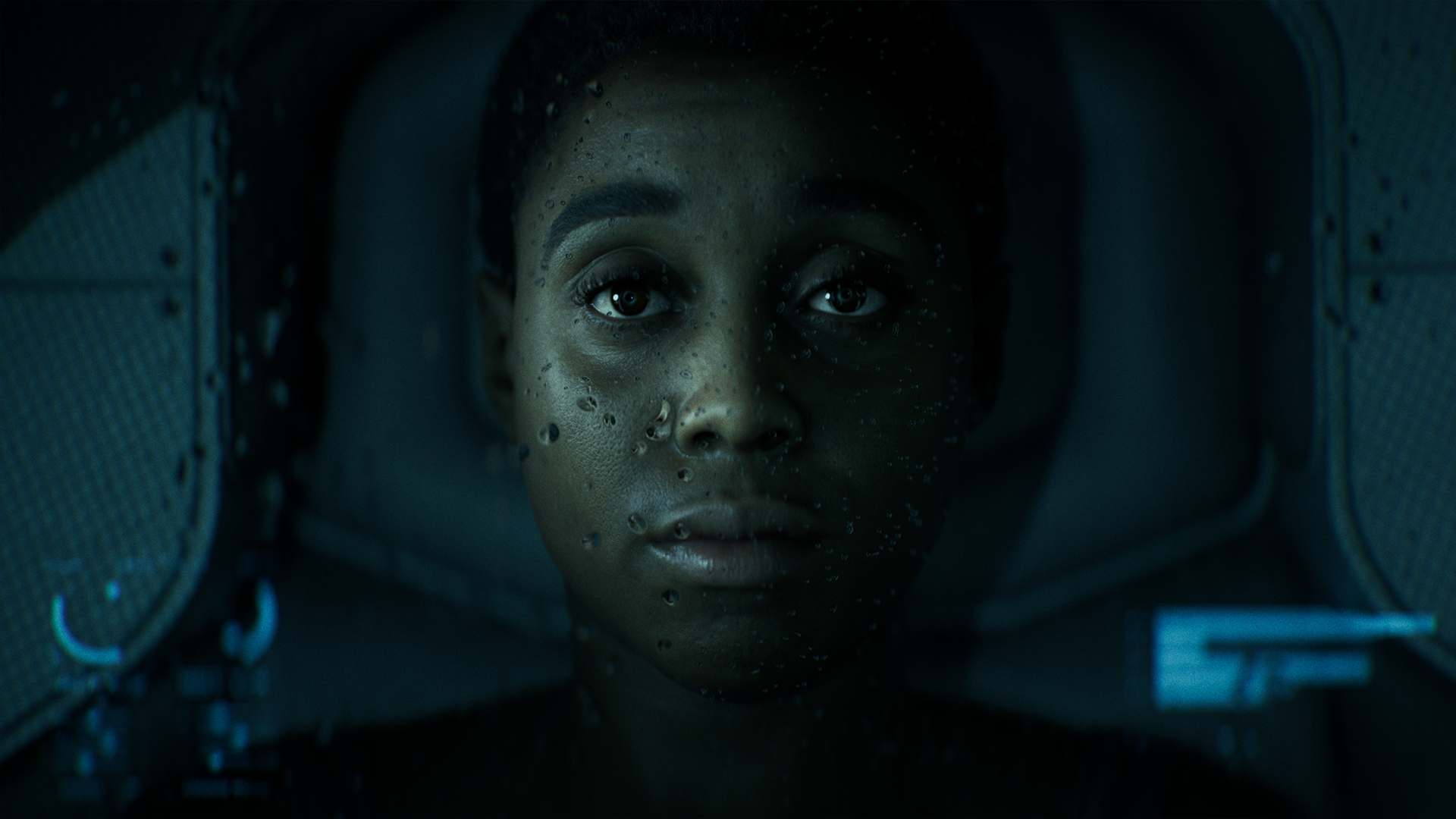
Supermassive Games achieves this by using an amalgamation of full motion capture, voice acting and face capture, to bring performances in game. They present richly detailed character models with realistic motion and expressive performances, even in the odd scenes where the script falters.
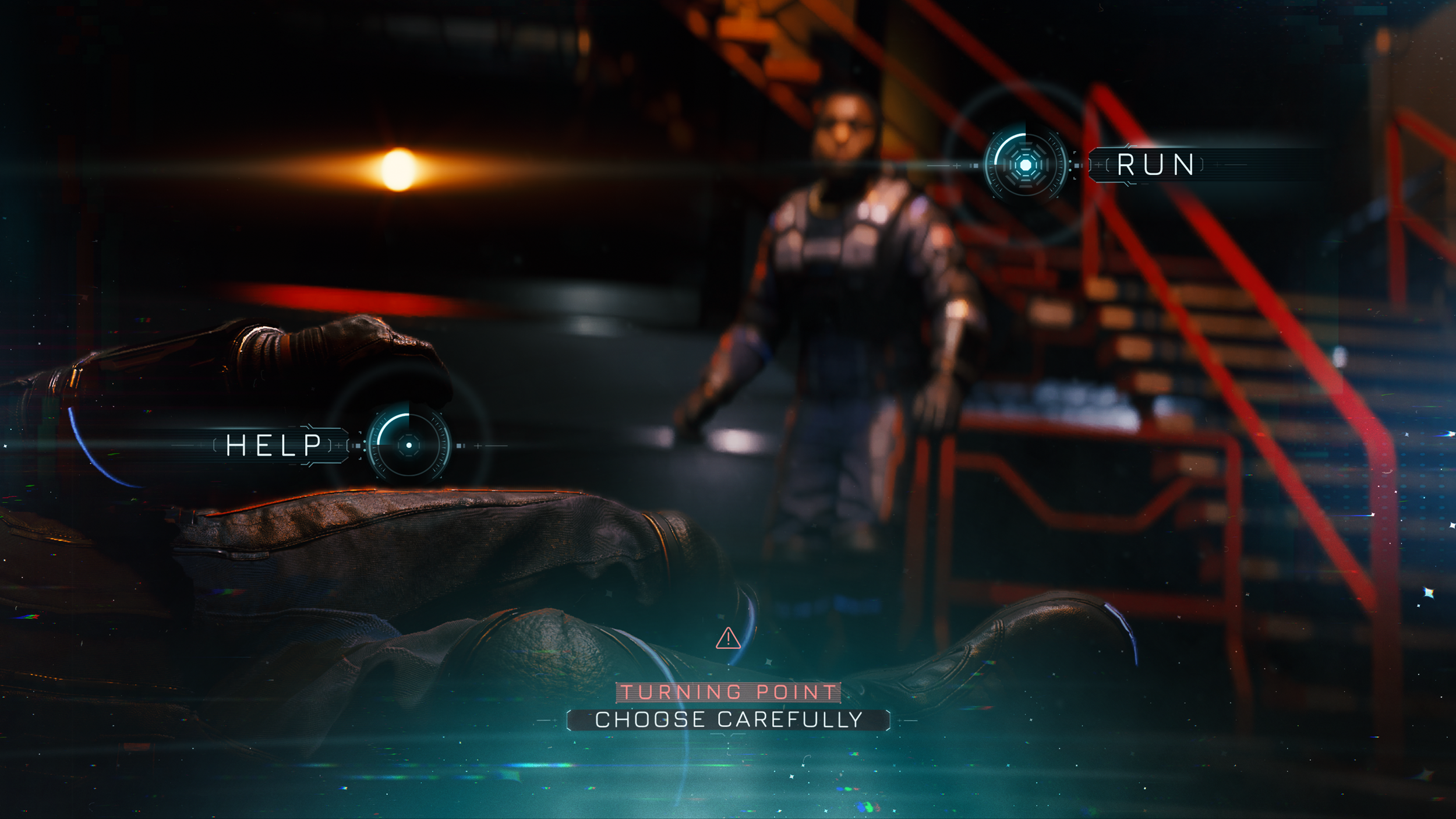
Still, I believe this is the strongest performances in a Dark Pictures game to date. There's no better example than when a crew member faces a mimic of itself, causing complete distrust. Each character no longer knows who's a friend or a threat. Forcing players to make life or death choices that showcase an actor's talent.
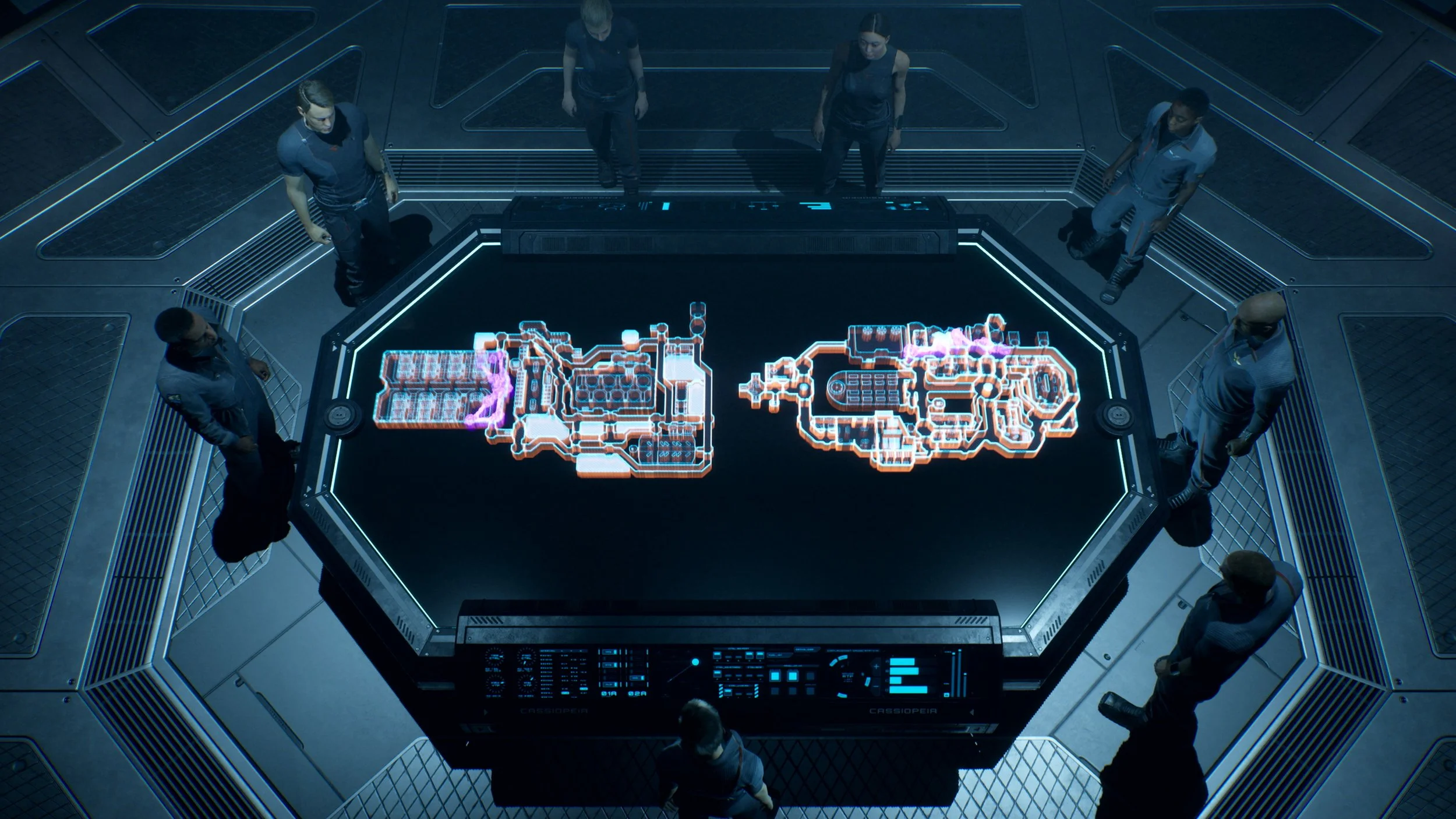
The beautifully rendered malfunctioning spaceship also helps players become fully immersed in these dramatic moments - an area where Supermassive Games have always been at the top of their craft. Whether Brianna Young piloting from the bridge, Medical Officer Samantha Cooper preparing medicine in the lab, Senior Mission Officer Laura Eisele observing plant development in hydroponics, Technical Engineer Josef Cernan maintaining the guts of the ship and more. It feels like a living breathing space that slowly becomes claustrophobic and dangerous.
The extra development time clearly helped polish the visuals, contrasting perfectly between manmade surfaces and corrupting organic masses. Even on console the game looks impressive, as light lands realistically on skin and manufactured materials, and helmets fog when characters breathe. Adding to the creeping horror of the Cassiopeia.
On Playstation 5 Pro, Directive 8020 includes three gameplay modes with varying frame rates and resolutions. While the Playstation 5 has a quality and performance mode, Playstation 5 Pro also has a balanced mode for 120hz screens, to run the game at 40 frames per second.
Outside of the visuals, a cinematic horror game lives and dies on its audio design. Luckily, Directive 8020 is enhanced by atmospheric sound effects like when footsteps can be heard around you whilst exploring otherwise silent vents, that lets the fear breathe. And a sci-fi score enhances every moment as it shifts from relaxed lulls during friendly conversations, to a foreboding tension as you explore and get startled by a fleeting shadow just out of sight, and crescendos as the ship whines when bullets fly and the crew is in the height of battle
Handpicked songs bookend each episode like a television show. Supermassive Games smartly uses an episodic structure to make it more approachable and pick up and play, to enjoy with friends or family over a few evenings.
But when Directive 8020 is firing on all cylinders with good action scenes, impactful player decisions, or wide linear horror stealth situations, it's one of the best Dark Pictures games. However, the scenes with stilted writing, moments where a character's actions are nonsensical, or you're funnelled into a frustrating stealth sequence, bring the overall experience down a little bit.
Despite these issues, the good outweighs the bad, as it's incredibly easy to overlook minor issues when you are having a great time playing in multiplayer and discussing all the choices you made to impact the story.
If certain stealth levels had been tweaked, Directive 8020 would've easily been my favourite Dark Pictures game, as the sci-fi setting and its clear horror inspirations appeal to me. That being said, it's still one of the better titles in the series. It's an entertaining game with a lot of replayability, and if anything, I wouldn't want Supermassive Games to stop taking swings to distinguish each title in the series with unique gameplay mechanics. As even if they don't always fully land, they make the games stand out from each other.
For those who only play in single-player, it might be harder to overlook little frustrations. But if you play each entry in multiplayer, the shared experience surpasses little flaws and frustrations, and with the new feature to access the story tree and rewind the game at turning points, you can quickly return to scenes where things went wrong to see the alternate branch in the story.
So, if someone enjoys high-fidelity, cinematic choose-your-own-adventure games in the horror genre, the latest in the Dark Pictures series has a lot to offer. Although Directive 8020’s story isn't original, it's an entertaining and atmospheric experience with plenty of twists and turns, where choice and consequence matter above all else. Even with more gameplay variety, mileage will vary with the sometimes cumbersome stealth. It isn't perfect, but the developers' passion is clear to see on screen and I had one of the most memorable gaming experiences of the year whilst playing through the game in multiplayer.
*Review Code Provided By Publisher.