Since the early days of video games, the arcade genre has been a persistent staple in real-world arcades and at home. Infinite experiences that deliver the unique dopamine hit of achieving a high-score above your friends on the leaderboard.
Faraway by solo developer Steph Thirion keeps the core principles that made past greats thrive while using modern techniques like an endless procedurally generated world to make every run a worthy challenge.
The setup is simple: you control a shooting star with a limited life-span that must forge constellations to stay alive. After a minimalist written introduction and prologue, Faraway throws you into its easy to read universe of stars.
You begin by learning the basics of how to form constellations. As the shooting star, you're constantly soaring through space and can attach to the orbit of nearby stars. But when you do, an ever-changing circle fades from grey to bright red to determine the speed you will propel when you decide to release the star. With only one button to press and hold, Faraway is immediately approachable to anyone, but difficult to master.
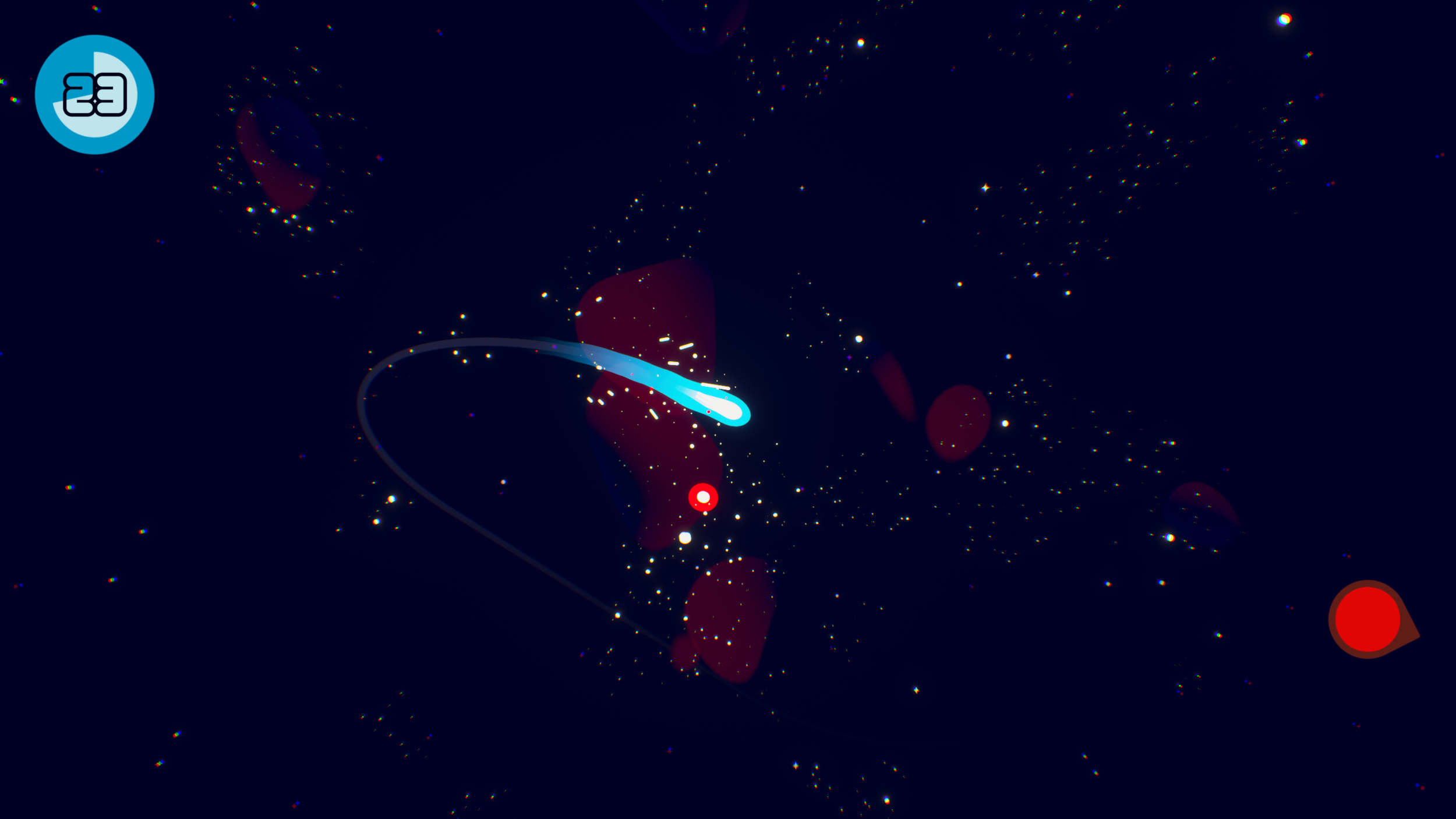
Image: Faraway - Space
At the start of your journey, you'll clock a red marker somewhere around the periphery of the screen. This acts as an arrow to guide you to the nearest area to make a constellation. But while you're barrelling through space, there's a timer that tells you how long your little star has until it fizzles out and dies. Fortunately, forming constellations inside the large circles can earn back time and accumulate points.
Faraway initially teaches you the basics of how to link stars together to form a constellation. Just like attaching to stars in space, you orbit the chosen star, but this time, there's a line of light attached to you. But like before, you hold down the button to determine your speed and upcoming direction. After lining up with a nearby star, you release to float into its gravity so that you can attach to it and connect the line of light.
The tutorial and early parts of the endless mode teach you to slowly attach to every star in a constellation circle. This gives you 10 points per connected node, and a bonus for connecting 100 percent of the constellation. However, this is only achievable if you don't overlap the lines of light. It's imperative to carefully choose a starting star, and adjust your speed and angles of approach accordingly. As if you don't think ahead, your constellations will suffer, and you'll quickly run out of time.
I did take a while to get used to the moment-to-moment gameplay of picking the correct side of a star to spin around to line up my approach towards circled stars that offer potential score and time bonuses. But in order to progress to the higher levels of Faraway, you need to master advanced manoeuvres to achieve score multipliers, else you'll simply run out of time.
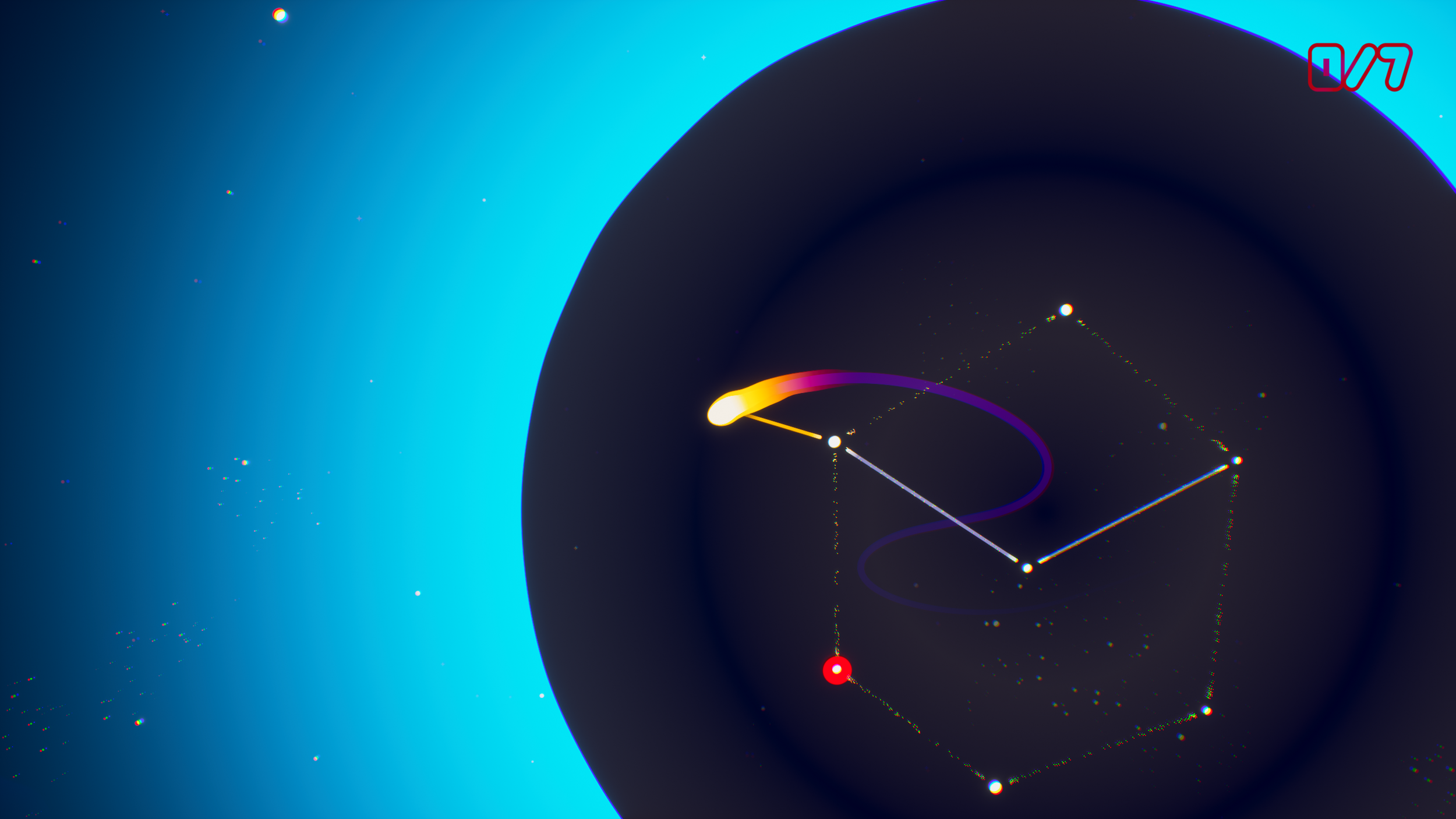
Image: Faraway - Constellations
Due to struggling to form complicated constellations, I practised on the optional missions that teach different techniques. Afterwards, I began to connect circled stars and find my groove. Forming small triangles by looping around them became muscle memory, activating score multipliers with each closed loop. Sometimes I'd even achieve 5 or 6 times multipliers, to earn 50 or 60 points per connected star. And if you manage to connect every star, you'll achieve a massive score that quickly boosts you to the top of the leaderboards, but also unlock every optional mission.
Although I am used to the intricacies of Faraway, there's still times when things feel unfair. Whether a marginally miscalculated propulsion, or failing to lock-on to a nearby star, the game never quite feels as good as I'd hoped.
Despite this, Faraway does offer 3 difficulty modes: slow, normal, and fast. Altering the overall game speed and time limit. I'd definitely recommend trying slow to get your bearings before gradually moving up to place on the other 2 leaderboards.
However, my biggest gripe is Faraway's pacing, as after each completed constellation, it calculates your score and takes too long to return to the action. I would definitely favour an option to remove or speed up this process. As it would greatly improve the flow and desire to try again.
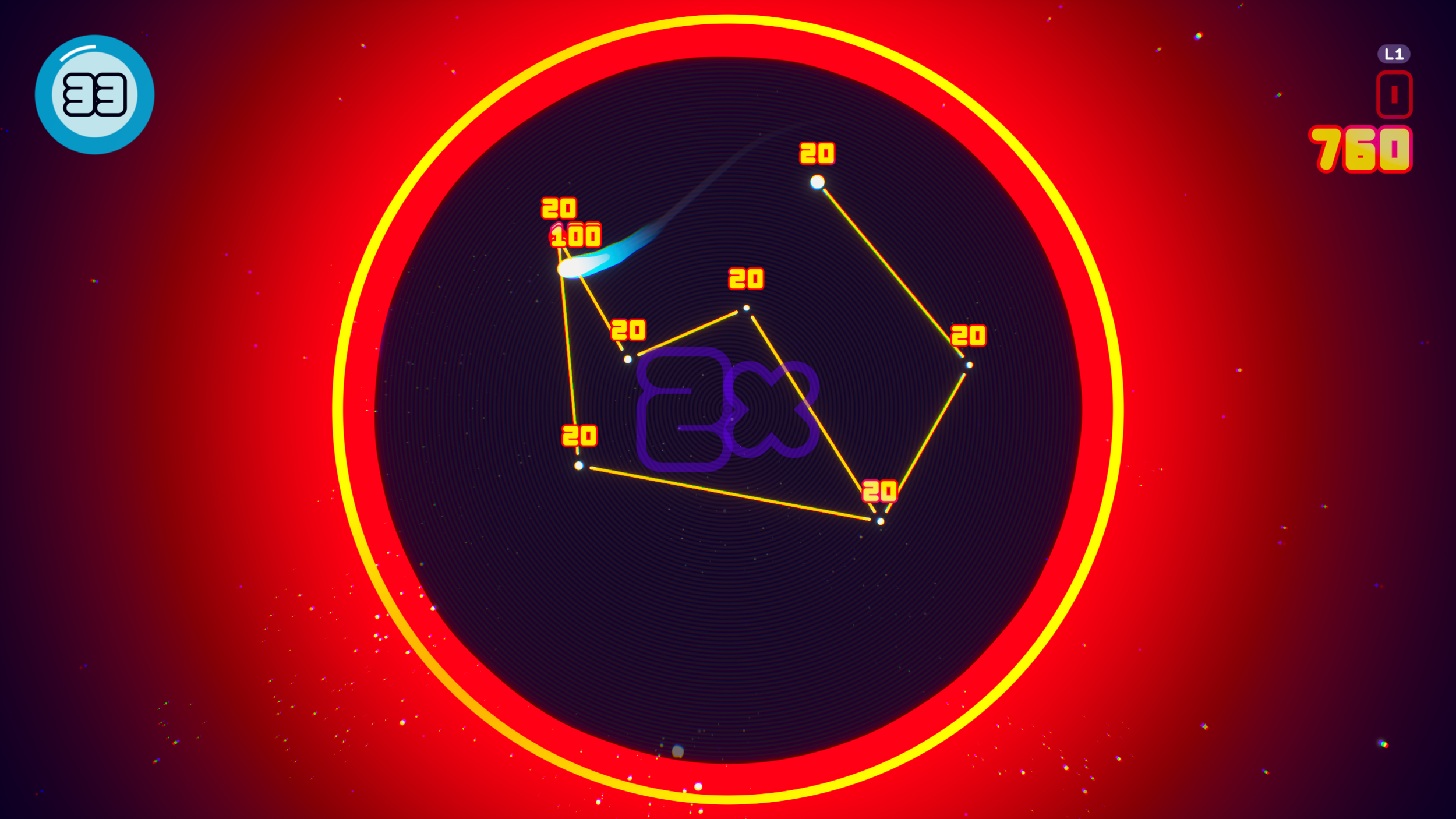
Image: Faraway - Complete Constellation
Yet Faraway still has enough hooks in me to return for more runs between games, or whenever I have a few minutes. It's the relaxing atmosphere and compulsion to want to master the controls to land at the top of the leaderboards that keeps me coming back. And the hypnotic, minimalist audiovisual design also helps the tone of a shooting star making the most of its short existence. The art is slick and sharp, clearly colour coordinated. While the music suits the atmosphere of endless space.
Faraway is easy to pick up and play, but difficult to master. It's clear that developer Steph has achieved their focused creative vision, as Faraway is a very immersive experience. Yet, the steep learning curve, slower pace, and feeling of unfairness will discourage some players. But even so, I can't pull myself away from trying to improve on my scores. For fans of arcade games, there's enough in the satisfying gameplay loop to want to explore Faraway's infinite space, especially at its low entry price.
*Review Code Provided By Publisher
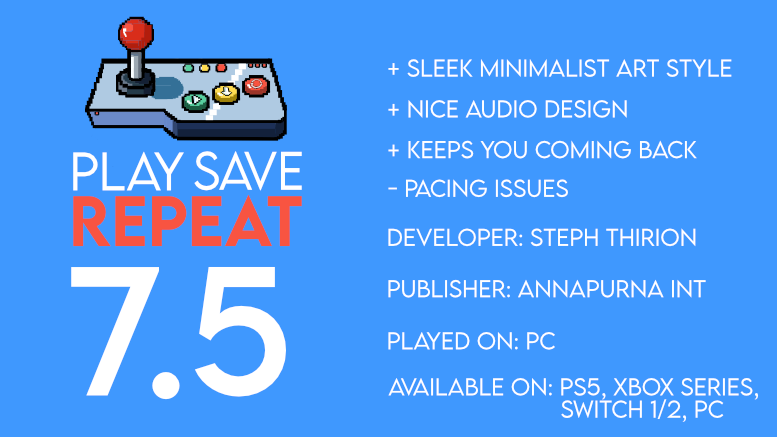
Image: Faraway - Score - 7.5/10