

There are certain video games where you know after an hour that you're going to connect with. But on rarer occasions, you complete a game that refuses to leave your thoughts. Funeral for the Sun is one of those video games.
Funeral for the Sun is a deeply layered narrative deduction game from developer Nicolás Cid Delgado. It's told by assembling the connections between generations of people from the same town - a similar system to The Roottrees Are Dead's family tree. It combines the light exploration of a point-and-click adventure with the narrative complexity of Pentiment.
You play as the inquisitive Nayla Rivera who is guided by an elderly boatman to Cerro Milagroso - an abandoned town full of life, death, and secrets - a setting rooted in Latin American history. After a terrible event ruined the town in the 1960s, Nayla attempts to uncover the truth. Searching through the ashes, Nayla becomes entangled in a mystery spanning four hundred years, and must travel back in time to deduce what happened to a community doomed by generations of supernatural entities and unwanted interference.
After making her way into town, Nayla locates Funeral for the Sun's key sparkling points of interest: objects, people, and large blue flowers. Unable to directly control Nayla, you click on point of interest. She narrates everything she sees and reads, and logs any important information like names and photos in her journal.
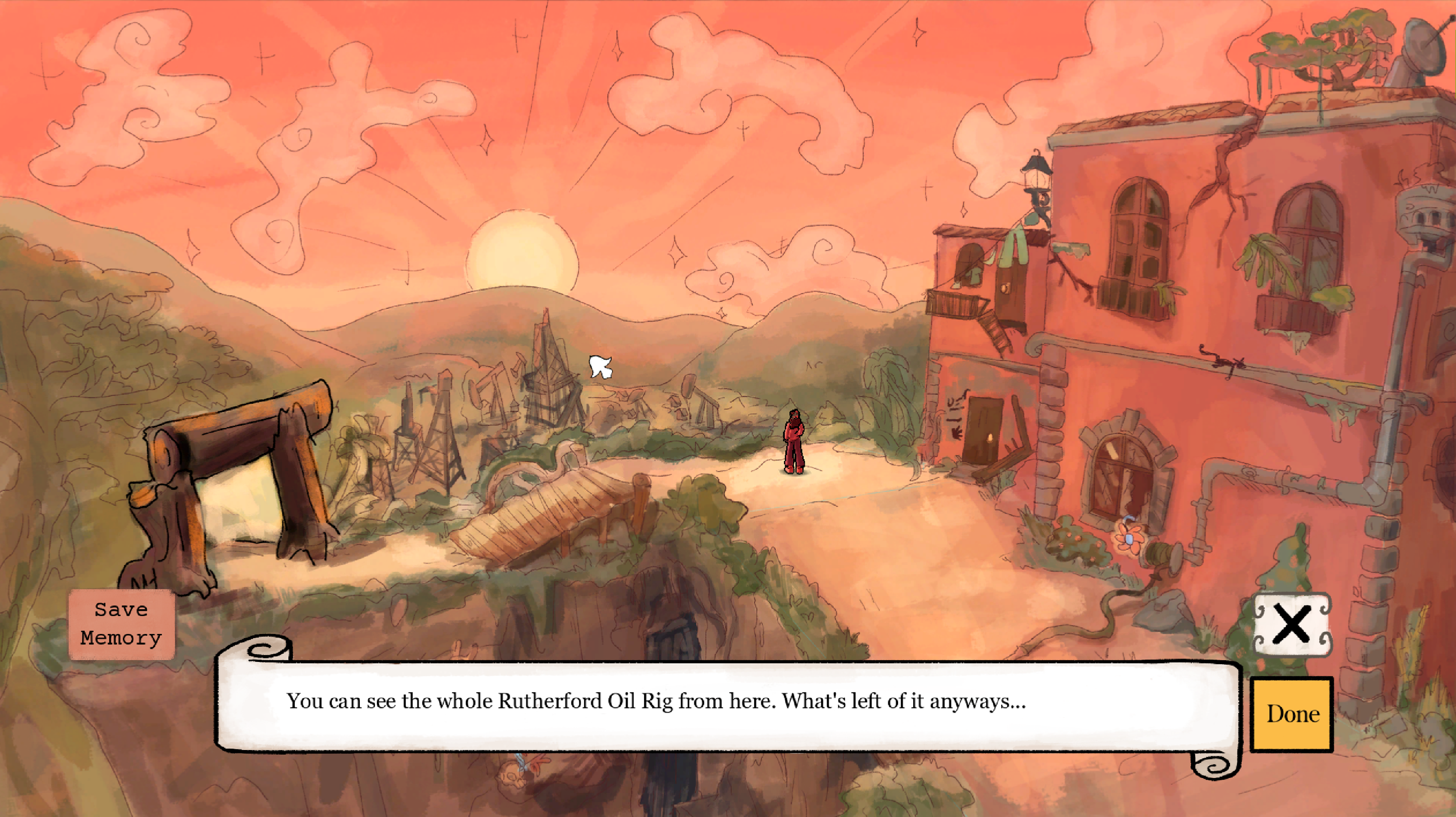
Image: Funeral for the Sun - Street
The journal opens to a massive grid that you can zoom in and out of. This is where the bulk of Funeral for the Sun's puzzle solving takes place. The moment you open the journal, any recently added character portraits will be waiting for you to drag them onto the grid. The whole aim is to eventually figure out their names and connections to the other townsfolk, so that you can understand what happened in Cerro Milagroso.
Once you have learned enough information to correctly enter a person's first and last names, you select the wonderfully drawn character portrait and choose your selections from a list of learned names. But that's just the start, as once you add more of the community to the journal, you'll use the journal's tools to apply connections, such as who's a couple, assign parents, or discover who has killed someone. It's a task that gets more and more complicated as you add a large cast of characters from different eras.
But this is given more depth due to the different time periods. As you'll eventually find younger and older character portraits of already named people. So, on top of finding connections, you must also combine character portraits to fully understand a character's role in every era. An incredibly rewarding and tactile gameplay loop, that slowly unravels the true mystery of the town.
The developer also understands that such an ambition mystery box of a narrative needs a way to store thoughts and theories. Thankfully, the journal has a place to type notes, save key dialogue exchanges, and a helpful map with fast-travel points.
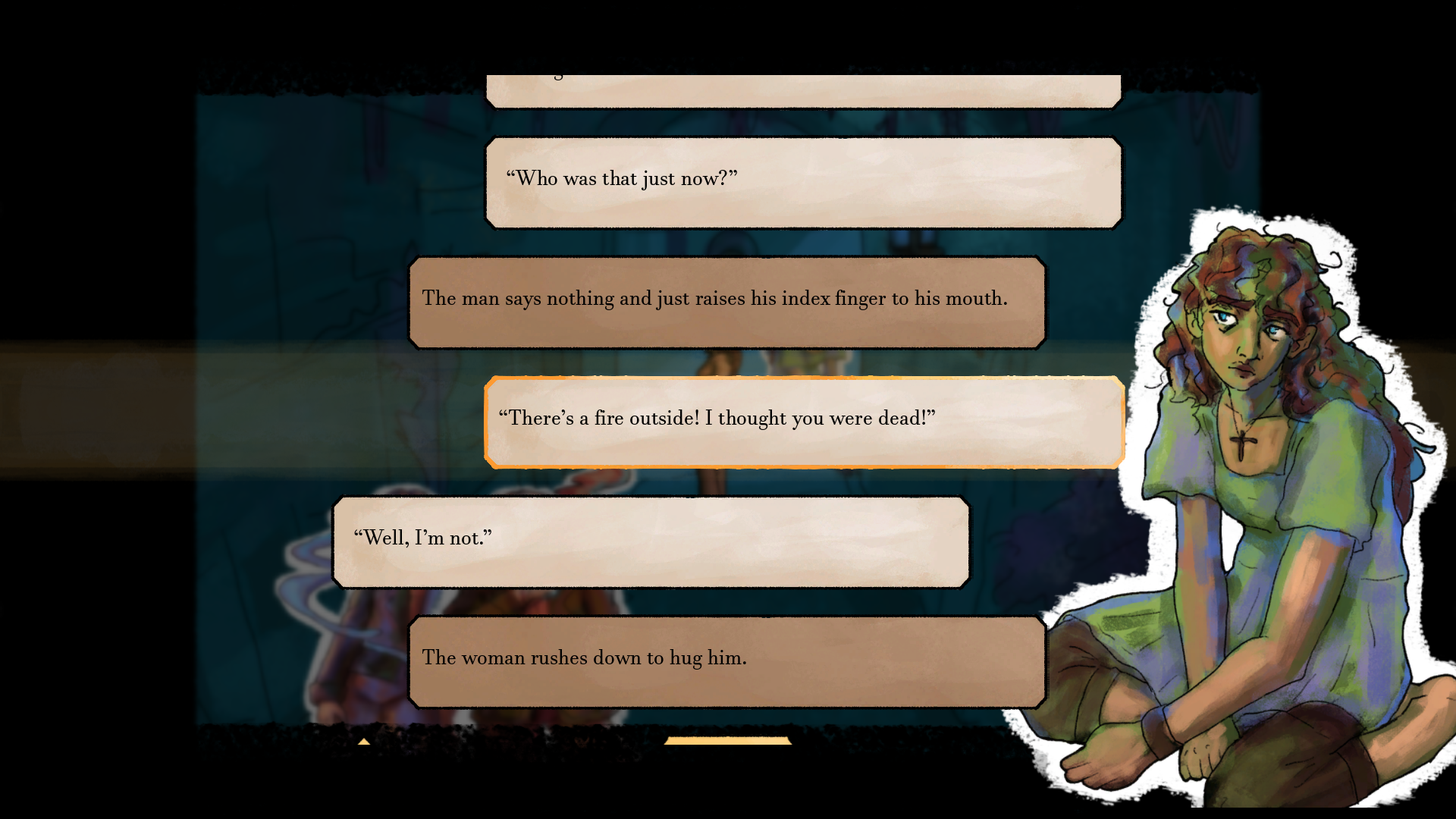
Image: Funeral for the Sun - Character Portrait
But from the very first scene in the town, all of this is propped up on a backbone of magical realism. You exhaust the regular points of interest, and turn your attention to the striking blue flower. A dreamy animation of Nayla's eyes blinks you to another time. The colour palette switches to a cooler tone, as remnants of memories now stand before her.
She watches two brothers discuss what another boy has done to the youngest sibling, as their Nanny shouts them from the end of the street. The dialogue is instantly sharp and insightful; characters are drawn with verve and unique personalities. A real skill when dialogue must serve the dual purpose of carefully supplying character details to balance the pace players solve the non-linear story. But the real talent is making the town feel like its own character.
Yet it was the painterly art style that first caught my eye. The minimalist 2D sketch style backgrounds that populate 3D levels give a dreamlike feel. While the odd background does feel underdone, the majority evoke an ethereal atmosphere, like floating through someone else's memories. The fixed camera angles only heighten the feeling that certain things shouldn't be in the town. But even the sparse colours have been carefully chosen to distinguish eras and emotional tones.
Nayla's character model is the only part of Funeral for the Sun that stands out as three-dimensional as she lingers on the spot unable to move, stuck in a small looping animation. As instead of having a fully traversable environment in a point-and-click fashion, Funeral for the Sun opts to have Nayla stand in one position while players select points on the screen.
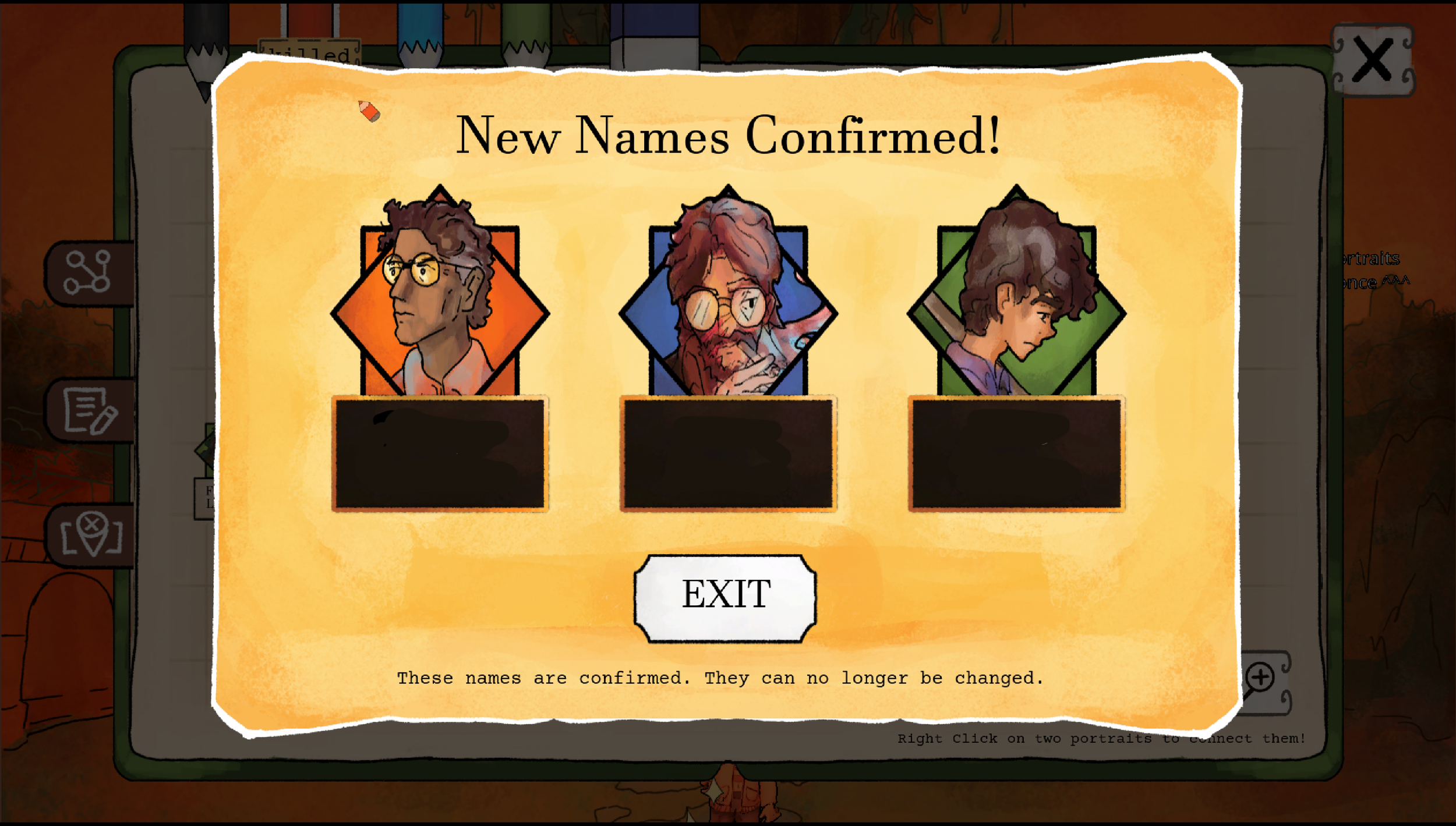
Image: Funeral for the Sun - Character Names
Away from the initial streets, you find a large hacienda and encounter a mysterious man fused inside a large tree. He's something ancient; a supernatural relic from a bygone time who cannot remember his past. However, like Nayla, he feels a pull to the blue flowers, and implores her to keep exploring the old memories to help him uncover his own and the truth of the town.
This establishes the crux of Funeral for the Sun's gameplay loop. The man in the tree will open up new areas of the town to explore and experience new flowers. Each time, there's a new checklist for the amount of names, set number of memories to experience, connections to make, and number of portraits to combine before you can return to him again and open new areas.
Each new place complicates the interconnected narrative web of the community through family feuds, adultery, premature deaths, forbidden love, political upheaval, and so much more. All while characters deal with personal struggles stemming from colonisation, xenophobia, transphobia, and moral quandaries. It sounds overwhelming, but in actuality, it's intelligently managed with good non-linear pacing.
There isn't any rush to solve anything. You can take your time evaluating every room. Absorb the information from the present day version of a location before seeing the memory. But it's the slow reveal of characters and information that makes everything manageable and fun. As by gating progress into areas, it keeps you engaged in the narrative while still offering a good challenge.
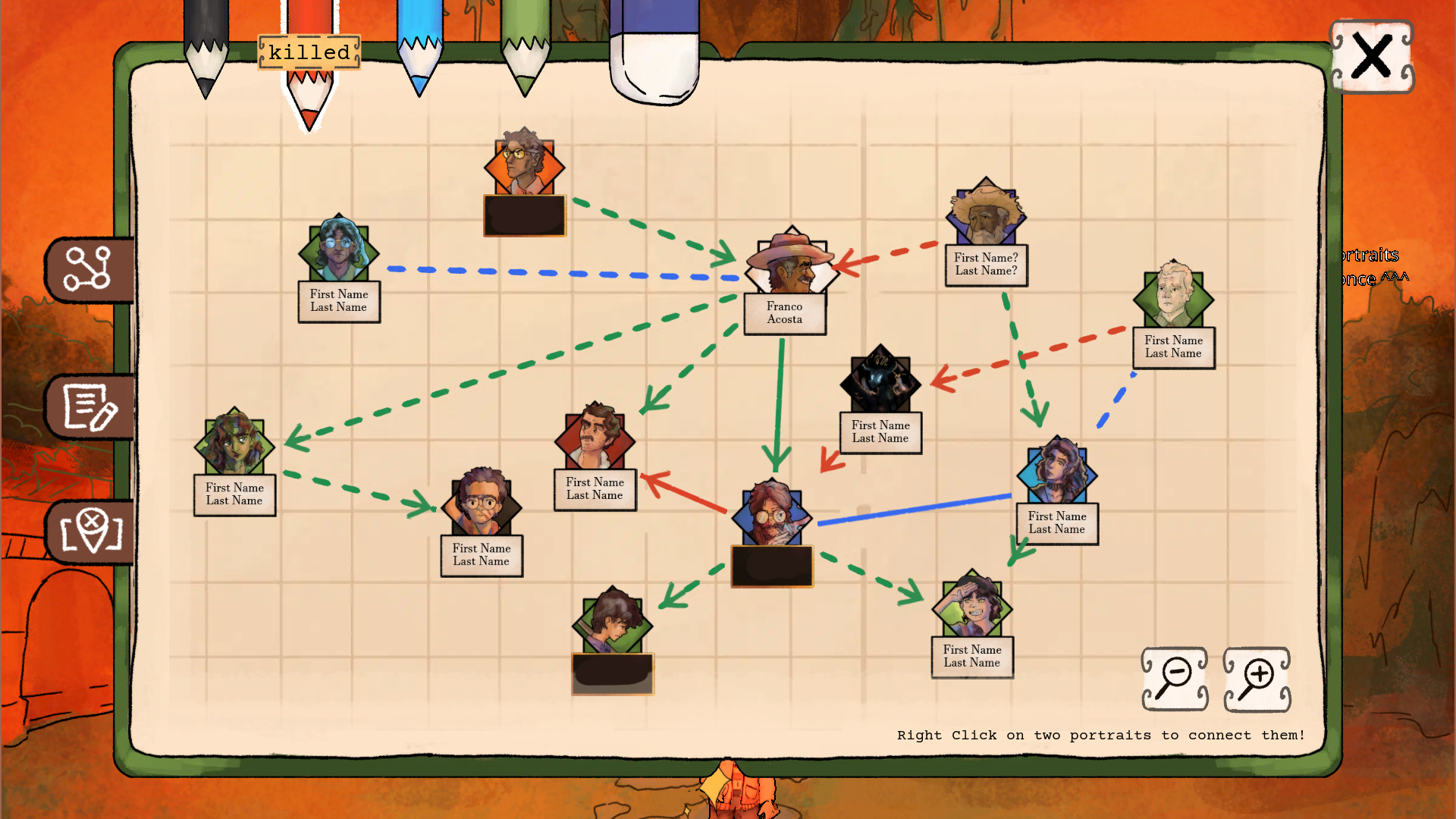
Image: Funeral for the Sun - Journal Grid
Similarly to The Roottrees Are Dead, you need to fill in three characters' names correctly before Funeral for the Sun will validate your answers. The same goes for each type of connection. That isn't to say that you can't fill in more than each restrictive area asks for. As sometimes you'll piece together more than you need. Much like the game as a whole, as you don't need to fully complete every connection and name to reach the end.
But none of this would be as impactful without its impressive narrative. As I believe that's Funeral for the Sun's megaton weapon. Characters feel authentic and vivid; motivated by life choices, social experiences, and world events. Some are morally grey, or even question their own principles and actions - a real mix of characters to love and despise. It's up to players to make judgements on what the characters believe to be the right decisions. Even with the supernatural elements, it still feels very grounded.
Although, it's truly impressive how the plot still knits together when it allows players to encounter different story beats at different times. Even being non-linear in segmented sections, it isn't easy to make discoveries feel earned and personal. But Funeral for the Sun successfully has you chip away at a mystery that feels bespoke to you in that moment.
But even a well told story will crumble without a satisfying conclusion. Thankfully, the story wraps up nicely. In no small part thanks to every seemingly small, inconsequential detail coming together to form the full linear story.
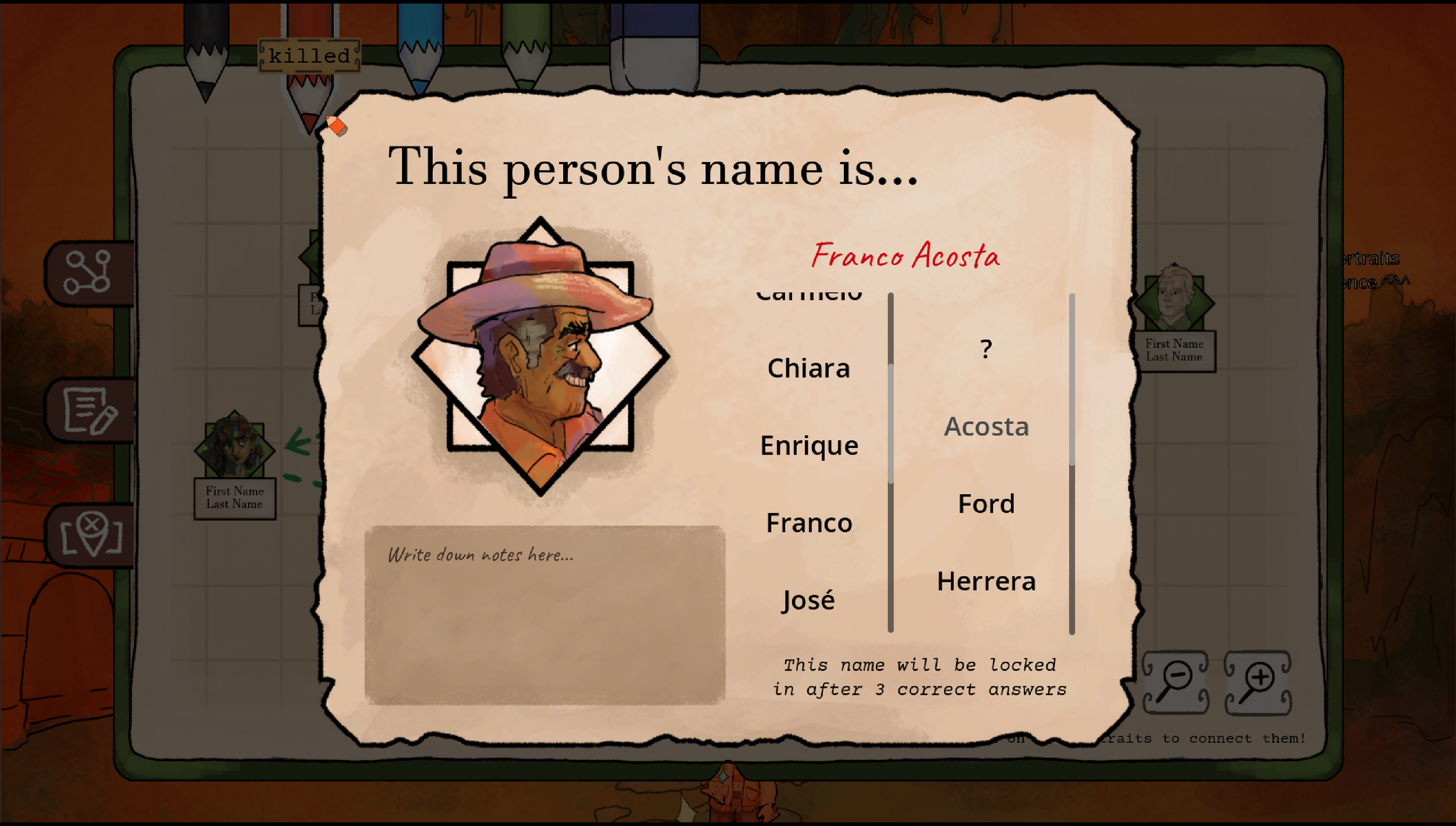
Image: Funeral for the Sun - Choosing Name
Yet it is how the town is personified through Nicolás Cid Delgado's infusion of magical realism and a deep knowledge of Latin American history that makes Cerro Milagroso a gaming location that I'll remember fondly. History pumps through its foundations: colonisation of indigenous communities and traditions, dictatorships and rebellions, and the drain of capitalism by foreign powers. Every detail threads the needle to create a narrative that sings on every level.
But the score by the developer's brother Alejandro Delgado helps revelatory moments land with poise, adding further personality to the expressive character portraits during conversations. Effortlessly cool guitar riffs establish both time period and tone. Each track knows when to loosen or tighten the knot of an emotional moment. While it could've benefitted from voiced performances, it's an understandable omission from a small indie title. Fortunately, the cohesion between gameplay mechanics and narrative do an excellent job on their own.
Despite this, Funeral for the Sun does have a few minor UI issues during puzzle solving in the journal. There were moments when the connections tool didn't operate as accurately as I'd hoped, and I sometimes found it hard to parse information with the amount of crossing connections.
The only other different element was when you needed to open a safe with a code in the early game. As a fan of both deduction and point-and-click games, a few more of these puzzles would've been a welcome addition.
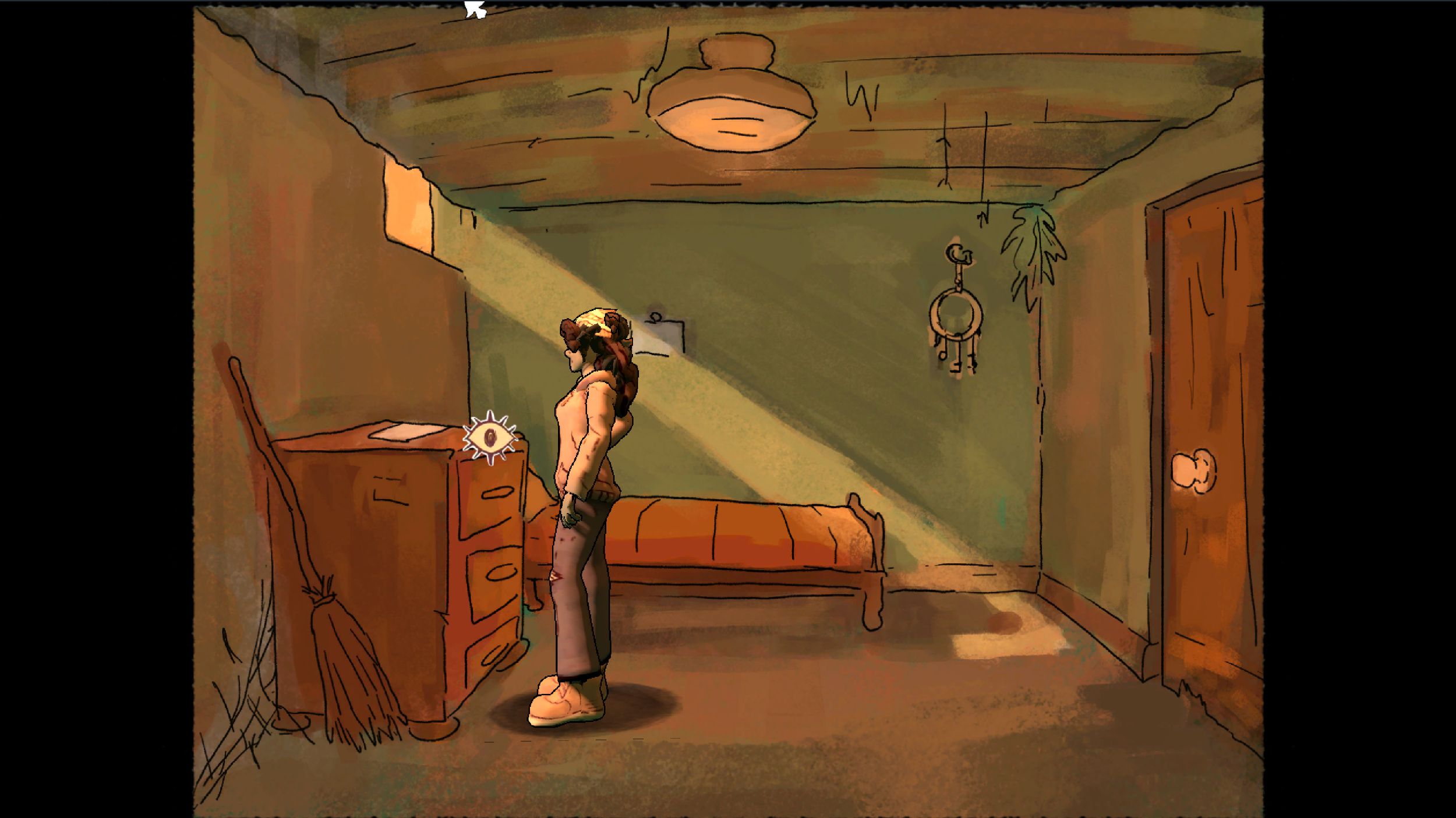
Image: Funeral for the Sun - Nayla
Nevertheless, Funeral for the Sun is a fantastic narrative deduction game. By successfully weaving together a deeply textured multi-generational story with rewarding puzzle solving, Nicolás Cid Delgado has made a debut video game with great confidence and quality. If you're a deduction fan, gamer, or a voracious absorber of stories, Funeral for the Sun is more than worth your time.
*Review Code Provided By Publisher
Image: Funeral for the Sun - Score - 9/10