Review - Dispatch
If someone unfamiliar with Dispatch saw a non-interactive cutscene, they'd find it hard not to mistake it for a television show, when the animation quality, although a different style, is on par with a high quality Amazon Prime show like Invincible. As an admirer of both unique superhero stories and animation techniques, and when combined with excellent writing that makes tonal shifts effortlessly, Dispatch has a lot going for it - it's no surprise Dispatch already surpassed one million sales in ten days.
Rightfully so, Ad Hoc Studio must be chuffed and relieved, considering its tumultuous history as a live-action Netflix show that fell through at the last minute. But after hearing it was going for a broader tone like The Office, I can't help but feel glad that we ended up with this version of Dispatch. Despite it's more mature tone, it's equally as special as The Walking Dead Season One and The Wolf Among Us, the few Telltale Games that broke through to the mainstream and received critical success.
Unsurprisingly, such a high level of quality comes from many ex-Telltale developers who worked on one of my favourite Telltale games, The Wolf Among Us, which is based on the brilliant, Eisner award-winning comic series Fables - a series I highly recommend. Although, their greatest achievement was telling a truly entertaining and genuinely funny story in the world of Borderlands, in Tales From the Borderlands. These experienced developers know how important a first impression is for an episodic release in a genre with stripped back gameplay, and for Dispatch, it's worked, for good reason. So, let's discuss how Ad Hoc have done it.
In Dispatch, you're put in the shoes of Robert Robertson. The latest in his lineage to hold the mantle of Mecha Man: a normal human without powers that uses a mech suit to protect the streets of Los Angeles. He pilots a bulkier Iron Man type suit, without the genius level intellect, but enough snark, level-headedness and wit to compensate. But when Robert fails to avenge his father's murder at the hands of the villain, Shroud, and his suit is broken, he's forced to accept a position at the private firm, SDN: the superhero dispatching network, as a superhero dispatcher. Robert accepts the role to mentor a rogues gallery of reformed villains called Z Team, and in return, his new boss, Blonde Blazer, promises to repair his mech to get him back in action. But I won't say anything more of the story beyond the general premise.
One of the strengths of the original Telltale Games releases was their ability to tell a strong episodic story. But as time went on, and more and more projects were being made simultaneously, for many reasons, the episodic structure brought delays and strain on the games, and unfortunately, on the staff. So when Ad Hoc announced their episodic plans, after recent games like the last two Life Is Strange games abandoned the format, I was slightly concerned. But I had no need to be. Ad Hoc had clearly already completed the game, choosing a two episodes a week release schedule to keep Dispatch in the internet Zeitgeist with discussion of cliffhangers, unresolved story threads and romance options. All perfect things for fans to discuss on social media. It's the old water cooler formula that used to let each weekly episode of television ruminate and digest before the next one, but fine-tuned in the age of internet communities.
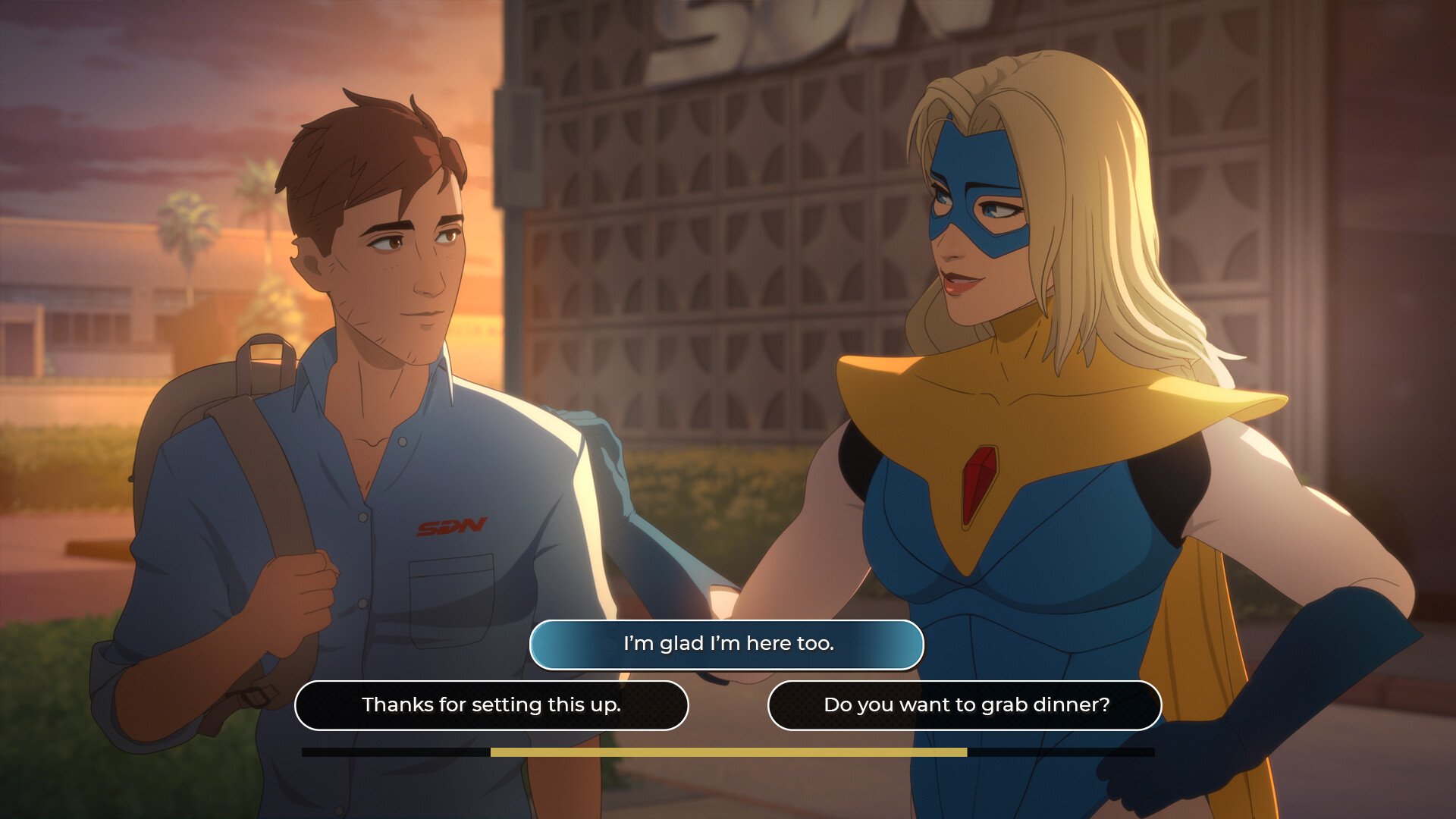
Image: Dispatch - Blonde Blazer - Ad Hoc Studio
Yet, none of this would've worked without Ad Hoc's talented writing team. No detail is too small. Every member of Robert's Z Team has their own interesting lore tidbits accessible in the menu of the dispatch sequences and information is sprinkled into sharply written dialogue during these dispatch missions. Also, some character details change or stay hidden depending on story choices you make or team members you partner together. It makes Z Team feel like an evolving squad, even if some get less screen time.
But it's the main characters where the writing in Dispatch truly shines. Robert Robertson is shown as a confident but raw and vulnerable man, dealing with the trauma of losing his father who was emotionally distant; then combine with being forced to face who he is without his mech suit, and he's a very layered protagonist. But what characterises Robert further, is his relationship with an old family friend, an elderly looking man called Chase - a former superhero with a foul-mouth and a morbid, self-depricating sense of humour about his inability to be a hero, with a heart of gold that yearns to help people again, especially Robert.
The other two key characters are Blonde Blazer, a Supergirl type hero who is Robert's boss, and Invisigirl, a rebellious former villain that can turn invisible, who's been hurt by life, but deep down wants to do good things. Both characters feel nuanced with realistic motives. On the surface, Blonde Blazer is the atypical perfect hero, but off the clock, she gets worried and stressed and drinks hard alcohol just to try to feel something. Whereas, Invisigirl is a blunt talking, lonely woman who pushes the world away; suspicious of anyone that wants to help her. Both develop their bonds with Robert naturally, which leads to one of the many difficult, story altering decisions in the earlier episodes.
It can't be overlooked how challenging it is for a writer to compose branching storylines that all give a player the illusion of choice and the impression theirs is a unique story that's the only one that's supposed to exist. To complete a narrative web where every important decision leads to an equal quality experience is all that matters. As we've seen with games in the past, when it goes wrong, it splits opinion. But when it goes well, it can ignore a passionate fanbase and leave them eager for more.
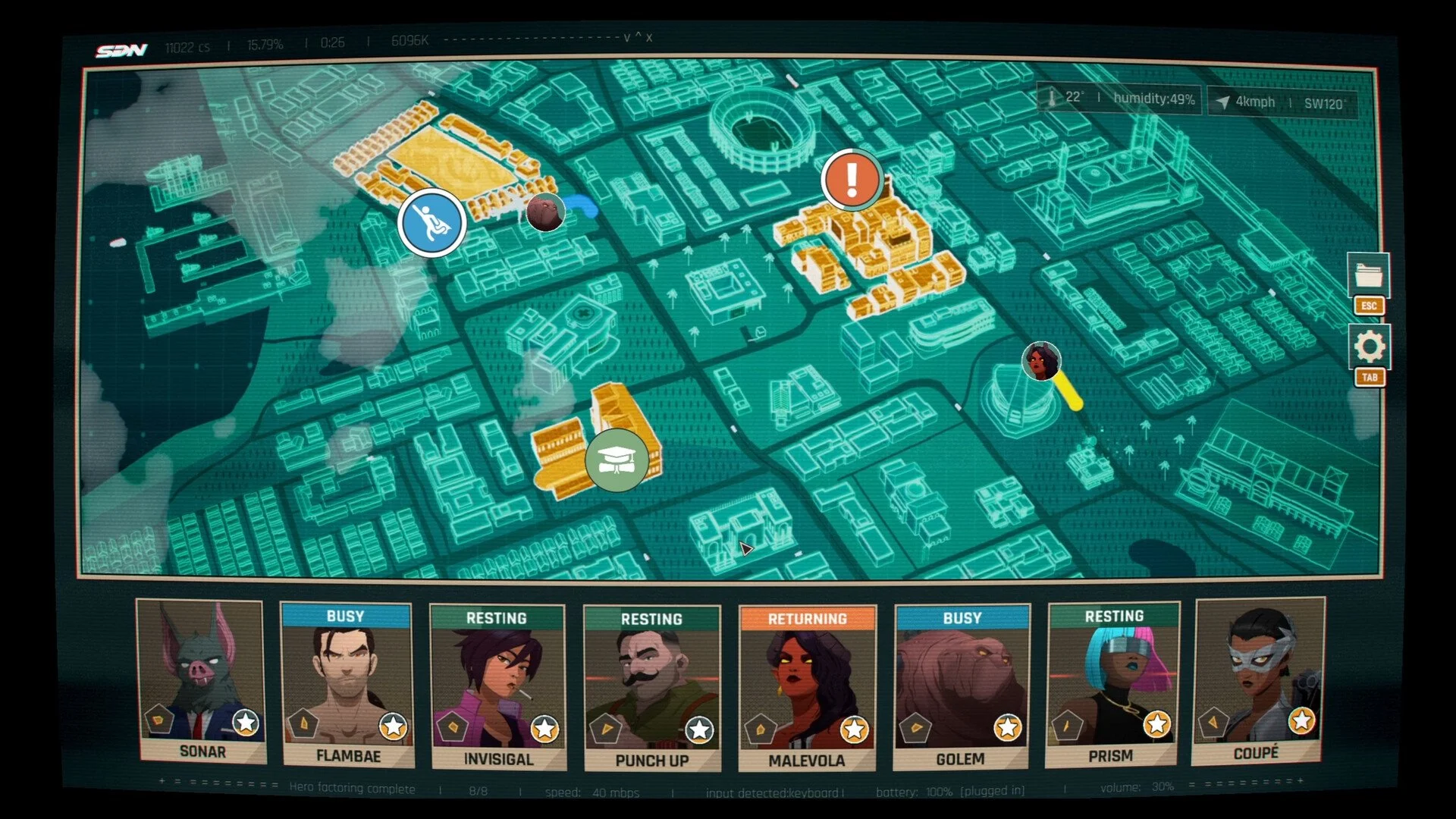
Image: Dispatch - Map - Ad Hoc Studio
Overall, I believe Dispatch works because the story hook is so strong. The idea of following the story of a superhero dispatcher is a great idea that fits almost every storytelling medium. I would still be interested in seeing an animated or live-action extension of the show, or even an expanded version of the strategy game inside Dispatch, which I'll explore shortly. But in the game, everything just works. The story feels perfectly paced at around an hour or under per episode, which is shorter than most episodic video games, but in line with many a television show. Each episode is long enough to be fulfilling and short enough to urge you to continue onto the next episode, which compliments the two episode a week release schedule.
But the most important part needed to make the story all come together is the performances. Protagonist Robert Robertson is voiced by actor Aaron Paul of Breaking Bad and Westworld fame - a very talented actor that brings gravitas to the role, switching between confident banter to vulnerable emotional intensity with ease. Being no stranger to voice work with his role in BoJack Horseman, Aaron Paul disappears within Robert Robertson so that you totally believe the character and his motives.
This strong performance is matched by both Erin Yvette as top superhero Blonde Blazer and Laura Bailey as the sharp-tongued, ex-villain turned wannabe hero. You might recognise Erin Yvette's voice from The Wolf Among Us, where she brilliantly played Snow White. Whereas, Laura Bailey, another phenomenal actor, has had many high profile roles in the likes of The Last of Us Part 2 and Infamous, plus her work at Critical Role. She never fails to give a pitch perfect performance, whether voice acted or a complete motion performance. One day I do hope that she gets given the chance to do more live action work too.
But another standout is from one of the most famous names amongst the case, Jeffrey Wright. He plays an older man called Chase that works with Robert at the SDN and has a shared history with his family. It's a banter filled relationship where Jeffrey Wright interjects with frequent fiery but kind-hearted swear filled rants. The character is just another in a long line that makes the world feel bigger and better.
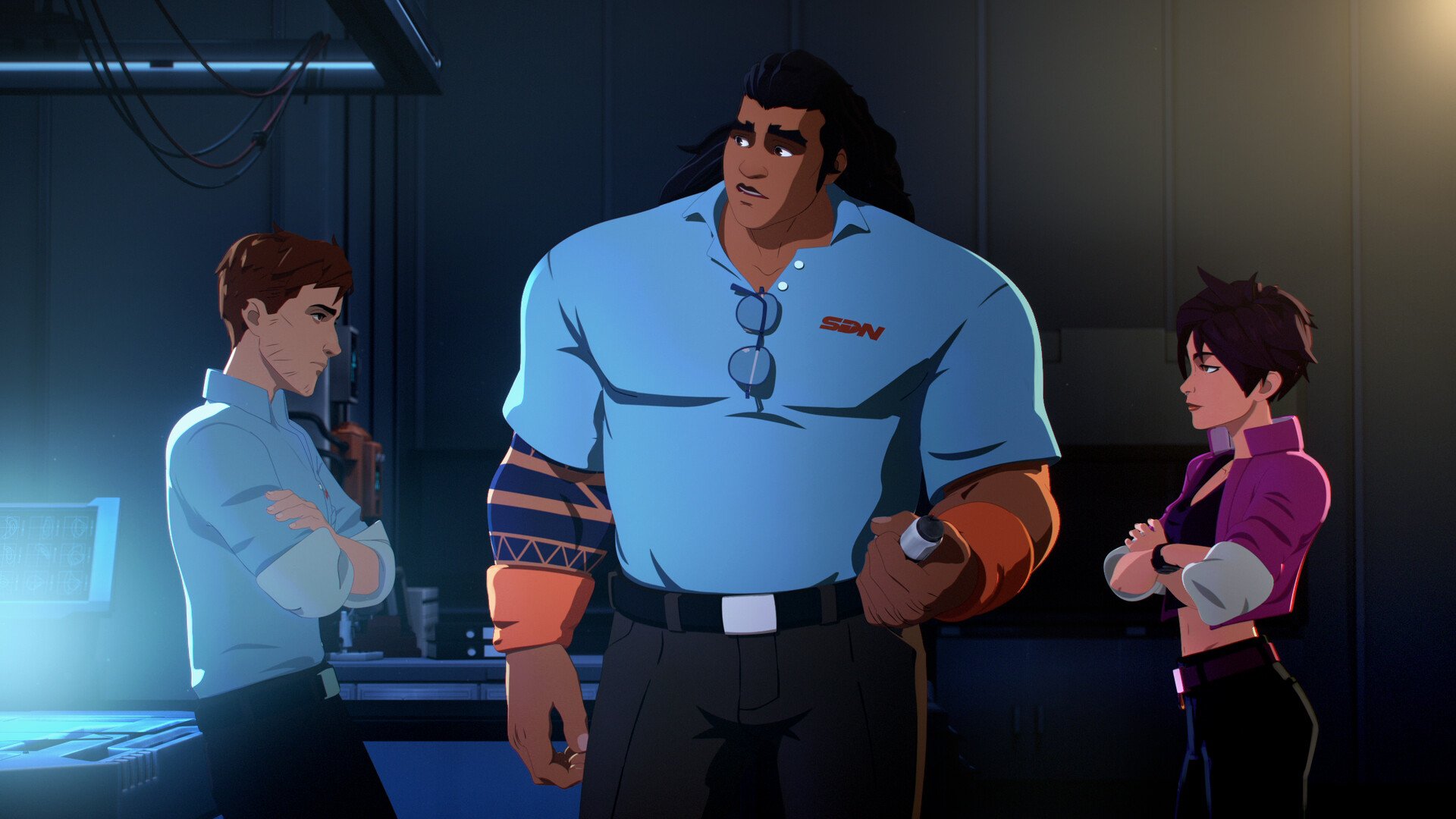
Image: Dispatch - Invisigirl - Ad Hoc Studio
Pretty much every character from the main cast is well drawn, even each member of the Z Team is brought to life by a mixture of experienced voice actors and surprisingly, content creators. I wasn't surprised or concerned when I saw Alanah Pearce in the cast, the writer and content creator and now actor, as she has already shown her acting ability in the film V/H/S Beyond and a few games as well. Whereas, I wasn't sure if JackSepticEye or MoistCritikal would stand out. Thankfully, my worries were for nothing and instantly each actor felt at home as their characters. You couldn't ask for more. And for animal lovers, Richard has a small dog named Beef that appears in multiple scenes throughout the season.
However, Dispatch is still a video game with a variety of gameplay. At the beginning, there is an option to choose between a cinematic or interactive mode. The cinematic mode allows you to watch the cutscenes without touching the controller, and the interactive mode requires you to complete quick time events - button prompts - when they appear on the screen, which gives the chance of failure, to alter some scenes. The inclusion of the cinematic mode is interesting when you consider the biggest departure from old Telltale game design: the removal of all level investigation and exploration. In an alternate world where Dispatch was made by Telltale Games, exploration sequences would put the pace in the player's hands as Robert explored the office and talked to colleagues. Sometimes this worked in The Walking Dead games by Telltale, but other times it felt like filler to overload exposition or move an item from one area to another. These segments always felt like a natural leftover from the traditional point and click games that I enjoy, and that inspired Telltale. But clearly, Ad Hoc made strong creative decisions in removing exploration to benefit their vision of film quality directing, camera work and animation. Still, the other narrative game types exist and now we have Ad Hoc's take on the interactive narrative genre. But without exploration, this meant Ad Hoc needed to invent a replacement gameplay mechanics, and it's a fun one.
Ad Hoc replaced player controlled exploration with a fun strategy game with light RPG elements. This begins when Robert begins a shift at SDN and sits at his computer. You're tasked with dispatching Z Team when crime alerts come into the system. Fundamentally, these sections last between 10 and 20 minutes per episode, while Robert allocates team members to stop or prevent crimes. Each crime is different and requires a team member that has the skills necessary to be successful. All heroes have a visual pentagon to show the amount of points in the five skill sets: combat, vigor, mobility, charisma and intellect. Each mission gives vague hints that nudge you into making the right hero selection based on their skills. Narratively, Team Z all have the start skills you'd expect based on their powers: like Invisigirl has great base mobility due to her invisible powers, Punch Up has good combat due to his strength and prepentacy to punch groins, and Prism has good charisma from being a singer. But sometimes missions require you to combine heroes so the pentagon of skills grows greater and covers the skill sets needed to be successful - the more heroes you use, the more the pentagon is filled and the more likely you are to succeed. But the further the season goes, the more you've leveled up each hero to your liking, and when you think you've got heroes capable of solving crimes on their own or in a set duo, they add in bonus objectives or minimise points of the pentagon that if covered means an immediate failure. This keeps the strategy dispatching game evolving throughout the whole season.
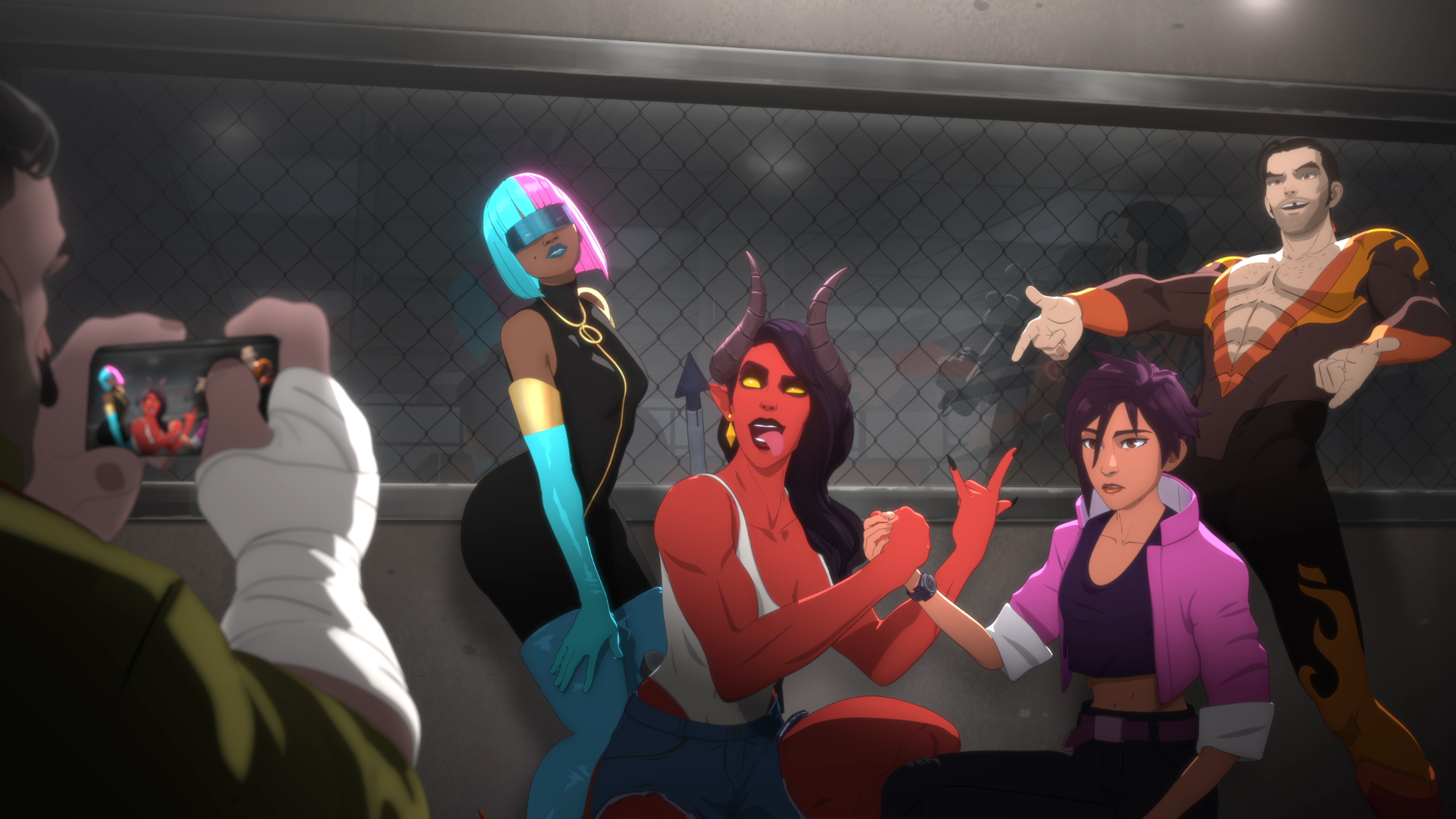
Image: Dispatch - Z Team - Ad Hoc Studio
The later episodes increases the amount of crimes coming in, and really builds up the tension when making decisions of who to send out. It replicates the tension of what a real dispatching job would bring. Luckily, if you make mistakes and you're team members get injured or need a rest, you can unlock abilities for Robert to use to fix this during the strategy sections. Along with Robert levelling up and Team Z leveling the pentagon of skills, heroes can go for training with Blonde Blazer to add perks, like gaining skill points when partnering with certain heroes.
The final major element within the strategy game is Robert's hacking skills. At certain times, missions will get disrupted and you will be asked to pick a solution that's judged on a heroes skill level, or Robert will be given the option to hack. These hacking mini games are like grid based puzzles where you locate passwords to reach the end. However, these grow in complexity over the season, developing into urgent sequenced where you must find an electrical source to defeat the defence system trying to kill you. On its own, the hacking mini game is fine, but when combined with all of what the dispatching strategy game has to offer, it's a solid part of the overall experience. It has an addictive quality to become a solid enough strategy RPG, that I'd like to see as an expanded full game in the future. As every time the section ended, I wanted to do a little bit more. But like everything else, it's all in service of being additive to the story.
I also have to praise the original score, as Dispatch's theme brings a fun, catchy beat that sets the scene when Richard arrives for a day at the dispatch offices, to reinforce the theme of the workplace comedy. Then, Ad Hoc cleverly uses licensed music at key moments to backdrop emotional scenes and stylish set pieces. One of my favourite songs was the remix of the band Future Islands. But these songs, along with nudity, can be turned off to make it safe for streamers.
Another smart move Ad Hoc made was collaborating with Critical Role on brand awareness by doing a table top one shot on YouTube, set in the Dispatch world and intent on doing other things related to tabletop and animation in the near future. They also have a deal to make an interactive narrative game like Dispatch in Critical Roles own fantasy world. This partnership came about when Travis Willingham CEO of Critical Role and talented voice actor got an audition for Dispatch and like everyone else, saw the animation and wanted to do something with Ad Hoc.
Now that the season is over, I can confidently say Dispatch stands as one of the best interactive narrative video games I've ever played. Building a layered cast of characters in the fun Z Team, and an evolving story over eight episodes that touches on dark comedy, romance and drama. Ad Hoc Studio manages to narrow down a unique hook in the oversaturated superhero genre and make it feel new and interesting - an IP that has the potential to be known beyond gamers.
Even if they hadn't nailed the ending, I would still recommend Dispatch to anyone that loves television shows or superhero comics. However, in my view, the ending was satisfying and I hope we get to return to the world of Dispatch soon. But beyond Dispatch, I can't wait to see what Ad Hoc Studio creates for Critical Role and whatever other games they make in the future.
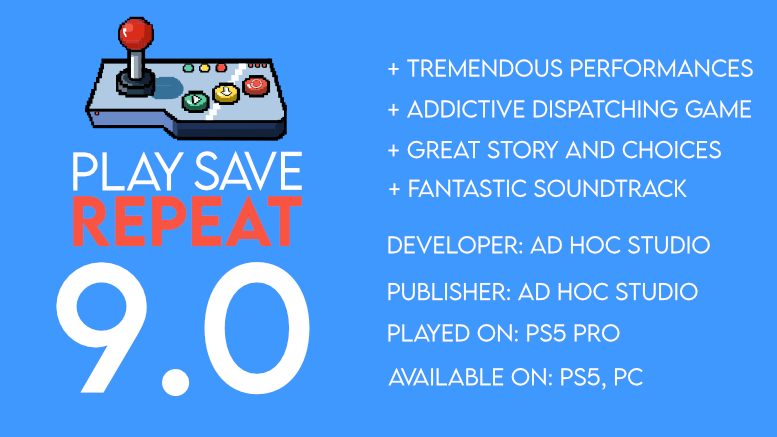
Image: Dispatch Review Score - 9.0/10 - Ad Hoc Studio