Review - The Berlin Apartment
All homes are private places - away from watching eyes - where we forge most of our memories. The Berlin Apartment inverts this notion of privacy by asking the question, what have the walls seen over the last century? Allowing us to embody the past tenants of one apartment and live through their memories.
The Berlin Apartment is another narrative-driven exploration game, like What Remains of Edith Finch? But this time, the developers intend to deliver the opportunity to play out an intimate and poignant story in different time periods, using a plethora of gameplay mechanics and storytelling techniques.
So, let's see if the game successfully brings Berlin's history to life, or sinks under the weight of its creative vision.
Set in 2020, The Berlin Apartment begins with Malik, father to his daughter, Dilara, during the uncertain backdrop of the COVID pandemic. Every school is closed, forcing Malik to take Dilara on his most recent job, to renovate an apartment in Berlin - an old building full of history. As Dilara, players explore the apartment in the early stages of remodeling. Getting the lay of the land from the window, admiring the street below and clock tower that shows the real-world time. Before conversing with her father as she locates interactive objects.
Eventually, Dilara finds a hidden letter from a previous occupant, so her inquisitive mind urges her to ask her father to tell her about it. He gladly feeds her curiosity with a story. These flashbacks transport the player back to pivotal moments over the previous century, to experience the memories of past occupants of the apartment.
Originally from the gaming division of the company btf, and now a separate entity called Blue Backpack Games, the German based development studio has used their perspective and knowledge to make an important video game and a piece of art with historical significance. The clever story hook to focus on one apartment through time, allowed the development team to focus on pivotal moments from German history.
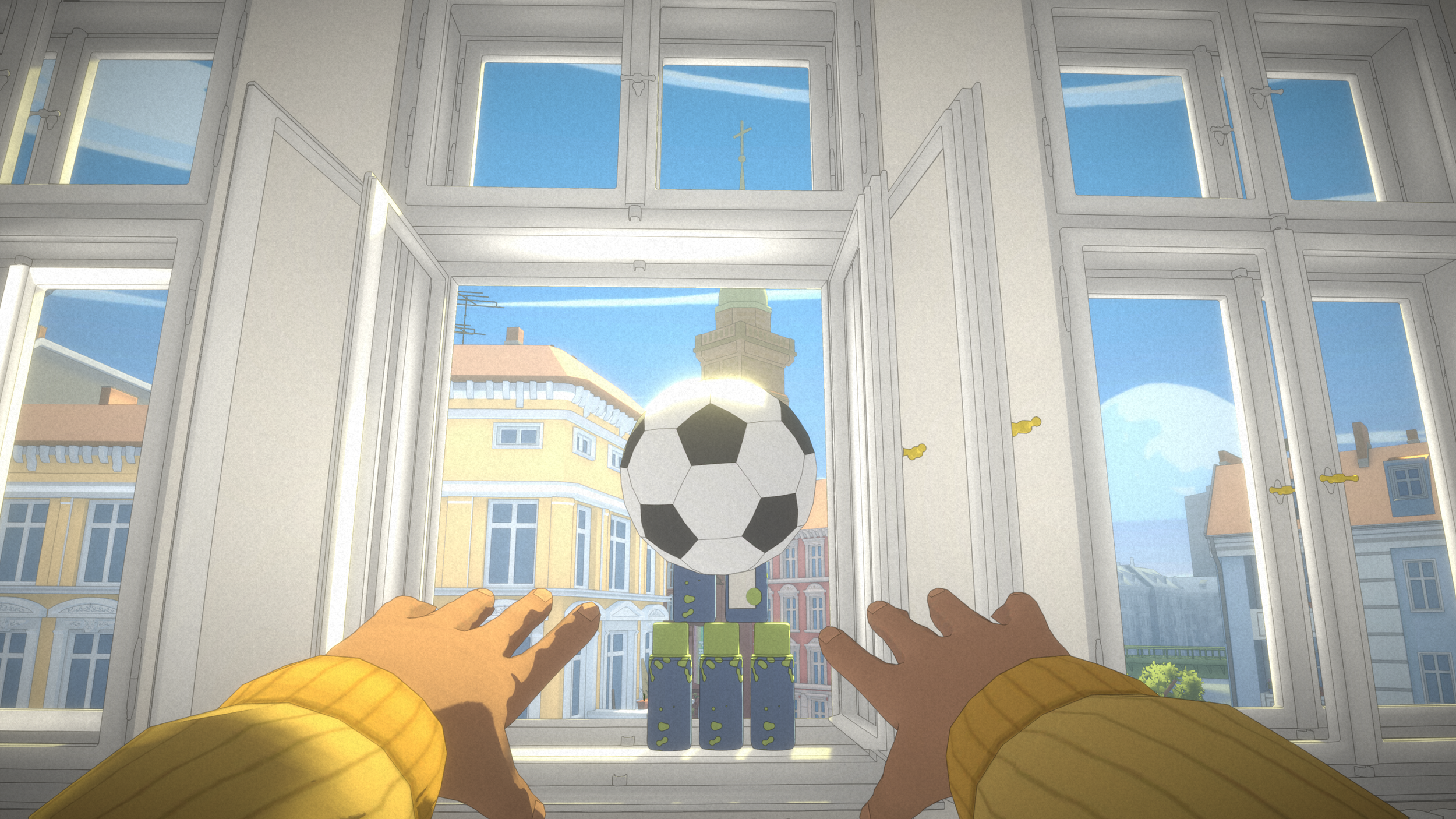
Image: The Berlin Apartment - Football - Blue Back Pack
As a story-rich video game, the structure is reminiscent of What Remains of Edith Finch? Where each section is from a different perspective and examines their personal life experience. Sharing unique perspectives of unfamiliar hardships and emotional challenges unique to a different time and situation. What makes The Berlin Apartment so powerful and endearing is because the stories use real historical events. You feel transported to a specific time and place, not just to inform, but to make you feel. The developers don't judge the characters, but instead, make them feel layered and real - human. Flashbacks visit the time around the Reichstag Fire, post-WW2, and socialist East Germany. A true dichotomy of a century of political and social systems.
What The Berlin Apartment does best is it doesn't shy away from the hard subjects. It acknowledges them in a way that real people would've at the time. Empathy is shown for the people who lived in each era. Something that is best shown in the present day sections, when Malik attempts to create normality in an uncertain pandemic stricken world, by letting Dilara draw on the walls before he finishes renovating them. Something the world could do with more of.
Being a narrative focused video game, I will only mention a small detail from the first flashback and I'll keep the specifics of the rest to a minimum.
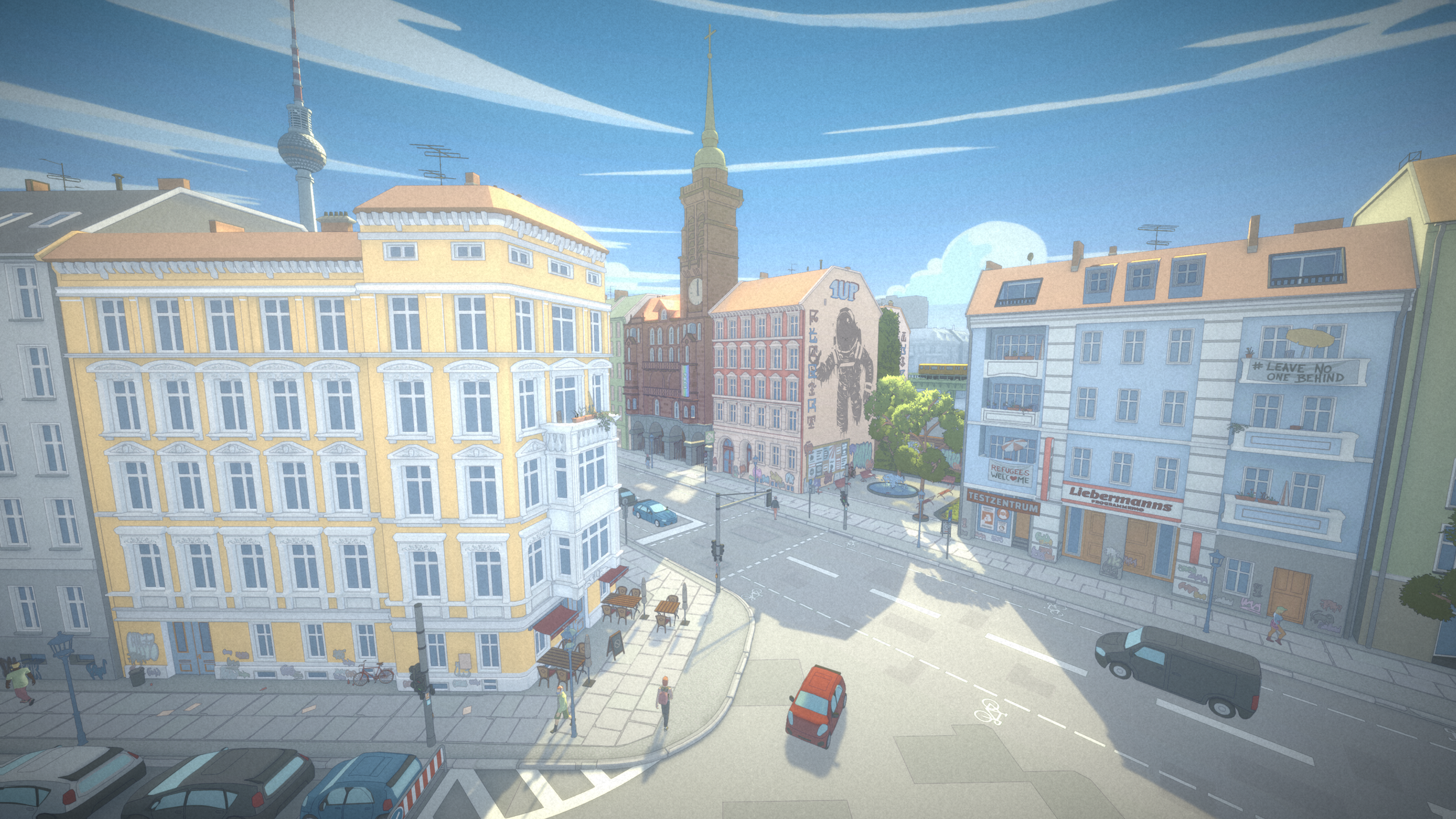
Image@ The Berlin Apartment - Window - Blue Back Pack
One way the apartment feels distinct in each era is because of the solid writing. Each flashback has a well-defined and unique playable character: one suffering from pangs of loneliness, others unfathomable injustices and incomparable guilt. But even in the darkness, hope and empathy shine through - from a yearning to understand different perspectives. The narration from young and old, goes between all junctures of the human experience: showing kindness, sincerity, confusion, vulnerability and optimism.
But it's Malik and Dilara's relationship that works as the heart of the story. Despite it's sweet, endearing nature, that can sometimes verge on saccharine, it never feels sickly or totally overdone. It's always personal and well-intentioned - an example of a parent's prepentacy to protect and teach. To let Dilara inherit his knowledge through truth and lessons in his stories, and view the history of the city they live in - a city that has endured and changed. So that another generation doesn't forget the past. To not sit silent without questioning things.
Also, I'd be remiss if I didn't mention the writing on parody posters, objects and letters; each nicely presented and some translated from German to English in an overlay. Some of my favourite writing was in the letters between neighbours across the Berlin Wall. Living under drastically different political regimes, they find common ground in the most human of things: small talk over bad food and a shared dislike of extreme authority. Everything feels timely and is lovingly crafted.
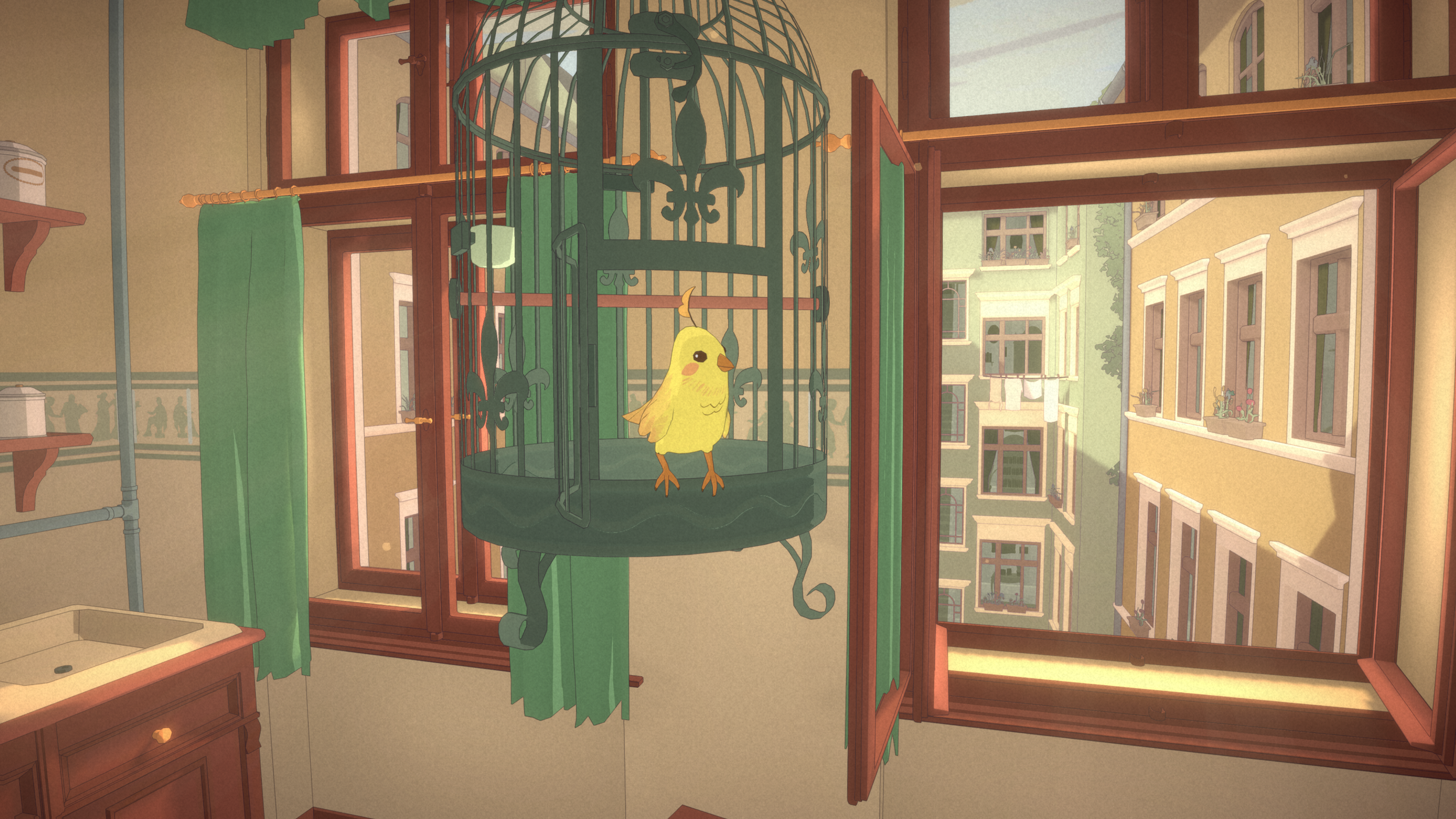
Image: The Berlin Apartment - Bird - Blue Back Pack
Although, the writing is the story and writing is the heart of The Berlin Apartment, it's the vocal performances that breathe life into each moment. From the moment we meet Dilara, her inquisitive and sweet sensibilities endear you to whatever her curiosity takes an interest in. A delicate performance of childhood innocent intrigue, even questioning the darkest of subjects. From the moment she finds the letter into the first flashback, she acts as our conduit to get the hard answers from different perspectives.
The playable characters vary massively in age and class, impacting their perspectives and understanding of events, and influences how they talk to others. One of my favourite parts is when you play as a child, asking their parent difficult questions in a post-WW2 Berlin. The developers made this a particularly heartfelt moment by allowing the player to choose the questions. Each set of questions get harder for the parent, but the child doesn't understand why. She just knows that something very bad has happened, and she doesn't know if she's a good or bad person. All of the flashbacks carry this undertone of uncertainty as to why these things are happening to them. It's a sad but honest look at important parts of Germany's history. It all makes you consider how even in this single apartment, the ghosts and memories linger forever in the walls. But as there was a past, it reminds us, that there's also the bright potential of the future.
The Berlin Apartment is also fully voiced in native German which sounded good from what I could tell. Both vocal options complimented the gentle ambience and melodies of each section. The score can sound subtle but ebbs and flows and builds when the story needs it to.
Outside of the solid acting, the striking visual presentation is what got me to first take notice of The Berlin Apartment. Right from the initial trailer, I was impressed by the mixture of distinct colour palettes, from pastel, monochrome, to bright tones, that colour in the sharp and defined line work. The perfect backdrop to the lovingly animated character models. Each character is in cartoon style that matches the rest of the art. Even though you only see a few full character models, you can look down and see your current playable character's body. Each has their own height and walk. Such immersive attention to detail is rare, especially in a smaller scale game like this.
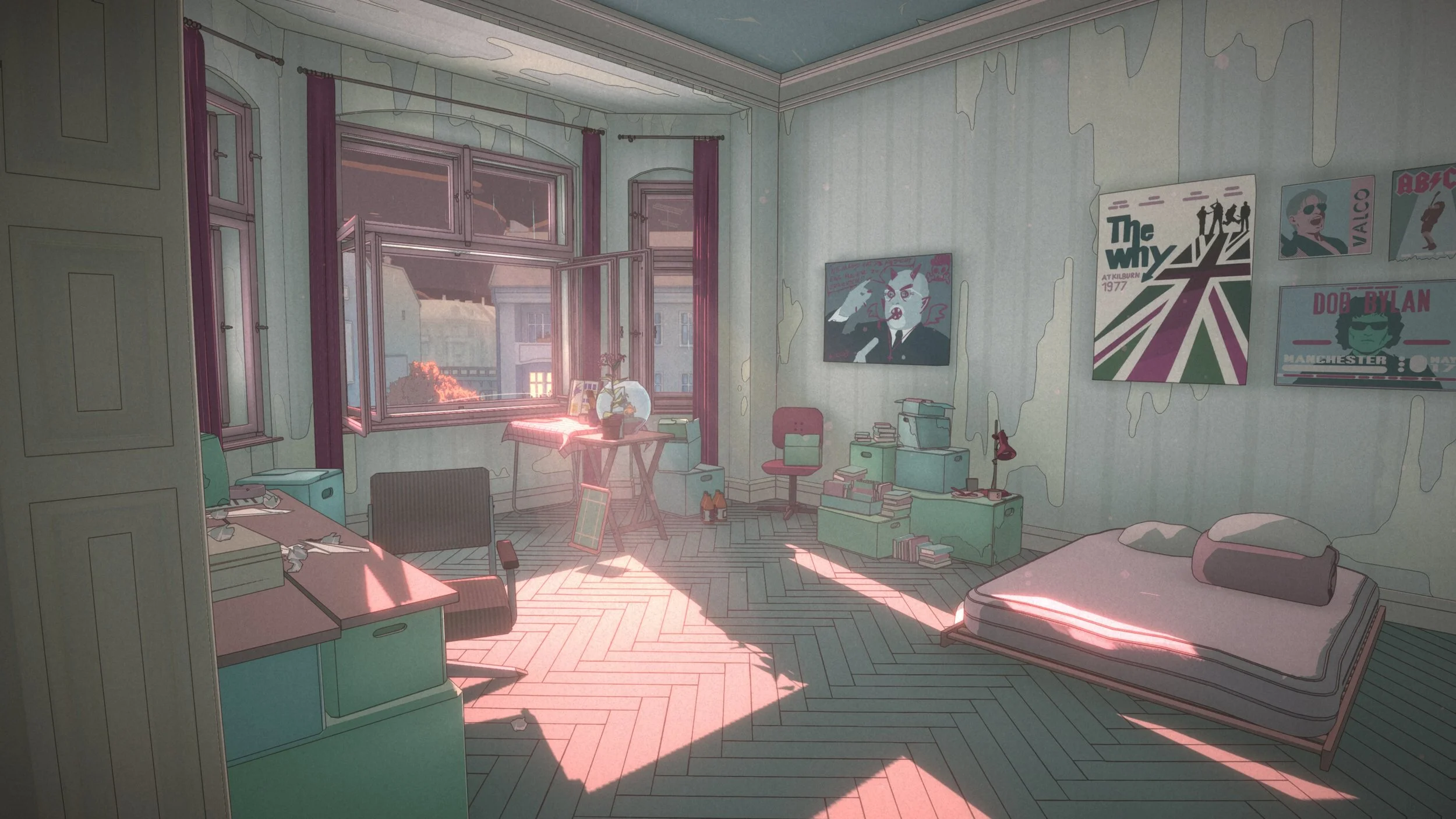
Image: The Berlin Apartment - Who - Blue Back Pack
Clearly immense effort was put into establishing each flashback with visual style changes that help set the era and tone of story, or characterise a person's decor tastes and class. They use colour or lack of, to effectively illicit emotions, like the gloom of a troubled city. Whereas another apartment is cluttered with expensive belongings from a life well lived. But although the apartment itself stays standing, the outside world never stops changing.
Despite the well-written and auditory narrative design, every video game needs solid gameplay mechanics that further the intent of the game. The Berlin Apartment's core gameplay mechanic is to explore the apartment in each of the different eras, interacting with characters and objects in the environment. Each interaction gives extra narration core to the story or to the environment outside of the apartment.
Although, most flashbacks start with a small interactive cutscenes where you push the joystick or drag the mouse in a particular direction or hold the left mouse button or a controller button to perform an action. More often than not, these mimic an action like moving limbs or going through the stages of cooking, from firing up the oven to choosing the right herb. Small, approachable interactions that can appeal to a broad audience interested in the history and story being told here.
Obviously, these mini game style mechanics won't appeal to everyone. There was the odd moment where I found an action on the verge of tedious from being repeated too much, but it's the overall experience that kept me going. As these tasks are narrated over with character and story details that turn the mundane into interesting and purposeful moments. They help to bring a character to life. Take the first flashback sequence: a lonely man lives in the apartment on the socialist side of the Berlin Wall, inside his apartment, a prisoner to a compulsory routine and standards; outside trapped by a literal wall. He converses with another character and muses his ideas whilst cooking, which brings meaning to the mundane whilst subtly teaching about the sociopolitics of the world and emotional state of the character. Until a message reaches his window, and the idea of there being more to life beyond East Germany fills him with hope.
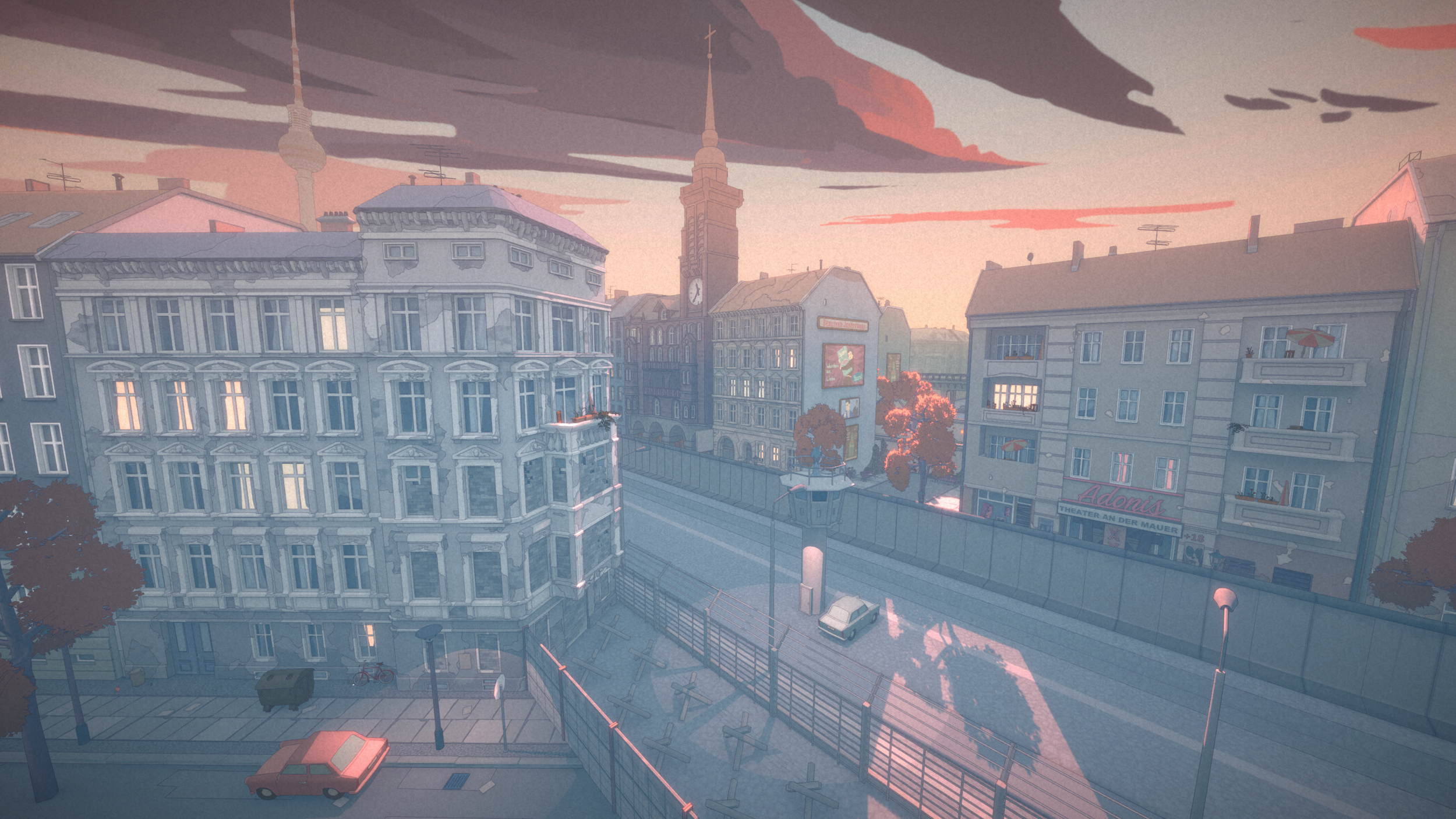
Image: The Berlin Apartment - Wall - Blue Back Pack
The Berlin Apartment is full of introspective and emotional stories like these about people who had to live during the most challenging of times. This is where the gameplay is so meaningful. Each story, like the COVID pandemic, highlights the human need to connect, even in the worst of times. Something seemingly inconsequential to the character, like choosing the correct paper aeroplane to impress a stranger can feel like the biggest decision in the world.
During my 4-5 hour playthrough, I only encountered a handful of minor visual glitches that didn't impact my experience, and the game performed at a smooth frame rate on PC. But beyond the few overused repetitive tasks, every facet of game design has come together in a focused singular vision that sings loudly in every level, even if the interaction with these elements isn't as strong as it could be. Like with many other video games in the genre, if you don't find the story or history interesting or emotionally affecting, then I could see how someone wouldn't enjoy the game as much as I did. As I found The Berlin Apartment engaging from beginning to end, even when acknowledging its shortcomings.
Personally, The Berlin Apartment is a recommend. Bfd, now Blue Back Pack, have made an important game. Not many video games tell such historically vital stories that humanises and shows this level of empathy. If you're into narrative exploration games or history, I can't think of many better, short experiences. With a lovely aesthetic and all round production quality, it's a good way to spend an evening or a weekend.
*Game provided by publisher
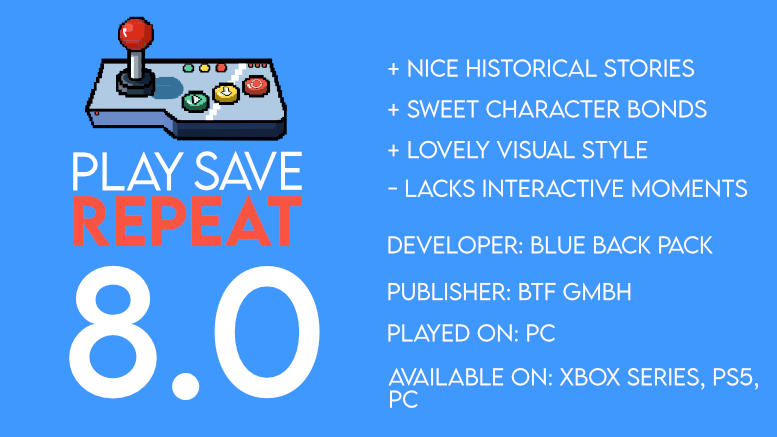
Image: The Berlin Apartment Review Score - 8.0/10