Review - Goodnight Universe
Goodnight Universe asks you what you'd do if you were a hyper intelligent baby with super powers. Would you sit and watch your family struggle? Or intervene at the risk of exposing your powers to the world?
Unlike traditionally controlled games, on most platforms, Goodnight Universe is a uniquely interactive experience, that uses a camera to interface with the game. Although, even without this immersive feature, Goodnight Universe uses the sci-fi genre to explore the human experience and what it means to be a part of a family. To witness the sacrifices our parents or guardians and siblings make to help raise us when we're young, and how that can turn to an unfair indignity when we're older. It touches on complex subjects that can go drastically wrong, but when done right, can be emotionally affecting. So, let's see if Goodnight Universe succeeds.
In Goodnight Universe, you take control of six-month old baby, Isaac, who rapidly realises via his adult-aged inner-monologue, that there's something very different about him. He has the intelligence of an adult, but all the foibles of a baby: unable to talk, walk or control his emotions. He feels trapped in a body that is unable to obey his wishes. But he quickly leans that he possesses psychic abilities in the form of telekinesis, to move objects with his mind, and telepathy, to read the minds of others.
Instantly, Isaac sees this as an opportunity to use his powers to solve his family's problems - a way to repay them for doting on his every need. Although, the use of his abilities attract the unwanted attention of a big tech company and risk the safety of his family. And throw in the mystery of the family's Grandpa and you've got a layered story. But all Isaac knows is that he loves his family and wants to keep them safe.
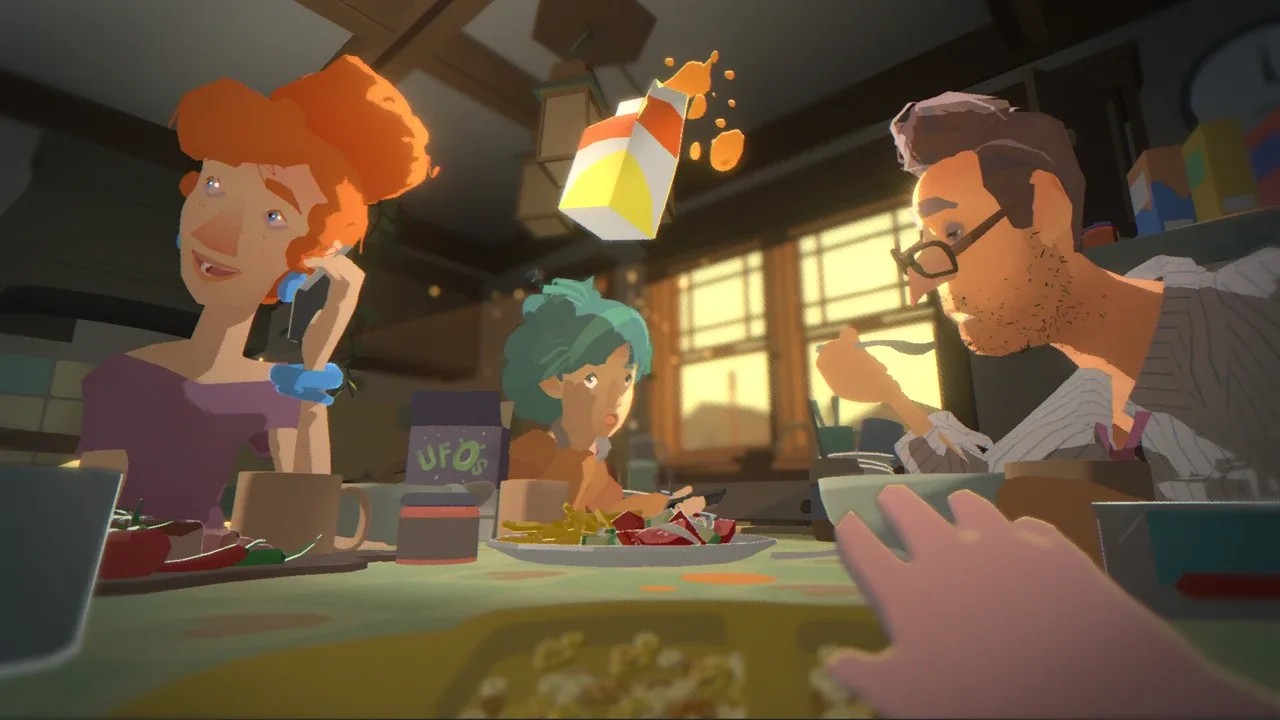
Image: Goodnight Universe - Family - Nice Dream
Development studio, Nice Dream, tell a profound and emotional story that covers themes like nature and nurture; about how your family and upbringing can help define who you become and how it changes your behaviours or even leaves its scars and loving memories. Nice Dream springboard the beginning of Goodnight Universe by showcasing the grief caused by the death of a close family member. But Nice Dream is no stranger to tackling challenging topics such as life and death. As in their previous game, Before Your Eyes, another interactive story told from a first-person, stationary perspective, where you look around and blink to progress scenes, which proved their adeptness in creating deeply emotional and masterful storytelling.
But Nice Dream haven't simply settled for replicating Before Your Eyes. They've attempted to build upon everything that made it an award-winning game. Although, it's important to acknowledge how each part of Goodnight Universe comes together to complete another game from a very unique narrative focused studio.
First, the backbone of Goodnight Universe is how it plays, seemlessly blending story and interactivity together. Nice Dream let you embody Isaac as closely as possible without using virtual reality - a platform that prior title Before Your Eyes released on after launch, and I hope Goodnight Universe follows suit. Despite the absence of VR, Goodnight Universe has two main control methods on most platforms, which will be added to Switch 2 in the near future. The universal control scheme uses the mouse or controller, whilst the other versions can use a mouse and camera setup.
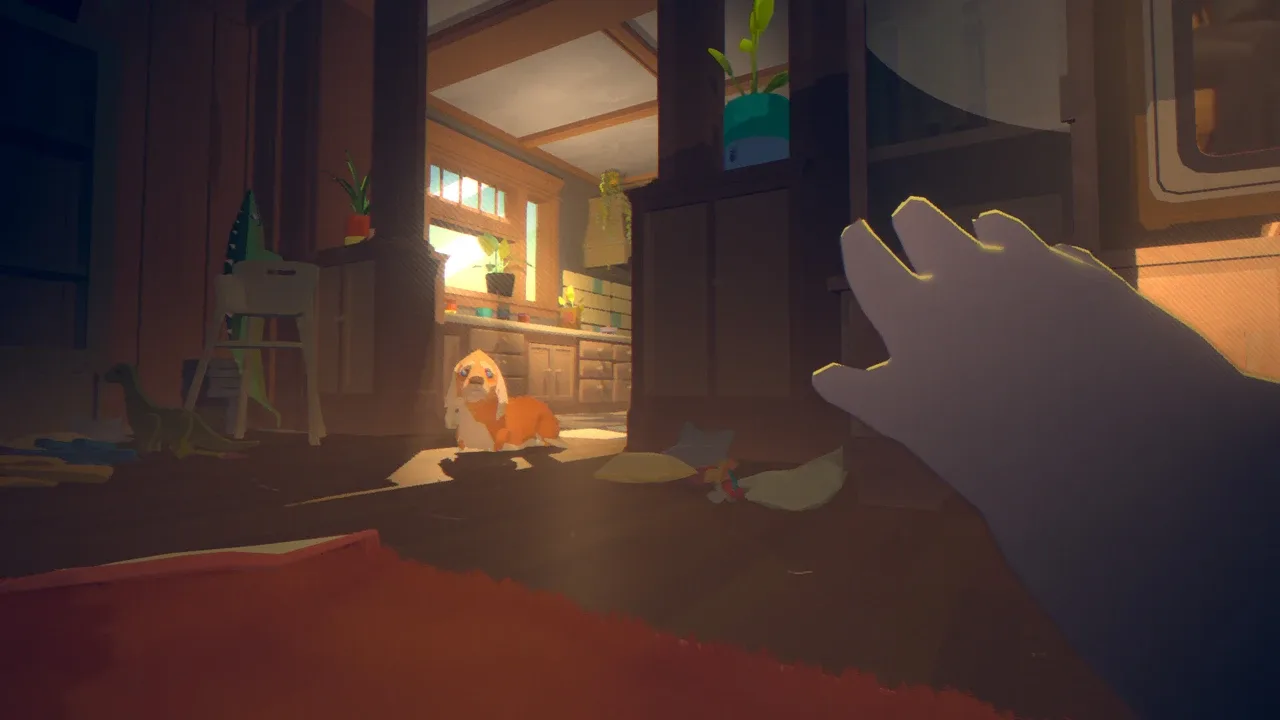
Image: Goodnight Universe - Dog - Nice Dream
Your main means of interactivity throughout Goodnight Universe is simply looking around, sitting in a stationary position as you control where Isaac looks with the control stick or mouse. Narratively, this parallelism works really well to mimic the daily life of a baby; like a helpless bystander that watches the world unfold around them. Also, you move the cursor over words to make choices to diverge the narrative, and then, like Before Your Eyes, you can blink to interact with certain objects or to move a scene forward.
However, Goodnight Universe isn't a replica of that same system. Instead, Nice Dream chose to take the camera interaction up a notch. They've made cameras able to recognise basic emotions: a smile for happiness, a resting face for neutral, and a frown for sadness. Meaning Isaac can non-verbally react to certain story beats. Every camera addition is in favour of furthering the immersion for the player.
The camera is setup by a quick and easy calibration tool, that asks you to open and close your eyes, and show it a smile and a frown. For the most part, the camera controls worked well, but there were the odd occasions throughout my 4 to 5 hour playthrough where it glitched and my character would continuously blink. But fortunately, a quick recalibration solved these issues and returned the intuitive actions back to normal.
Tiny quibbles aside, there's even more to the gameplay than meets the eye. Once Isaac develops his psychic abilities, he can throw and pull things with his mind by clicking the left mouse button and dragging the mouse, or blink to activate switches and lights. Not long after this does Isaac develop his telepathy power, his ability to read minds. This is one of the main reasons Nice Dream recommend players to wear headphones, and I would agree with them. In order to read minds, you close your eyes and turn your head from side to side as if you were the dial to tune a radio. Listening carefully, you zone in on the sound until the game's audio is replaced by the person's thoughts you're trying to hear. With your eyes closed and headphones in, you're completely immersed in a sensory experience, where your imagination fills in the blanks as we hear the raw and honest thoughts, motivations and feelings of each character in the story. It's a really impressive gameplay mechanic.
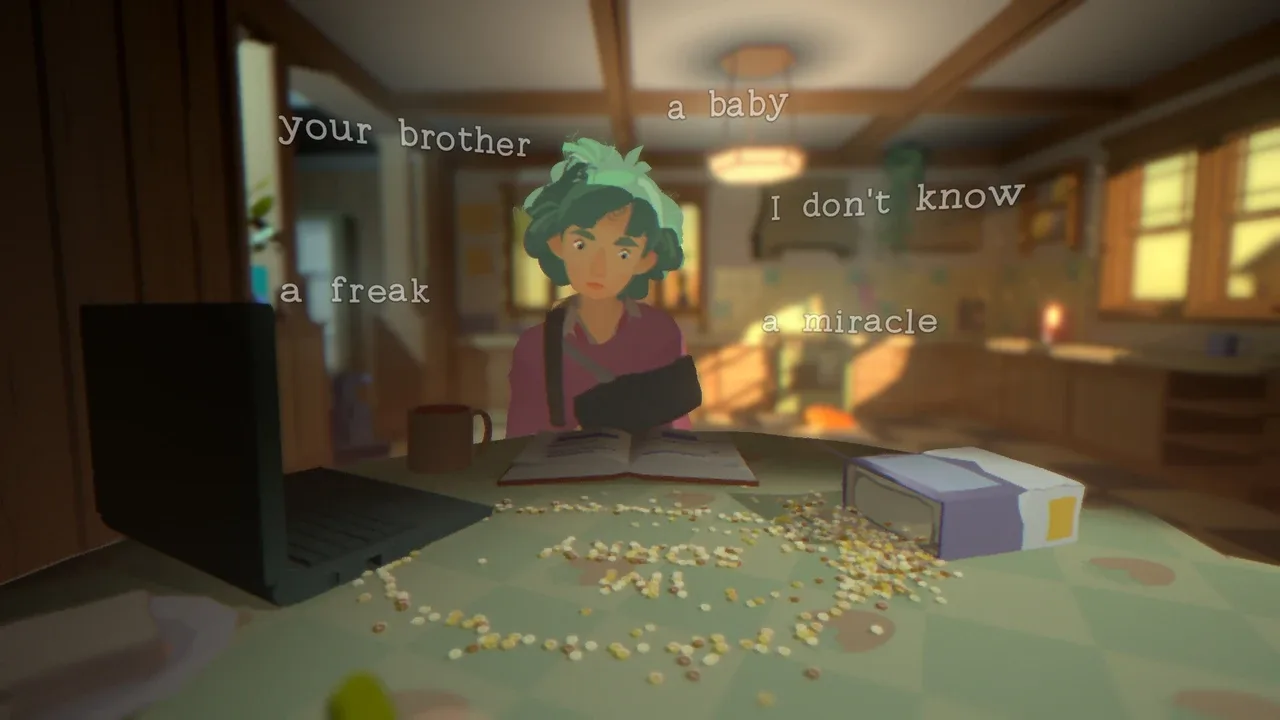
Image: Goodnight Universe - Sister - Nice Dream
Further in the game, the use of these powers becomes more complex as certain on-rails exploration scenes requires you to avoid detection from robotic drones and lasers. So as you're hurtling towards danger, you have to keep calm and think fast, to deactivate a laser with a blink, then find and blink at a switch to open the door and then swipe a robot inside the open doorway and blink again to trap it inside. All of this happens in seconds and feels natural by this point in the game. That's the true magic of what gameplay is in Goodnight Universe. Everything is intentionally designed to be approachable and natural. The kind of experience that non-gamers who like television shows can enjoy.
Just like the gameplay mechanics, the story is also designed to flow in service of the creative vision. Much like Before Your Eyes, Goodnight Universe is phenomenally well-written when it comes to the authentic dialogue, especially for something that has a selection of diverging choices. But it is these diverging paths that feel the most ineffective as they don't lead to massively different outcomes, which may be disappointing to some players.
Clearly, the writers have put meticulous effort into making sure each member of the family doesn't feel tropey and is well drawn, with their own backstories. Each hide motivations, feelings and dreams from each other. But beyond what they leave unsaid, they love and support each other. We get to know a mum impacted by her upbringing, a dad that has regrets, and a daughter who wants her parents to listen and accept that she can make her own decisions. All of this is additive to the thematic through line of nature and nurture and what family means, whether genetic or found.
Although, Goodnight Universe has more than excellent writing on its side, when characters are voiced by a cast of skilled and experienced actors. Two of my favourite characters, Isaac and Cleo, are performed by Lewis Pullman from Marvel's Thunderbolts, and upcoming actor, Tessa Espinola. Lewis Pullman delivers a nuanced and sincere performance that verbalises all the confusion and uncertainty and joy a baby experiences. Whereas, Tessa Espinola gives a pitch-perfect rendition of an intelligent, funny and caring young woman that just wants to be heard. But then again, there isn't one below good performance from the entire cast.
Despite the strength of the performances, the whole project would suffer without a perfectly attuned score and one of Goodnight Universe's biggest strengths, its sound design. With a music composition that can perfectly summon whimsy when Isaac is first discovering the world, and easily shift tones to more dramatic tracks when the drama rises. All of it compliments the sci-fi angle at the heart of the story. But the use of sound exceeds music and furthers interactivity. It's in the telepathic moments where you tune into someone's thoughts that the sound blips from existence and is replaced by another vocal track. Such a drastic change lets you feel immersed in Isaac's story.
All of these design choices comes together with Nice Dream's masterful art direction. They've created a three-dimensional cartoon style in the detailed scenery and styled characters. The character models aren't overly detailed, but each have distinct features that combine with quality lighting and brilliant animations. The animation quality really is fantastic - a feature best shown in a humorous scene where Cleo has a friend over and Isaac tries to scare him. The friend flails around with an expressiveness equal to some of the best animated movies of today.
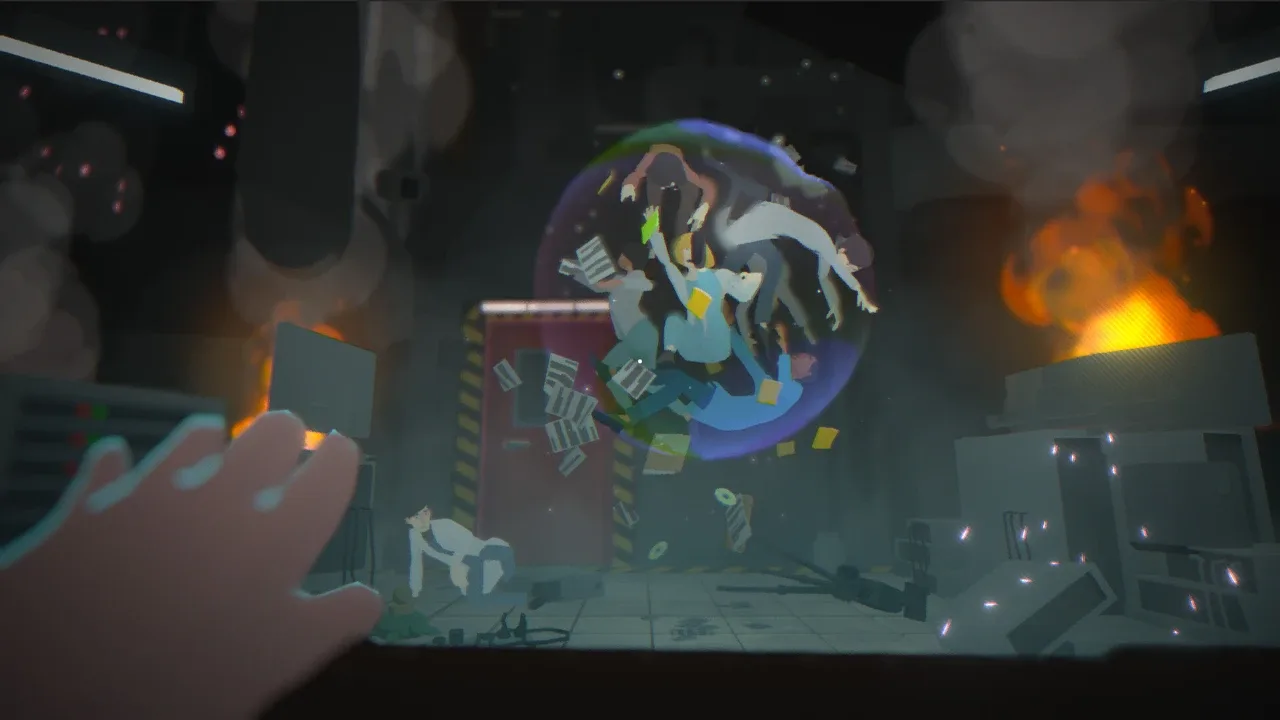
Image: Goodnight Universe - Power - Nice Dream
Nice Dream also uses sketch style chalk drawings during story beats outside of the current moment. They stand out compared to the normal art style, but they work when they include interactive elements like revealing words with the mouse or selecting dialogue choices. It's just another way to deliver story, that isn't overused.
That's not to say Goodnight Universe is faultless, even if it is very enjoyable. Throughout my 4-5 hour playtime, I found the on-rails action scenes slightly overused as if they were there to add more typical gameplay levels, and I was disappointed that there wasn't any organic use of the facial expression feature. As each use of the smile and frown mechanic is heavily choreographed, when it would've been more impactful to be able to react and get character responses mid-scene. But I understand why this possibly wasn't easy to achieve. My only other issue was I found the dialogue choices didn't really lead to many big scene changes. But although Goodnight Universe's story isn't as strong or emotional as Before Your Eyes', due to falling into plot tropes in the later half, it's still a well told narrative that's engaging and fun.
Once again, Nice Dream have added a new addition to their resume of video games, that you can take one glance at and know it's been made by them. Where Before Your Eyes showed the world that camera controlled games could be more than a gimmick, Goodnight Universe iterates and evolves to make a more immersive gameplay experience. With wonderful animations, stunning voice acting and a heartfelt story about family and the repercussions of the choices we make and the ones we have made for us. Even if every little thing doesn't land, there is more than enough here to recommend another great game to fans of story focused video games, or interactive gameplay, I recommend giving Goodnight Universe a go.
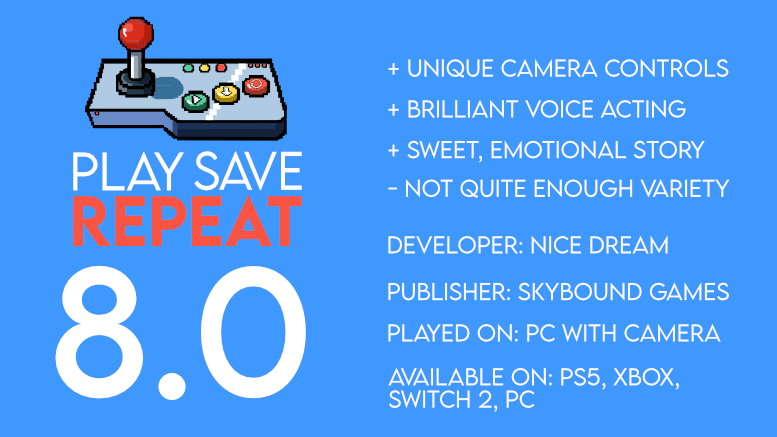
Image: Goodnight Universe Review Score - 8.0/10 - Nice Dream