Zero Parades: For Dead Spies Review
When reviewing Zero Parades: For Dead Spies, the latest cRPG from development studio ZA/UM, it's impossible to ignore the all-encompassing shadow of the publicised events that followed their previous work, the fantastic Disco Elysium. On one hand, it's an exceptionally well-written game born from authentic experiences, and on the other, it's known for what happened at the studio post-launch. (Extensively covered by People Make Games and NoClip on YouTube)
Whatever your view, ZA/UM have quietly rebuilt on top of the remaining team, to create Zero Parades: For Dead Spies, an espionage RPG, that aims to move on from the Disco Elysium series' untimely demise, in a brand new world of sociopolitical intrigue and interconnected stories. But it comes with the pressure of recreating Disco Elysium's quality, which could feel like a poison chalice to a new, hard-working team. However, despite Zero Parades closely following Disco Elysium's formula, it isn't a lesser facsimile.
Zero Parades has you play as Hershel Wilk, A.K.A CASCADE, a spy for the communist Superbloc outfit, the Opera. Since a mission went awry five years ago, she's been in the cold, until her handler Melita sends her back into the field to Portofiro - a place full of nightmares and ghosts. A city stuck between the whims of overwhelming powers: La Luz, a techno-fascist nation that's uses pop culture propaganda; EMTERR, the world's investment bank that aggressively spreads neoliberal supposed stabilisation to areas considered underdeveloped in their eyes; and the unflagging communist Superbloc, home to the Operant Bureau, the organisation Hershel represents. Each playing the game of espionage and subterfuge, whether through secret police and spies, or the brainwashing relentlessness of media.
As you start the game, it asks: what kind of spy are you? You're able to choose between four masks: kinetic, charismatic, analytical and custom. This allocates the number of base skill points into the Faculty badge system, Zero Parades' core skills that determine the outcome of dice roll skill checks during conversations or action sequences. The Faculty of Action determines your physical prowess, the Faculty of Relation impacts social and emotion based interactions, and the Faculty of Intellect functions of the brain.
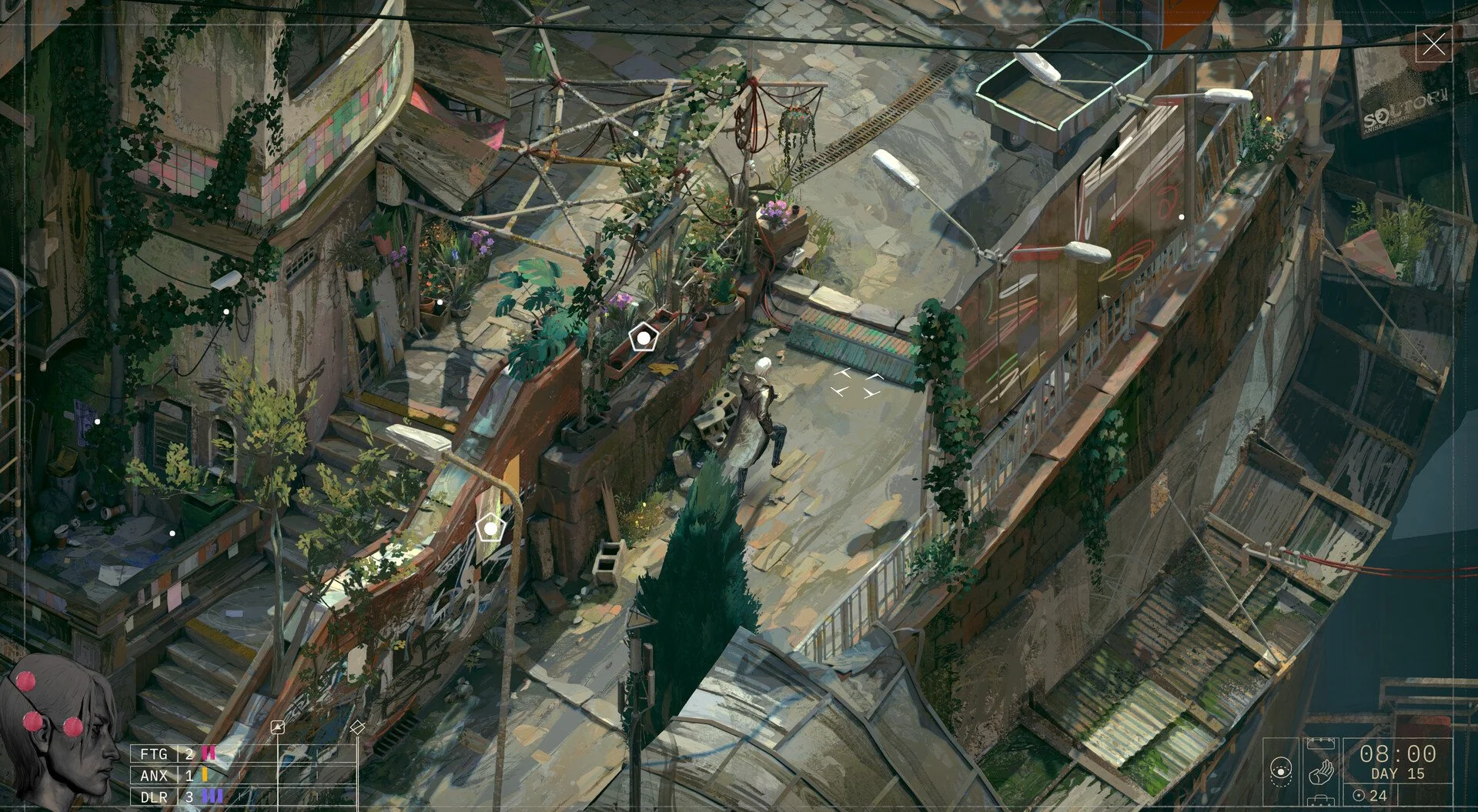
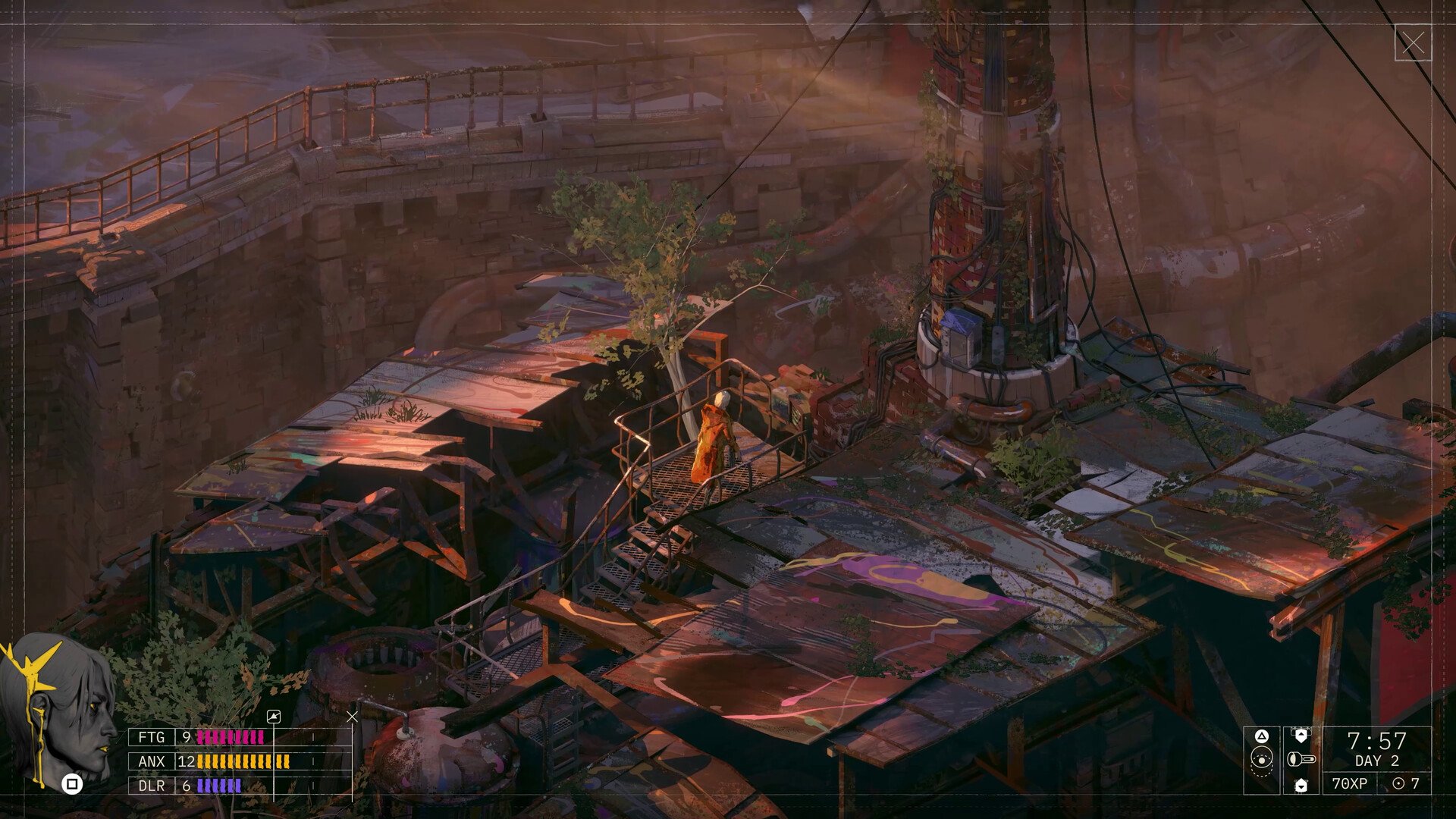
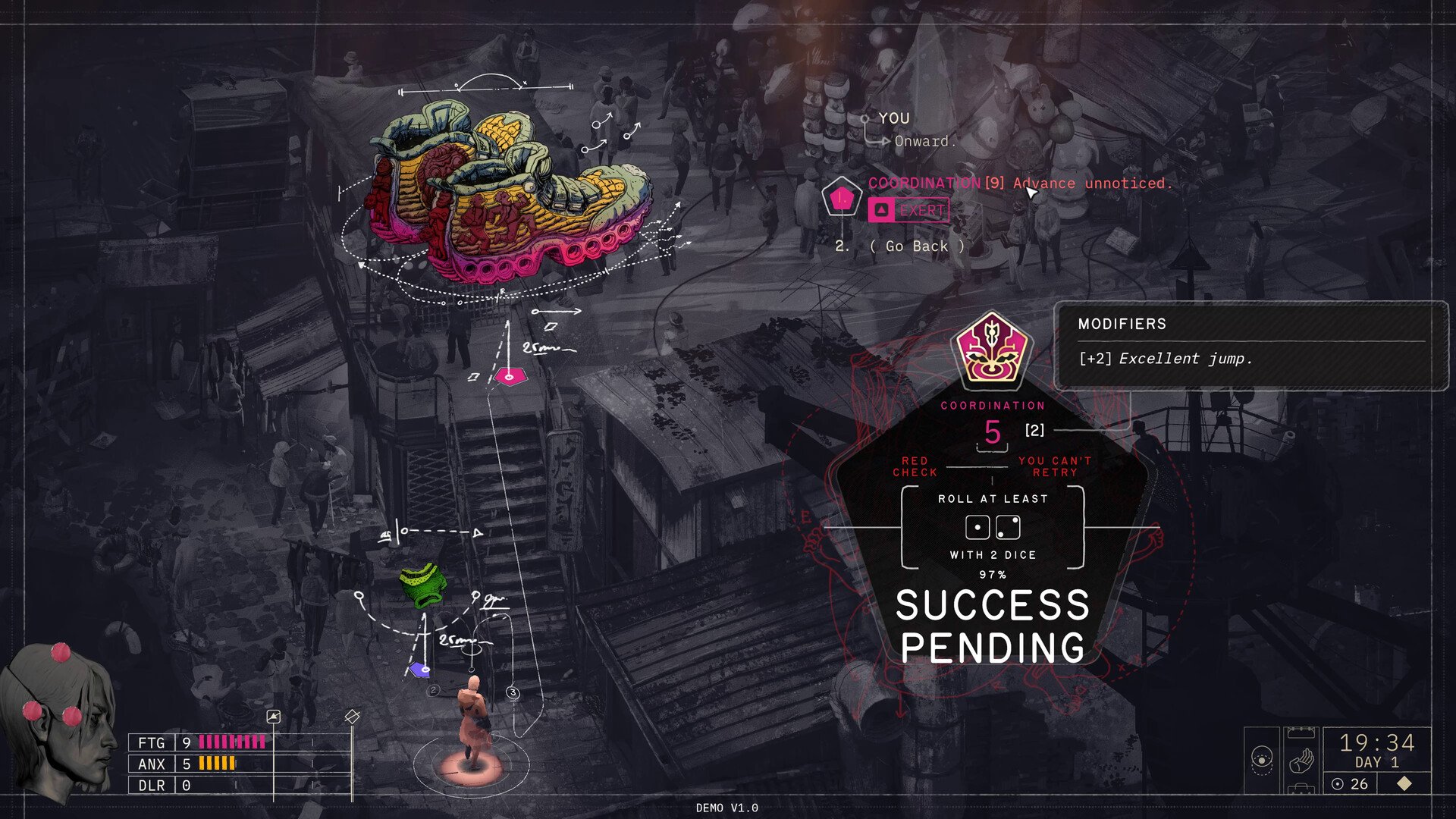
Faculties are tied to three ailments represented in growing bars in the bottom corner of the screen: action to fatigue, relation to anxiety and intellect to delirium. The bigger a faculty stat is, the higher your chance of a successful dice roll by upping your starting value. But if you need to increase your percentage of success, you can choose to exert yourself by rolling three die instead of two, at the cost of filling whichever ailments correlates to the dice roll. And if you max out an ailment bar, you must choose a skill to reduce by a point - a constant tug of war between risk and reward.
Unlike Disco Elysium, Zero Parades sets up Hershel's backstory before she awakens in a grotty apartment much like Harry Dubois did in Disco Elysium. However, you quickly learn that not everything people say is the truth. This is spycraft, after all. You know Hershel's past, but like her, you only know she's been ordered to meet her fellow Operant, PSEUDOPOD, for her operation brief. She finds him totally catatonic alongside a cryptogram that might hold the secrets to the operation. But when her handler orders her to leave, Hershel will do anything to avoid being decommissioned again.
Player agency is a massive part of what made Disco Elysium tick, and it's also present here. Allowing you to determine what type of spy Hershel will become after all these years out of action. Will she devote herself to the mission? Will she put the lives of others ahead of it? Will she become a nihilistic husk? Although, already knowing parts of Hershel's backstory helps you make informed decisions.
Choices impact how the story unfolds and each option passes time, objects can be used to alter missions, or certain dialogue options can open unique story outcomes. You begin to realise how each civilian's story unfolds and merges into the wider world like one entangled thread that's being split and pulled in three directions by battling powers.
Children know no better than to watch techno-fascist propaganda in the form of a television show due to their school being shut every other fortnight. A market trader communicates in doublespeak, unable to trust the air with her secrets when the secret police could be listening to punish anyone going against the grain. A Portofiro municipal policeman is blasé about investigating anything beyond his purview, accepting his roll as a cog in what he sees as an unchangeable machine.
Learning these stories presents a deeply fractured world that pressurises Portofiro - a chaotic city being eaten from the inside and outside. Cultural fascinations overpower vulnerable citizens like trite pop music imported from the technofascists and expensive fashion to work in unison with the investment banks loan schemes designed to cause extreme debt. Insidious propaganda is delivered to slowly ingrain authoritarian messages, and apply pressure to the lowest rung on the economic ladder. Ideologies designed to make citizens an ouroboros eating their own tail.
ZA/UM also lets you progress skills and alter the story with Conditioning: a mechanic similar to Disco Elysium's Thought Cabinet. By playing the game and making certain decisions, you unlock different forms of spy conditioning. These increase skills and offer extra positives, but also negatives to balance. Like being able to increase all skills by one point. But in order to use this particular conditioning, you can no longer upgrade any skills via skill points again. Your choices here, like the Thought Cabinet, drastically impact your version of Hershel and how you deal with conversations and the espionage specific sequences, Dramatic Encounters.
These culminations of your clandestine operations are called Dramatic Encounters. When they occur, the game freezes and surrealist artwork splashes over your options; Hershel's brain heightens and zones into her spy persona. You can choose to deduce the situation, scouting out potential options, such as direct confrontations or swift exits. Like in the bazaar where Hershel can choose to do a risky confrontation or stealthily blend into the crowd.
Inevitably, you'll run into situations where you'll be gutted that you've failed a dice roll. But during many non-vital conversations, you'll be able to back out before doing the skill check. Opening the door to using another feature directly from Disco Elysium: being able to quickly increase skill points by equipping clothes and gear which have your required attributes whilst taking the deductions into account.
Once fully kitted out, you can select a handheld item for further skill boosts, and even, inspect books to learn from. With a temporary boost in place, Hershel can now pass a skill check and unlock a new route through the conversation. But it's also a mechanic that can be manipulated if people choose to save and reload until they get their desired dice roll. Although, reloading saps away the fun of leaning into your espionage persona, but it's still a good option if that's how someone wants to play.
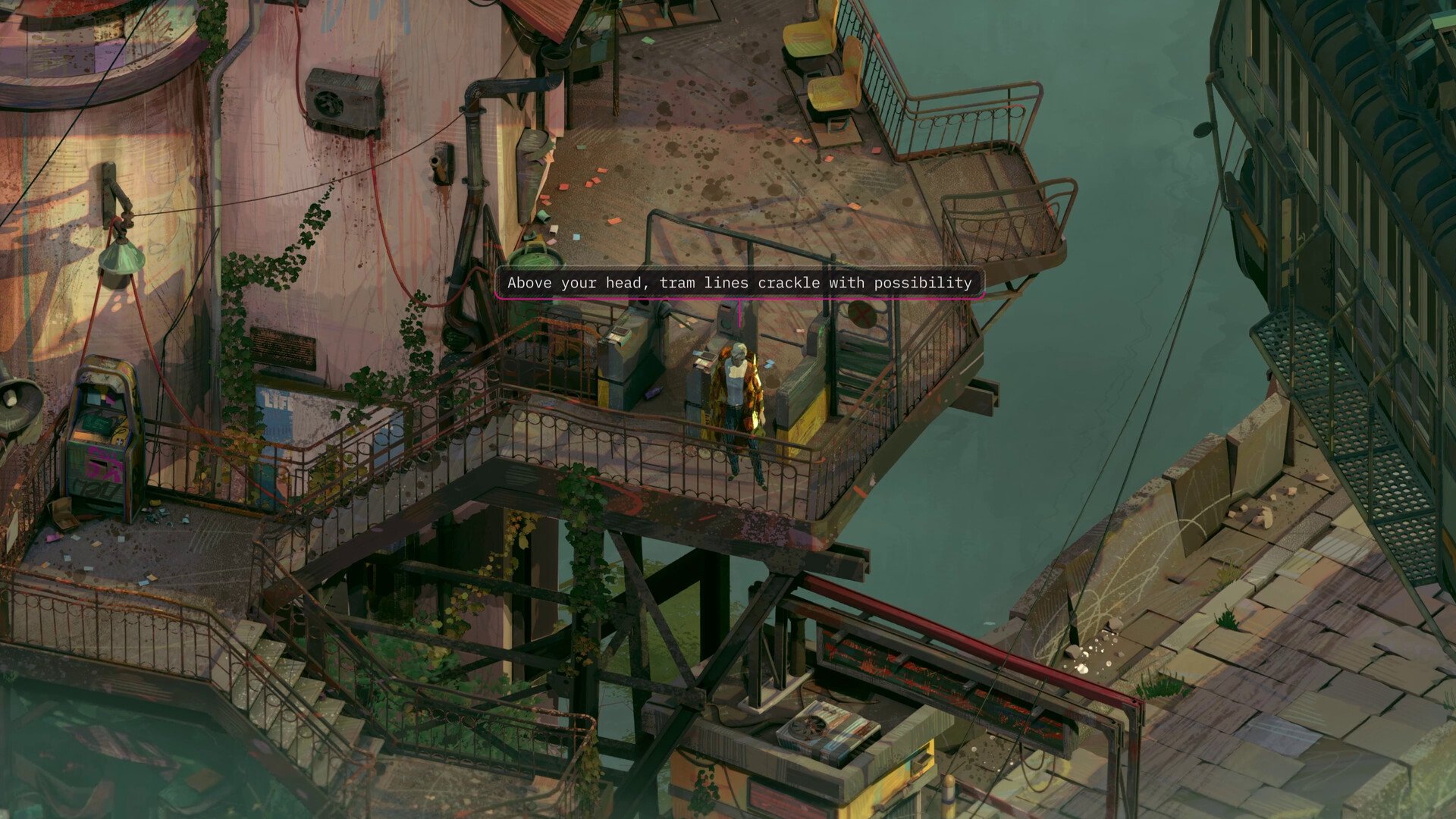
You also need to explore every nook and cranny of Portofiro from the bustling bazaar, the docks and every street and alleyway. The map presents a vague guide, which acts as a fast travel system that I never used. It's the kind of world where I quickly memorised each road and landmark. A place where there's something interesting around every corner and inside every accessible building. However, you'll soon stumble across locked boxes, doors and more. All requiring specific tools to unlock them.
Like everything in Zero Parades' world, nothing is free and tools are no exception. There's an economy to the privately owned phone lines, vending machines sell alcohol and food, vendors sell clothes and CDs, and less reputable traders sell illegal medication and tools. While you'll pick up some tools through quests, things like a lockpick costs money. And you'll need to ration your expenses or find a means to earn extra cash. Even the communist Opera are at the whims of capitalism.
However, even working adds to your ailments and pushes you to find ways to reduce them. With an important day and night cycle, where certain leads can only be followed at specific times, you must balance Hershel's need to sleep, in order to reduce a substantial amount of your ailments. Basically refreshing your ability to exert yourself during dice checks for another day. Although, Hershel can use her many vices to lower them without sleep, submitting herself to a litany of negative side effects. Another mechanic taken from Disco Elysium, but adapted to give a spy tilt on the themes of addiction and depression.
Zero Parades is a heavily systemic game where each layer works in conjunction with each other, similar to Disco Elysium. However, here, all systems function to serve the player's spy fantasy. Every decision and action is a step closer to moulding your ideal Operant. Whether a loyal communist, a spy whose decisions are guided by past traumas, or one who is swayed by the pressure cooker of Portofiro being squeezed by ideologies from all sides.
But ultimately, what made ZA/UM's previous work one of my favourite modern games wasn't just the decision making, it was its themes and verbose literary prose with satirical political commentary and an ideological through line, in a rich and layered universe. Which is why ZA/UM have made the correct decision to set Zero Parades in a brand new world, as even if they had made a great Disco Elysium sequel, it would have brought insurmountable baggage without the authentic expertise of those who used their childhood experience growing up during and post-Soviet Socialist Estonia to make the original.
This decision freed ZA/UM's new and highly skilled team to create a brand new world in crisis. Centred in a semi-realistic city in a stranglehold of an ideological war. Where Revachol in Disco Elysium lived in the aftermath, Portofiro is alive with people contending with what's happening around them.
ZA/UM returns to the Marxist themes of the bourgeois oppressing the proletarian. Privately owned companies that benefit from keeping the working man below the poverty line, forcing them to seek respite by drinking from the poisoned chalices of the technofascists - a steady stream of controlling mass media propaganda. All while Hershel's communist Opera tries to intervene against the socialists and everyone else. The perfect backdrop for a labyrinthian, morally ambiguous espionage RPG. Portofiro is a character itself - a much bigger location than Revachol in size, but also in what its outcome will mean to the wider world.
This liveliness is produced in expressionist oil painted backgrounds that are subtly animated, and 3D characters models. But differentiates itself from Disco Elysium with thicker brushstrokes to give propulsion to animations. Accurately delivering a grimy cyberpunk aesthetic via nicely lit South American and European inspired architecture
Thankfully, this precision and quality is represented in the writing right from the opening description of Hershel, "She was brilliant, erratic, cursed. An anti-personnel mine in human form." Continuing through every character in unique voices that range from the verbose, poetic, Lynchian, and frequently, satirical. None as impactful as Hershel's inner voice; the main narrator able to access all of her thoughts and feelings, and prod at her deepest insecurities and wants. A slow raspy droll that offers a schism of opinions. Often quick retorts that occur between hidden dialogue skill checks.
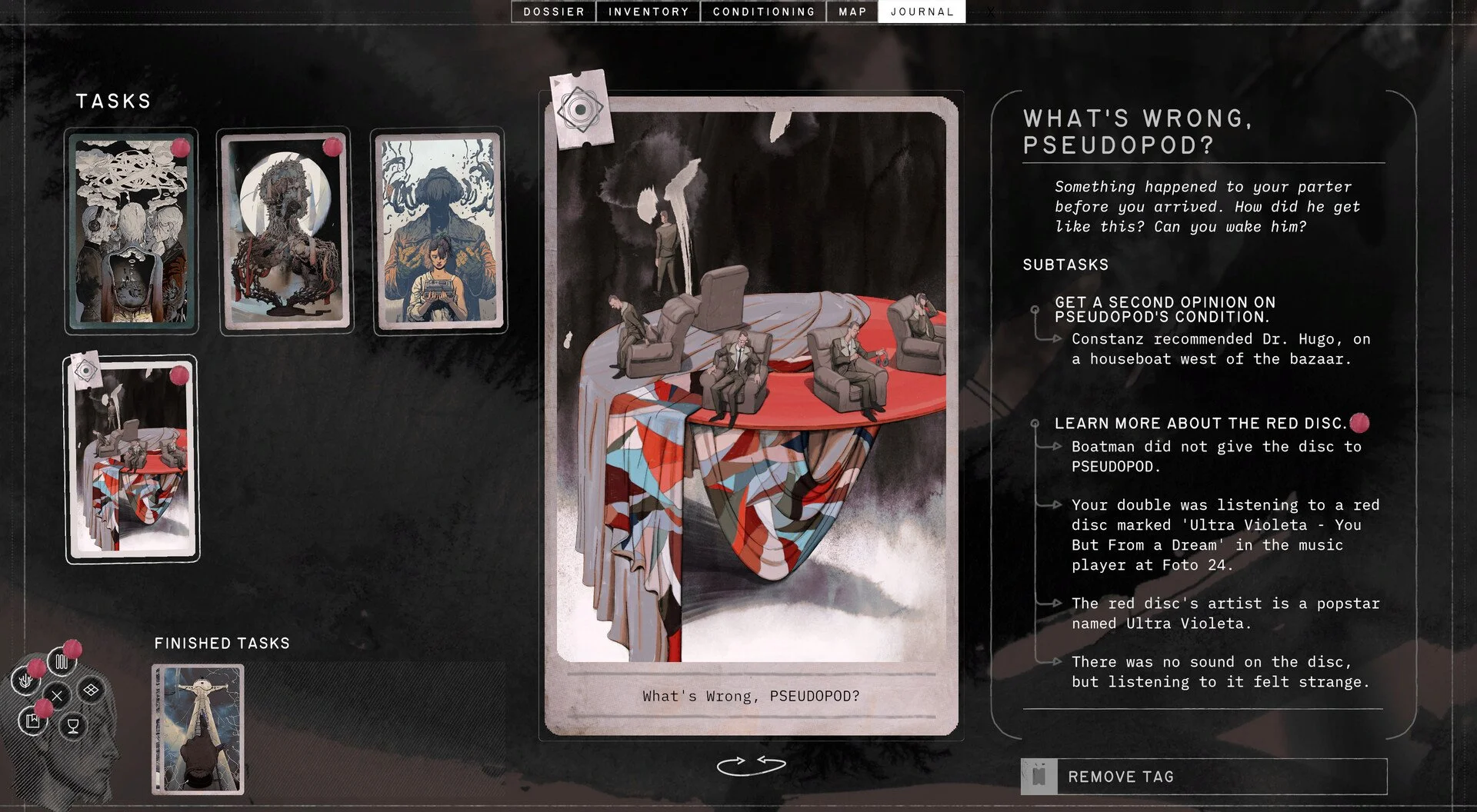
Interactions during main and side missions contain the impeccably drawn characters ZA/UM are known for - all missions tracked in stylish cards in a journal. Each has rich backstories and personalities with clear or hidden motives. Some are pleasant, others are reprehensible or positively outrageous. There's also a clear psychosexual theme running through repressive and internalised ideologies, the personal detachment that comes with spycraft, and how class has led to loneliness and self-sabotaging behaviours. Interactions that some people will find vulgar, and sometimes, I didn't think completely landed, but at other times, made characters feel realistically flawed and layered.
I won't name any characters to keep my review as spoiler free as possible, but every character you meet has been shaped by their worldview and past, and forces far beyond their control. Whether directly tortured or forced to work nonstop to keep food on the table; everyone is at the mercy of the outcome of Hershel's mission. Portofiro has a guillotine hanging over it, and you get to decide whether you can give it more time before the inevitable, or supply the cleanest of cuts.
But unlike the original release of Disco Elysium, Zero Parades launches with a significant amount of voiced lines, and ZA/UM informed me that most lines should be completely voiced sometime shortly after launch. It did take me a while to become accustomed to Hershel's inner voice as it's slightly over the top like Harry's, but these surreal interactions work.
The rest of the cast is mostly voice acted, bar a few characters at this point. I'd say over eighty percent of dialogue is voiced. Each performance just adds so much flavour to a character. It makes them feel more real and dynamic. Like the music trader, his pretentiousness jumps off the page due to the quality of writing, but when he speaks, his words get into you and he really begins to feel ostentatious. Or another one that uses doublespeak, too afraid of being whisked away by unlawful secret police and thrown out of the city she was born in. Her caginess is clearer through the performance, emphasising key details to add emotional context.
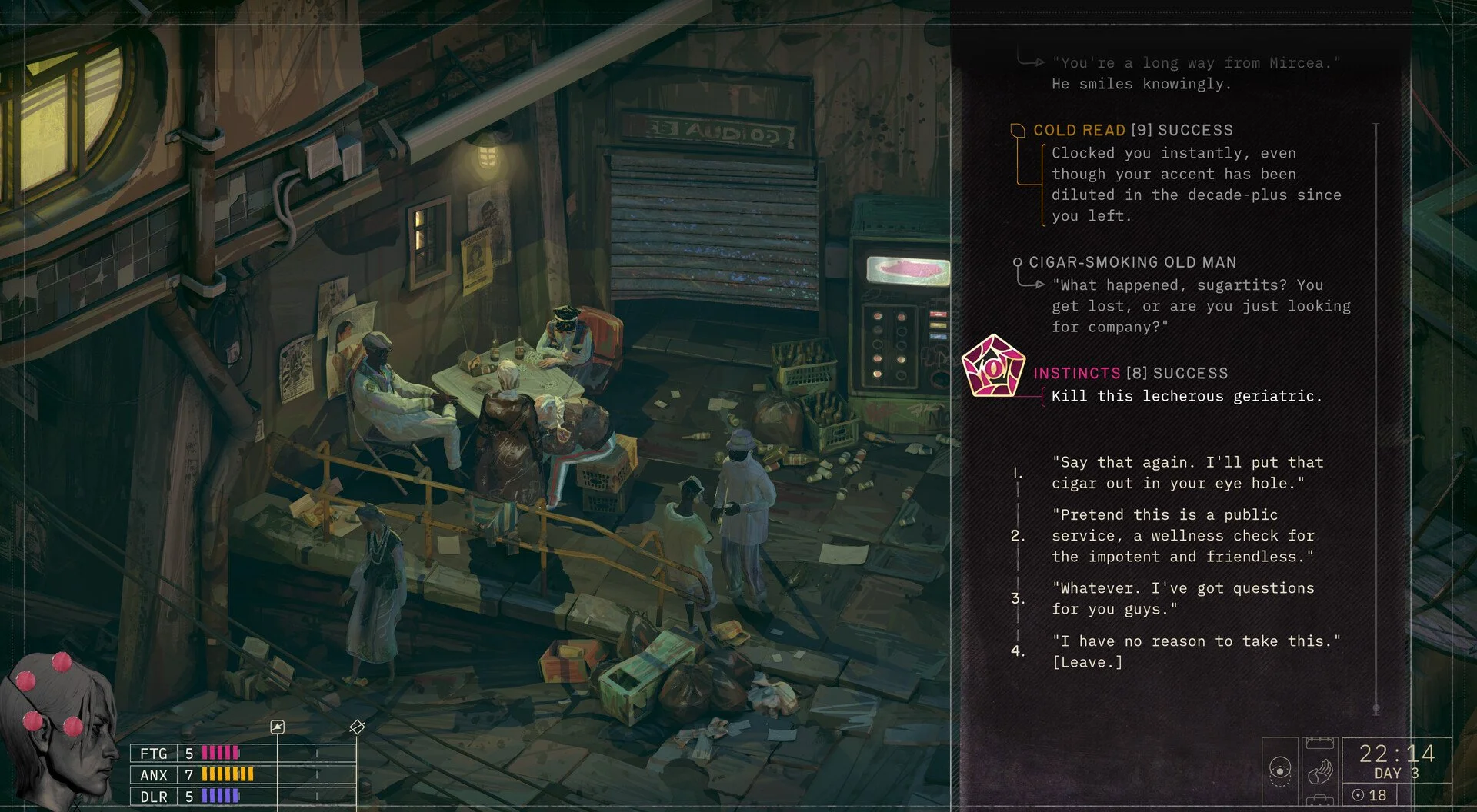
Also, a return of the wonderfully painted character portraits helps to create an even more detailed representation. ZA/UM's artists use the same industrial post-impressionist art style with weighty visible brushstrokes. An attention to detail that continues in the energetic and stylish UX design. Clear and intuitive menus and HUD elements to keep track of Hershel's ailments and the time.
But it's composer Fernando Cabrera that has the heavy task of following Sea Power's impeccable work in Disco Elysium - a timeless score. Thankfully, the main menu of Zero Parades sets the tone with an ethereal melancholic track. Overall, the score isn't as grandiose, but in most instances, it's more subtle like the espionage itself. Only growing into jazzier numbers when a scene heightens into action, in a well-earned, potent culmination. This subtlety gives you a chance to hear the birds, boars and many other sound effects, that helps bring Portofiro to life.
But when writing, sound and visuals are layered on top of the intricate choice based RPG systems, the developers' almost enyclopedically detailed world-building is realised with aplomb.
However, Zero Parades isn't without a few flaws. Minor frame rate hitches happened in a few areas when sprinting through zoomed out environments. Certain dialogue bugs repeated conversations and voice overs sometimes didn't match written dialogue. A few animations didn't play out correctly when mantling up and down ledges. Although, ZA/UM say the majority of issues will be fixed in the day one patch. However, none of these issues hampered my initial nearly 20 hour playthrough of Zero Parades, and when you take into account different story routes and multiple endings, you could easily spend 30 to 40 hours plus with the game.
ZA/UM have also included many positive accessibility features like changeable text sizes, dyslexic fonts, adjustable text speed, high contrast mode, text outline sizes, choose your own coloured text, auto lock onto points of interest, use the objective view to highlight objects, and for streamers, Twitch integration.
Zero Parades: For Dead Spies plays from Disco Elysium's playbook, and for good reason, it's a stylish book of complex systems, brilliant storytelling and an interweaved mission structure. But the remaining and new creatives at ZA/UM have made the wise decision to rewrite the plot. Without straying too far from what made Disco Elysium special, ZA/UM have made another memorable RPG that sticks to the sociopolitical themes and culminates in a twisty, well-written espionage story. Regardless of opinion concerning ZA/UM's past, it's clear the future is bright, and the artistic vision of their developers deserves their own parade of recognition, for the fantastic video game they've managed to create in Zero Parades: For Dead Spies.
*Review Code Provided By Publisher