
Review - Keeper
After the release of the continuation of Raz's story in the superb Psychonauts 2, Double Fine return with the smaller scoped, Keeper. Developed under the direction of Lee Petty, Keeper is a vastly different beast. Out now on Xbox Series, PC and available on Game Pass, Keeper is a mostly linear adventure with light platforming and simple puzzles to solve.
Keeper begins with an exuberant green seabird losing the rest of its flock when it's attacked by a living plague that flies through the sky. This attack wakes a sentient lighthouse from its dormant state, in time to save the seabird with a quick blast of its light. This is the first of many acts that begin to build a companionship between the odd duo of bird and structure.
Now awake, the lighthouse digs up enough material from the earth to forge spider-like legs. The appearance of which can be changed by selecting the arachnophobia mode in the accessibility options. From here on out, the lighthouse and the sea bird are compelled to travel across the island they call home, battling a continuous plague of tendrils, in hopes of reaching the distant mountain peak that calls to the lighthouse - in hopes of somehow curing the mysterious scourge from the land.
After the first couple of levels, I had the same feeling I did when I played similar games like the captivating Journey by The Game Company, the musical epic The Artful Escape by Beethoven and Dinosaur, and this year's enjoyable Sword of the Sea by Giant Squid. Joining a stellar list of rare gaming experiences when you just know that you're playing the combined and fully focused artistic vision of a team of developers at the peak of their craft.
Much like the other games I mentioned, Keeper relies on and uses strong artistic expression through exemplary world building, detailed character designs, and crucially, the ability to illicit strong emotions without using a single word of dialogue. But with all interesting art, this style of game isn't everyone's cup of tea. Some may even compare Keeper to a walking simulator from its first hour - a description that has somehow developed negative connotations over the years. Although, I've always found story-rich games like Gone Home and the brilliant What Remains of Edith Finch? - more than worthwhile experiences. Like any preference, it's okay for someone to dislike a particular genre or title as everyone's tastes are different, and it'd be pretty boring if everyone liked the exact same things.
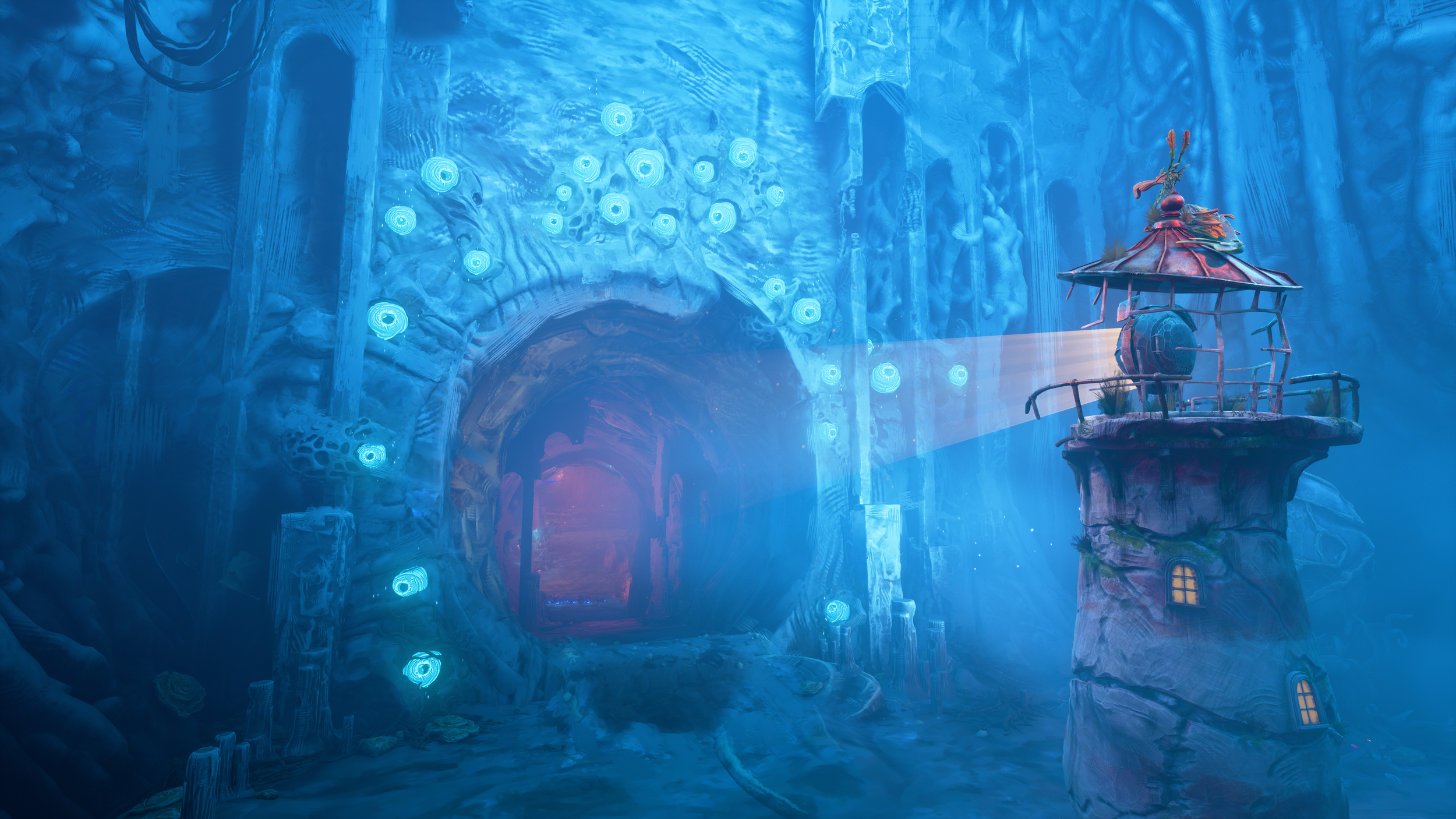
Image: Keeper - Gate - Double Fine
Admittedly, I do play most genres and I am always willing to give a linear, story-rich game a go, as long as the concept is good. But I would say Keeper is somewhere between a walking simulator and a light puzzler, that evolves into many other things in the second half. It has long walking sections along a linear path that lets you absorb the dreamlike landscapes, but also, new gameplay mechanics keep being added as you progress further into the game. I can see why some have compared these types of games to movies or interactive art projects, especially the first half of Keeper, but all video games are immersive, interactive art. That's why we enjoy them and what makes them so great - games can be anything and the medium is still so young compared to others that we've barely begun to scratch the surface on what's possible.
Yet, it wasn't Keeper's genre or playstyle that first grabbed my attention, it was the studio's lineage and the stunning art design. Double Fine made every frame like a surrealist painter's sketchbook brought to life - a unique presentation into colourful dreams. Although, identifiable visual flair isn't something new for Double Fine, it's more par for the course. Back in the day, they released the fun Stacking which had detailed matryoshka dolls for characters, and one of my personal favourites, the beautifully hand animated Broken Age.
While not all of Double Fine's games totally land, you can never fault them for taking massive creative swings with every project. Such imaginative work should be appreciated. And playing on the Series X, the game looked crisp and vibrant with only a handful of frame hiccups throughout. Otherwise, it was a perfectly smooth playthrough.
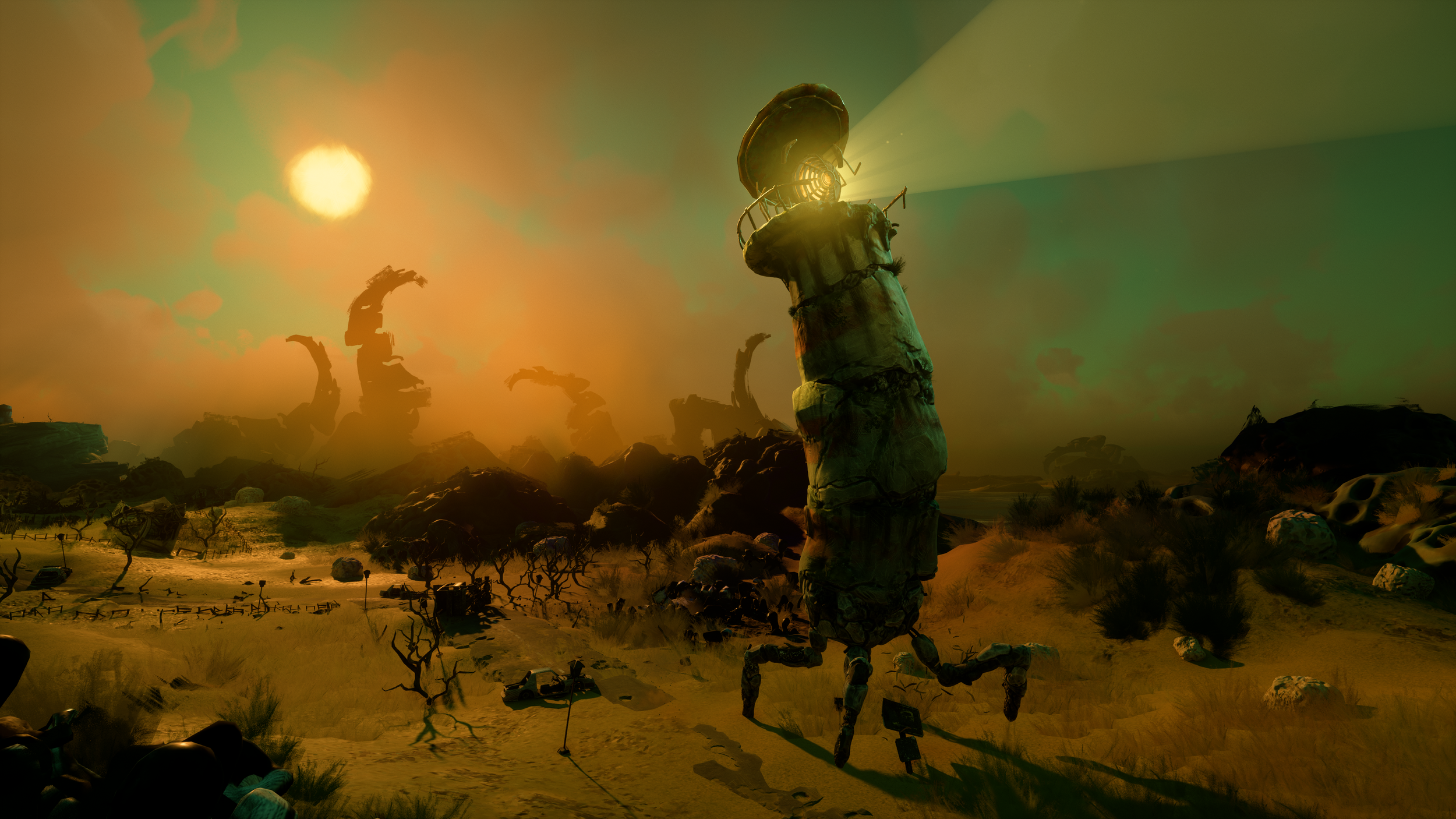
Image: Keeper - Lighthouse - Double Fine
Next, the story of Keeper. It's difficult to discuss Keeper's full narrative due to its voiceless characters. Beyond the basic plot that hints at environmental disaster in a world devoid of humans, there are a handful of secret paths to find that contains stone obelisks, which reveal lore visually and in the achievement descriptions. Whereas, the rest is up for interpretation. But outside of the beautiful island allowed to flourish without humans, the remaining inhabitants and ecology are being ravaged by a spreading plague. But Keeper remains focused on the core growing bond between the seabird and the lighthouse during their individual journeys: the seabird to find its lost flock, and the lighthouse, to uncover the mystery of the world.
This heartwarming friendship is brought to life by high-quality animations, that makes you root for a sentient structure on its journey. But upon travelling through the varying biomes, they encounter hints of old human civilisations undone by the plague tendrils, and meet a community of ancient mechanical beings in need of help. Each level colours in the history of the world and it's inhabitants: from giant animal skulls, to helpful crab-like creatures and friendly swimming behemoths. With each new encounter, the lighthouse is treated kindly in return. As like all good adventures, the lighthouse and seabird learn to show kindness and further trust each other. The lighthouse even begins to change in relation to the company it keeps and new environments it visits. Like the nature of the island, the lighthouse is also in need of repair, and only time and effort will suffice.
Although I am being intentionally vague in regards to how the story develops. That's because Keeper is a wonderful, but short experience that like the lighthouse, transforms and grows as it progresses. Which is why I've chosen to only include footage from the first half of the game, to keep the surprises of the best and latter half of the game in tact.
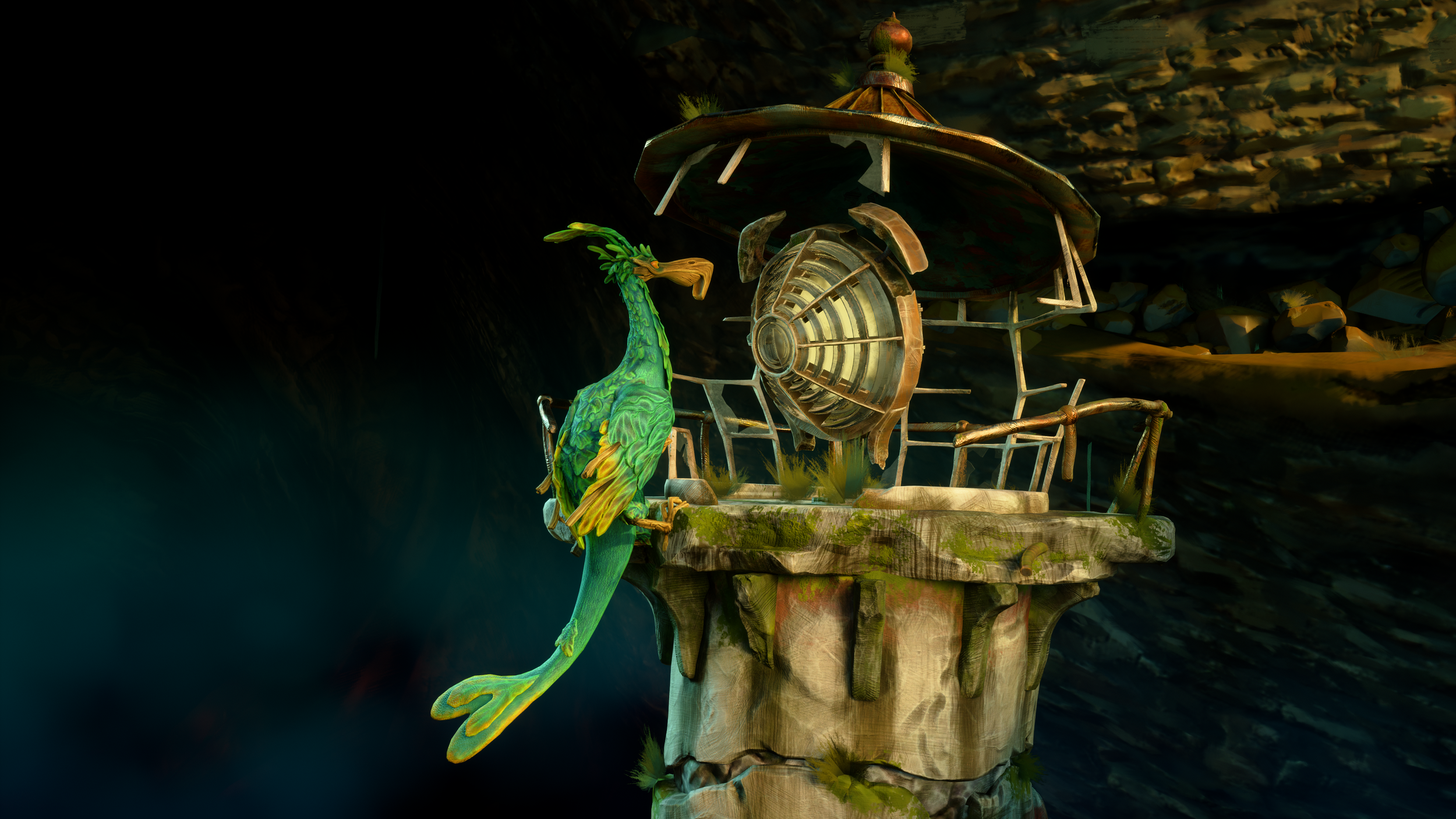
Image: Keeper - Bird - Double Fine
Despite the strength of the visual presentation and story, it's necessary to discuss the gameplay. For the first hour, the lighthouse is guided down linear paths and up raised edges as new abilities are slowly added. This allows the lighthouse to learn to burst forward to rip through vines blocking paths and generally speed up momentum. Then, eventually learn Keeper's key component: the ability to use the lighthouse lamp to use the joystick to aim a focused burst of light. This skill can be aimed at environmental flora, making it grow into luminescent strands which add visual touches. Or at special flora that open doorways or create new paths once activated. These mechanics evolve into needing the seabird's assistance, such as when overgrown plants cover one of the light activated switches, requiring the seabird to clear the obstruction. And if any point of interest sparkles, you can direct the seabird over to interact with it. For example, the seabird can be used to turn cranks or weigh down switches. These interactions make up the fundamentals of Keeper's simplistic puzzles. Early on, when the lighthouse needs to collect 3 orbs to open the path ahead, there is an instance where you must focus a light blast on a creature at the correct moment to make them fall through a weakened floor, to obtain one of the orbs. Or when you arrive at the town occupied by mechanical beings, the lighthouse can use the light to activate time bending switches. One switch travels to the past, turning the seabird into an egg, and another, goes forwards which turns the seabird into a ghost. This adds a new dimension to puzzles which the game needed by this point. Although the puzzles are still easy, they add one or two extra steps to the pull a lever and weigh down a switch puzzles, such as turning the seabird into a ghost, then directing them through a barred wall and bringing them back to life to turn the crank. But even though they're easy, I found them enjoyable enough to keep going and I'm glad that I did. As beyond this point, there's a nice change of pace with a fun platforming section unlike anything else in the game up to this point.
It's at the halfway point where Keeper went from a good game to a great game. Evolving mechanically with each new level and even including a wide linear level to explore. But I won't spoil the specifics of the levels. It's only when I rolled credits that hindsight allowed me to better appreciate the initial slow progression that runs parallel with the narrative and mirrors the duo's building bond and their growing grasp over their individual purposes.
Yet all of the atmospheric world building and simple puzzles and exploration would be redundant without being supported by a good musical arrangement. The composition strikes a nice balance between the calming tones of the tranquil backdrops, to the higher tempo rhythms behind boss encounters, and the unique soundscapes of kaleidoscopic dreamscapes.
Also, being a wordless story, the sound design is more important than usual. The shambling sounds of the Lighthouse's wooden carcass and the loud, friendly sqwarks of the seabird help bring heart and life to the two main characters. I do hope Keeper catches the eye of people or at the very least, appeals to those subscribed to Game Pass to give it a go.
Once again, Double Fine's unique creativity has welcomed players to quite a trip, into a cacophony of dreamlike stages that tell a wordless and touching story about companionship. It shouldn't be lost on anyone how special a studio Double Fine is, and if they can keep delivering longer, wonderful platformers like Psychonauts 2 and more frequent artistic escapes like Keeper, gamers who enjoy these types of games are very fortunate. Long may it continue.

Image: Keeper Review Score - 8.0/10